Department of Gastroenterology, The Third Xiangya Hospital of Central South University, Changsha, China.
Hunan Key Laboratory of Nonresolving Inflammation and Cancer, Central South University, Changsha, China.
Cancer Med. 2023 Apr;12(7):7962-7973. doi: 10.1002/cam4.5578. Epub 2023 Jan 6.
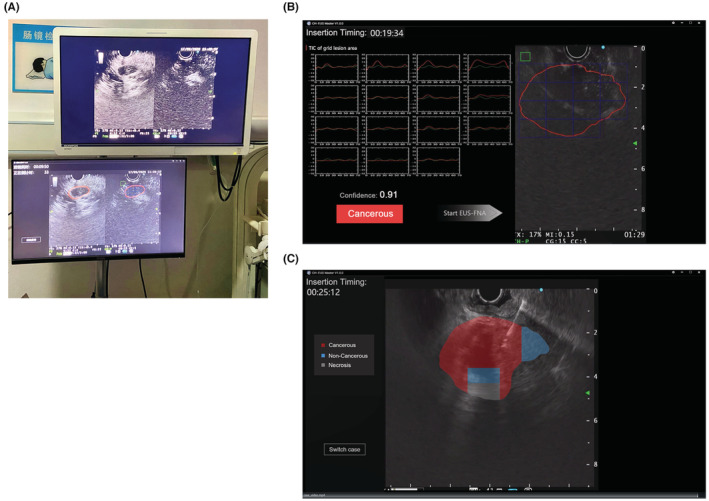
Distinguishing pancreatic cancer from nonneoplastic masses is critical and remains a clinical challenge. The study aims to construct a deep learning-based artificial intelligence system to facilitate pancreatic mass diagnosis, and to guide EUS-guided fine-needle aspiration (EUS-FNA) in real time.
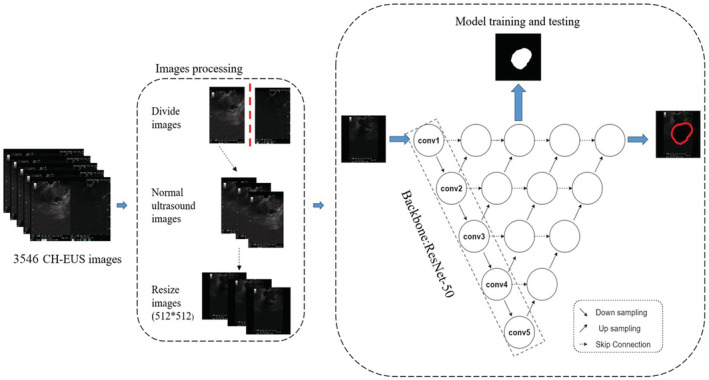
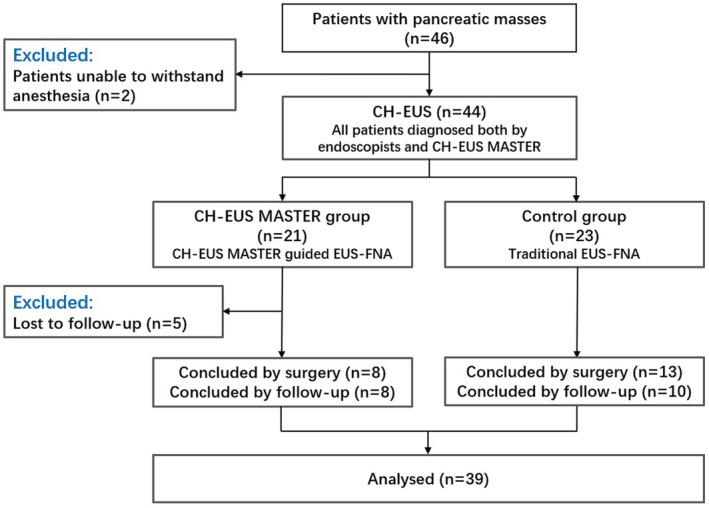
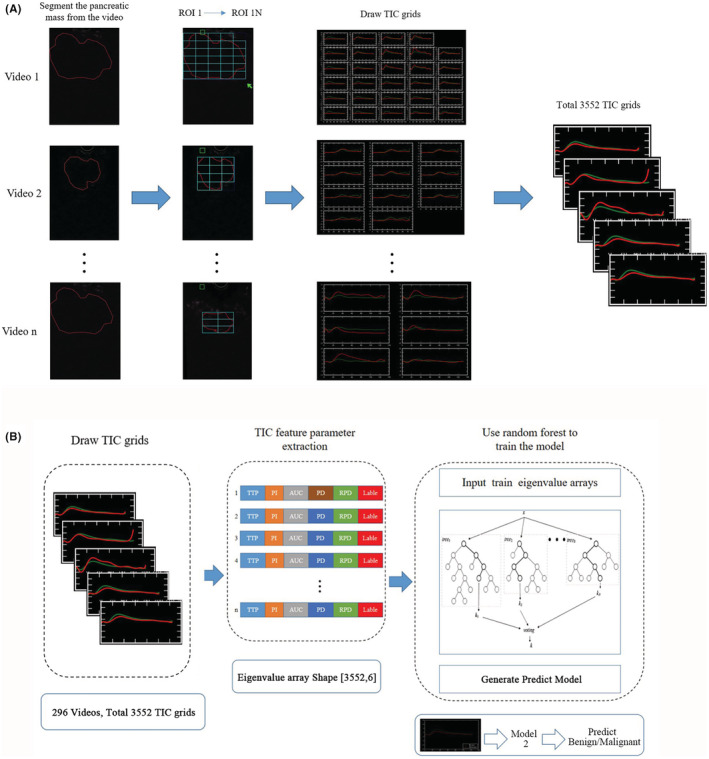
This is a prospective study. The CH-EUS MASTER system is composed of Model 1 (real-time capture and segmentation) and Model 2 (benign and malignant identification). It was developed using deep convolutional neural networks and Random Forest algorithm. Patients with pancreatic masses undergoing CH-EUS examinations followed by EUS-FNA were recruited. All patients underwent CH-EUS and were diagnosed both by endoscopists and CH-EUS MASTER. After diagnosis, they were randomly assigned to undergo EUS-FNA with or without CH-EUS MASTER guidance.
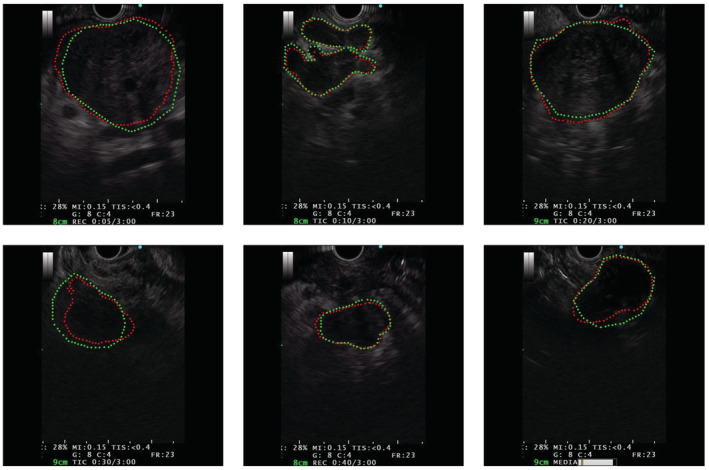
Compared with manual labeling by experts, the average overlap rate of Model 1 was 0.708. In the independent CH-EUS video testing set, Model 2 generated an accuracy of 88.9% in identifying malignant tumors. In clinical trial, the accuracy, sensitivity, and specificity for diagnosing pancreatic masses by CH-EUS MASTER were significantly better than that of endoscopists. The accuracy, sensitivity, specificity, positive predictive value, and negative predictive value were respectively 93.8%, 90.9%, 100%, 100%, and 83.3% by CH-EUS MASTER guided EUS-FNA, and were not significantly different compared to the control group. CH-EUS MASTER-guided EUS-FNA significantly improved the first-pass diagnostic yield.
CH-EUS MASTER is a promising artificial intelligence system diagnosing malignant and benign pancreatic masses and may guide FNA in real time.
NCT04607720.
鉴别胰腺良恶性肿瘤至关重要,但仍具挑战性。本研究旨在构建一种基于深度学习的人工智能系统,以辅助胰腺肿块诊断,并实时指导 EUS-FNA。
前瞻性研究。CH-EUS MASTER 系统由模型 1(实时采集和分割)和模型 2(良恶性鉴别)组成。它使用深度卷积神经网络和随机森林算法开发。纳入接受 CH-EUS 检查并随后行 EUS-FNA 的胰腺肿块患者。所有患者均接受 CH-EUS 检查,由内镜医生和 CH-EUS MASTER 进行诊断。诊断后,患者随机分为接受有或无 CH-EUS MASTER 指导的 EUS-FNA。
与专家手动标注相比,模型 1 的平均重叠率为 0.708。在独立的 CH-EUS 视频测试集中,模型 2 对恶性肿瘤的识别准确率为 88.9%。在临床试验中,CH-EUS MASTER 诊断胰腺肿块的准确率、敏感度和特异度明显优于内镜医生。CH-EUS MASTER 引导的 EUS-FNA 的准确率、敏感度、特异度、阳性预测值和阴性预测值分别为 93.8%、90.9%、100%、100%和 83.3%,与对照组无显著差异。CH-EUS MASTER 引导的 EUS-FNA 显著提高了首次诊断的阳性率。
CH-EUS MASTER 是一种有前途的人工智能系统,可用于诊断胰腺良恶性肿瘤,并可实时指导 FNA。
NCT04607720。