Institute of General Pharmacology and Toxicology, Goethe University Frankfurt, D-60590 Frankfurt, Germany.
Institute of Biochemistry II, Goethe University Frankfurt, D-60590 Frankfurt, Germany.
Cells. 2023 Jan 3;12(1):201. doi: 10.3390/cells12010201.
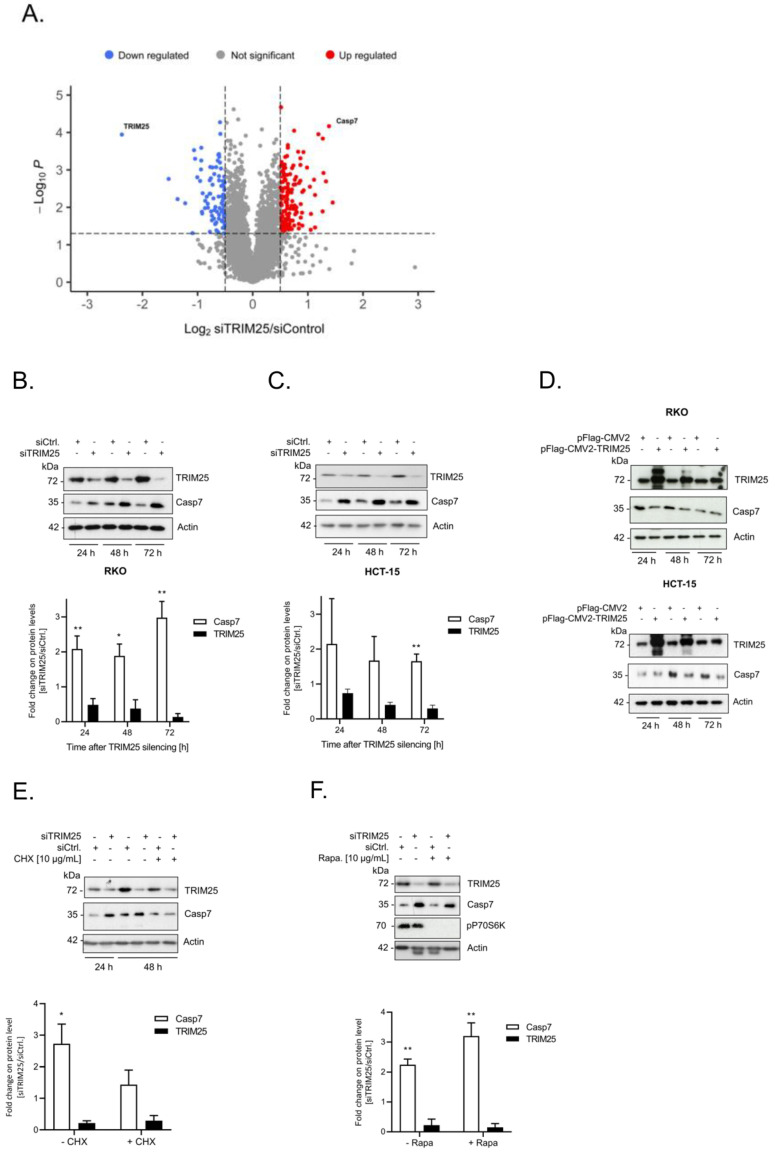
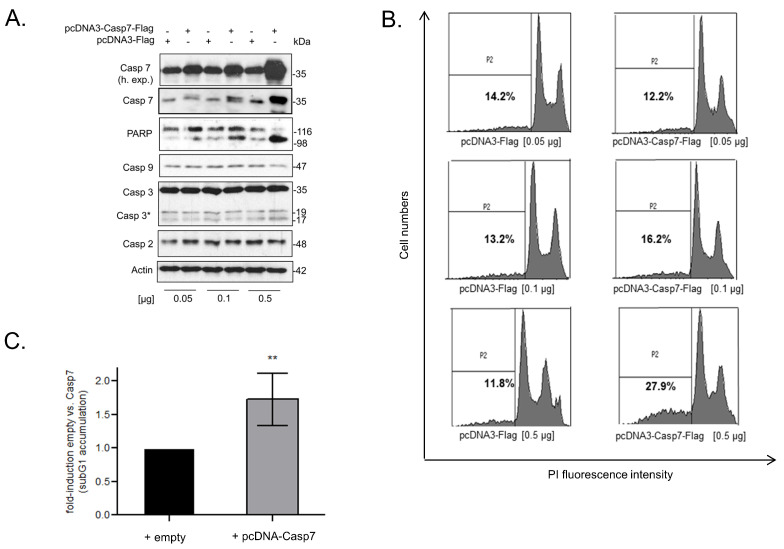
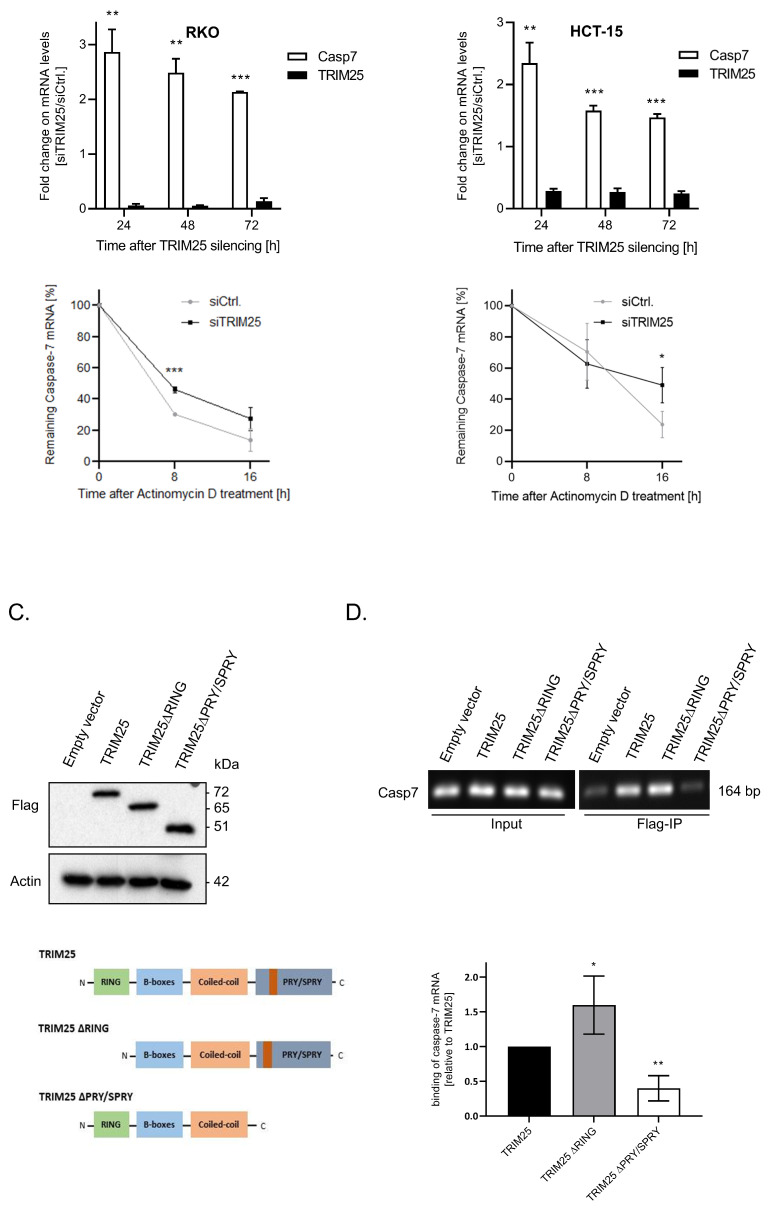
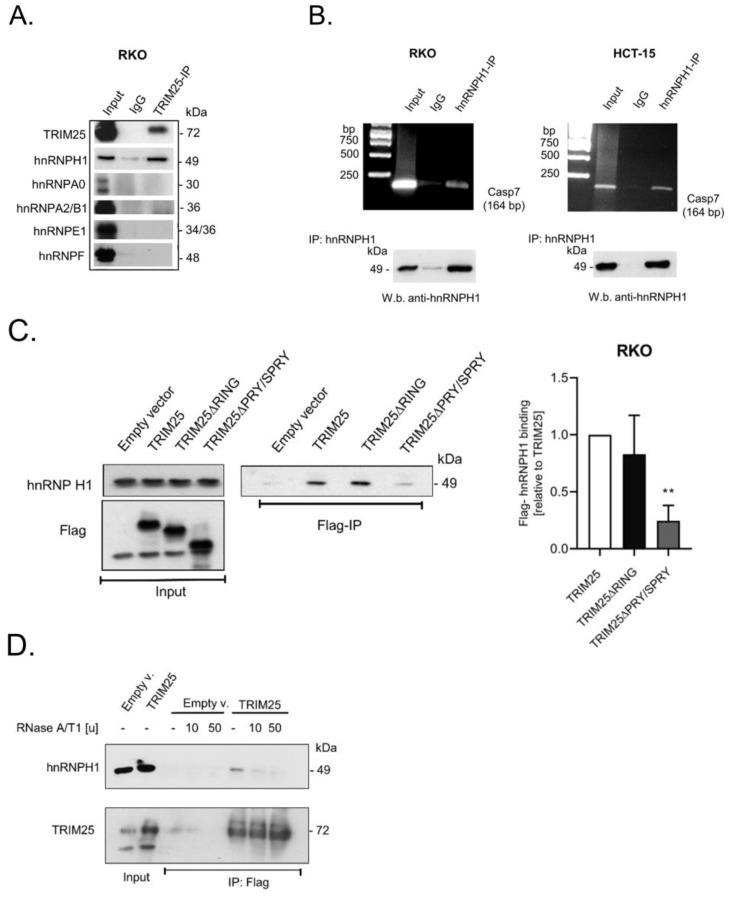
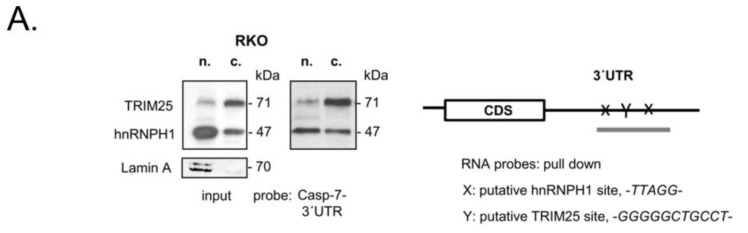
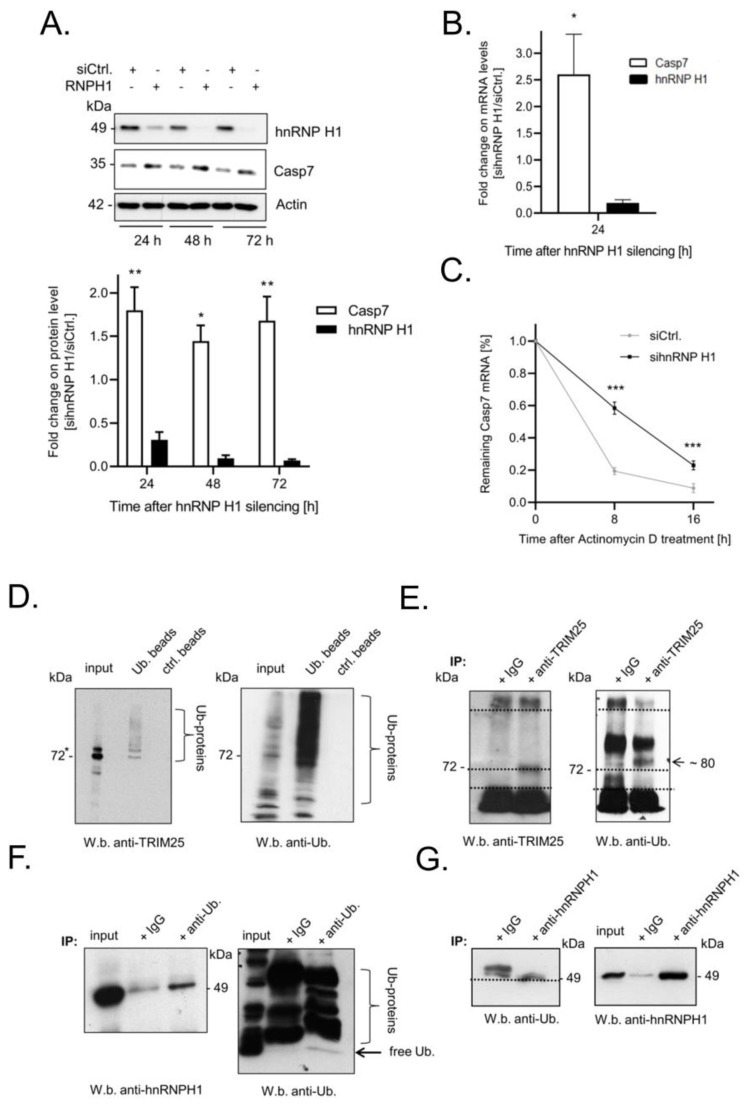
Therapy resistance is still a major reason for treatment failure in colorectal cancer (CRC). Previously, we identified the E3 ubiquitin ligase TRIM25 as a novel suppressor of caspase-2 translation which contributes to the apoptosis resistance of CRC cells towards chemotherapeutic drugs. Here, we report the executioner caspase-7 as being a further target of TRIM25. The results from the gain- and loss-of-function approaches and the actinomycin D experiments indicate that TRIM25 attenuates caspase-7 expression mainly through a decrease in mRNA stability. The data from the RNA pulldown assays with immunoprecipitated TRIM25 truncations indicate a direct TRIM25 binding to caspase-7 mRNA, which is mediated by the PRY/SPRY domain, which is also known to be highly relevant for protein-protein interactions. By employing TRIM25 immunoprecipitation, we identified the heterogeneous nuclear ribonucleoprotein H1 (hnRNPH1) as a novel TRIM25 binding protein with a functional impact on caspase-7 mRNA stability. Notably, the interaction of both proteins was highly sensitive to RNase A treatment and again depended on the PRY/SPRY domain, thus indicating an indirect interaction of both proteins which is achieved through a common RNA binding. Ubiquitin affinity chromatography showed that both proteins are targets of ubiquitin modification. Functionally, the ectopic expression of caspase-7 in CRC cells caused an increase in poly ADP-ribose polymerase (PARP) cleavage concomitant with a significant increase in apoptosis. Collectively, the negative regulation of caspase-7 by TRIM25, which is possibly executed by hnRNPH1, implies a novel survival mechanism underlying the chemotherapeutic drug resistance of CRC cells. The targeting of TRIM25 could therefore offer a promising strategy for the reduction in therapy resistance in CRC patients.
治疗抵抗仍然是结直肠癌(CRC)治疗失败的主要原因。以前,我们发现 E3 泛素连接酶 TRIM25 是一种新的半胱天冬酶-2 翻译抑制剂,有助于 CRC 细胞对化疗药物的抗凋亡作用。在这里,我们报告执行半胱天冬酶-7 是 TRIM25 的另一个靶标。增益和失能方法以及放线菌素 D 实验的结果表明,TRIM25 主要通过降低 mRNA 稳定性来减弱半胱天冬酶-7 的表达。来自带有免疫沉淀的 TRIM25 截短物的 RNA 下拉测定的数据表明,TRIM25 直接与半胱天冬酶-7 mRNA 结合,这是由 PRY/SPRY 结构域介导的,该结构域也与蛋白质-蛋白质相互作用高度相关。通过使用 TRIM25 免疫沉淀,我们鉴定了异质核核糖核蛋白 H1(hnRNPH1)作为一种新的 TRIM25 结合蛋白,其对半胱天冬酶-7 mRNA 稳定性具有功能影响。值得注意的是,两种蛋白质的相互作用对 RNase A 处理非常敏感,并且再次取决于 PRY/SPRY 结构域,因此表明两种蛋白质通过共同的 RNA 结合实现间接相互作用。泛素亲和层析表明,两种蛋白质都是泛素修饰的靶标。功能上,CRC 细胞中外源表达半胱天冬酶-7 会导致聚 ADP-核糖聚合酶(PARP)裂解增加,同时凋亡显著增加。总之,TRIM25 对半胱天冬酶-7 的负调控,可能是通过 hnRNPH1 执行的,暗示了 CRC 细胞化疗耐药的一种新的生存机制。TRIM25 的靶向治疗可能为降低 CRC 患者的治疗抵抗提供一种有前途的策略。