State Key Laboratory of Pig Genetic Improvement and Production Technology, Jiangxi Agricultural University, Nanchang 330045, China.
Nutrients. 2022 Dec 28;15(1):151. doi: 10.3390/nu15010151.
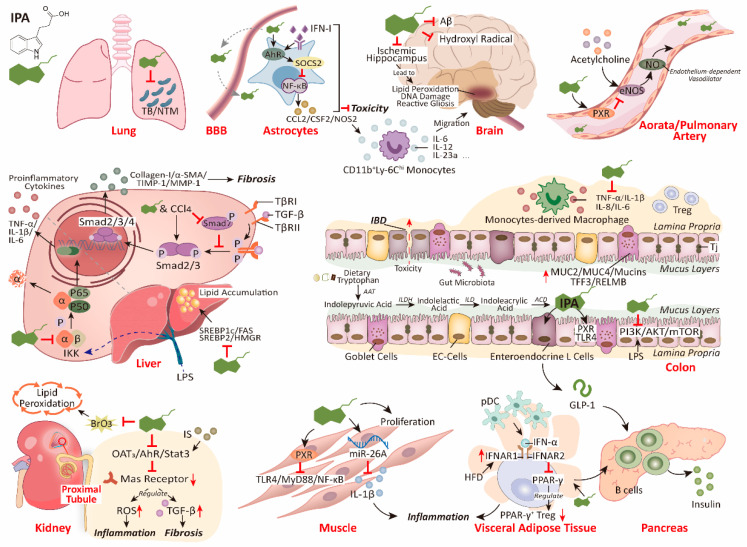
Increasing evidence suggests that metabolites produced by the gut microbiota play a crucial role in host-microbe interactions. Dietary tryptophan ingested by the host enters the gut, where indole-like metabolites such as indole propionic acid (IPA) are produced under deamination by commensal bacteria. Here, we summarize the IPA-producing bacteria, dietary patterns on IPA content, and functional roles of IPA in various diseases. IPA can not only stimulate the expression of tight junction (TJ) proteins to enhance gut barrier function and inhibit the penetration of toxic factors, but also modulate the immune system to exert anti-inflammatory and antioxidant effects to synergistically regulate body physiology. Moreover, IPA can act on target organs through blood circulation to form the gut-organ axis, which helps maintain systemic homeostasis. IPA shows great potential for the diagnosis and treatment of various clinical diseases, such as NAFLD, Alzheimer's disease, and breast cancer. However, the therapeutic effect of IPA depends on dose, target organ, or time. In future studies, further work should be performed to explore the effects and mechanisms of IPA on host health and disease to further improve the existing treatment program.
越来越多的证据表明,肠道微生物群产生的代谢物在宿主-微生物相互作用中起着至关重要的作用。宿主摄入的膳食色氨酸进入肠道,在共生菌脱氨酶的作用下产生吲哚样代谢物,如吲哚丙酸(IPA)。在这里,我们总结了产生 IPA 的细菌、IPA 含量的饮食模式以及 IPA 在各种疾病中的功能作用。IPA 不仅可以刺激紧密连接(TJ)蛋白的表达,增强肠道屏障功能并抑制有毒因素的渗透,还可以调节免疫系统发挥抗炎和抗氧化作用,从而协同调节身体生理机能。此外,IPA 可以通过血液循环作用于靶器官,形成肠道-器官轴,有助于维持全身内环境稳定。IPA 在非酒精性脂肪性肝病、阿尔茨海默病和乳腺癌等各种临床疾病的诊断和治疗中具有巨大的潜力。然而,IPA 的治疗效果取决于剂量、靶器官或时间。在未来的研究中,应进一步探索 IPA 对宿主健康和疾病的影响和机制,以进一步完善现有的治疗方案。