School of Public Health, The University of Hong Kong, Hong Kong Special Administrative Region, People's Republic of China.
Bacterial, Parasitic and Zoonotic Diseases Research Directorate, Ethiopian Public Health Institute, Addis Ababa, Ethiopia.
Emerg Microbes Infect. 2023 Dec;12(1):e2164218. doi: 10.1080/22221751.2022.2164218.
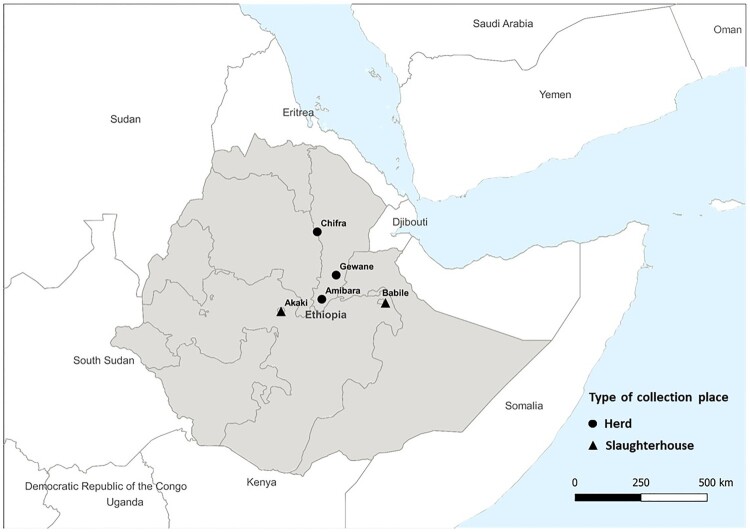
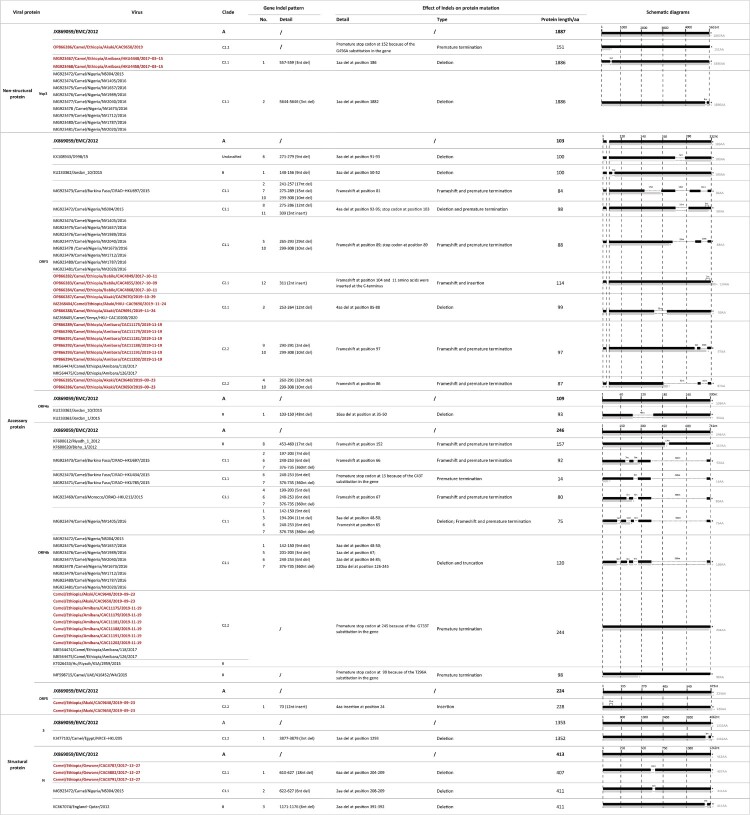
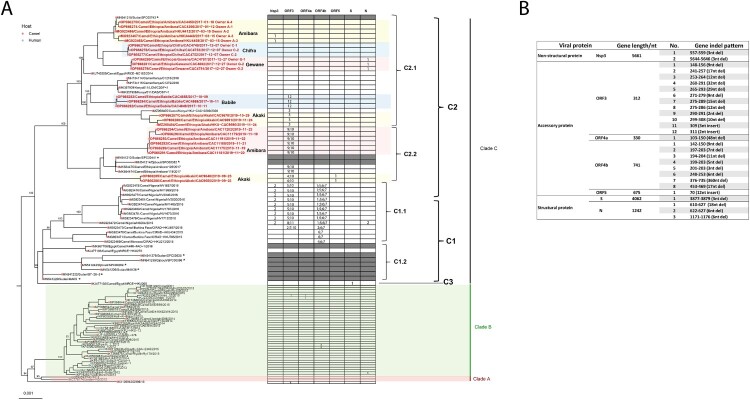
Middle East respiratory syndrome coronavirus (MERS-CoV) is enzootic in dromedary camels and causes zoonotic infection and disease in humans. Although over 80% of the global population of infected dromedary camels are found in Africa, zoonotic disease had only been reported in the Arabia Peninsula and travel-associated disease has been reported elsewhere. In this study, genetic diversity and molecular epidemiology of MERS-CoV in dromedary camels in Ethiopia were investigated during 2017-2020. Of 1766 nasal swab samples collected, 61 (3.5%) were detected positive for MERS-CoV RNA. Of 484 turbinate swab samples collected, 10 (2.1%) were detected positive for MERS-CoV RNA. Twenty-five whole genome sequences were obtained from these MERS-CoV positive samples. Phylogenetically, these Ethiopian camel-originated MERS-CoV belonged to clade C2, clustering with other East African camel strains. Virus sequences from camel herds clustered geographically while in an abattoir, two distinct phylogenetic clusters of MERS-CoVs were observed in two sequential sampling collections, which indicates the greater genetic diversity of MERS-CoV in abattoirs. In contrast to clade A and B viruses from the Arabian Peninsula, clade C camel-originated MERS-CoV from Ethiopia had various nucleotide insertions and deletions in non-structural gene nsp3, accessory genes ORF3 and ORF5 and structural gene N. This study demonstrates the genetic instability of MERS-CoV in dromedaries in East Africa, which indicates that the virus is still actively adapting to its camel host. The impact of the observed nucleotide insertions and deletions on virus evolution, viral fitness, and zoonotic potential deserves further study.
中东呼吸综合征冠状病毒(MERS-CoV)在单峰驼中地方性流行,并导致人类发生人畜共患病感染和疾病。尽管在全球感染的单峰驼种群中,超过 80%存在于非洲,但仅在阿拉伯半岛报告了人畜共患病,并且在其他地方报告了与旅行相关的疾病。在这项研究中,研究人员在 2017 年至 2020 年期间调查了埃塞俄比亚单峰驼中 MERS-CoV 的遗传多样性和分子流行病学。在采集的 1766 份鼻腔拭子样本中,有 61 份(3.5%)检测到 MERS-CoV RNA 呈阳性。在采集的 484 份鼻甲拭子样本中,有 10 份(2.1%)检测到 MERS-CoV RNA 呈阳性。从这些 MERS-CoV 阳性样本中获得了 25 个全基因组序列。从系统发生学上看,这些源自埃塞俄比亚骆驼的 MERS-CoV 属于 C2 分支,与其他东非骆驼株系聚类。骆驼群的病毒序列在地理上聚类,而在屠宰场,在两次连续采样中观察到两个不同的 MERS-CoV 进化枝簇,这表明屠宰场中 MERS-CoV 的遗传多样性更大。与来自阿拉伯半岛的 A 型和 B 型病毒不同,源自埃塞俄比亚骆驼的 C 型骆驼起源的 MERS-CoV 在非结构基因 nsp3、辅助基因 ORF3 和 ORF5 以及结构基因 N 中具有各种核苷酸插入和缺失。本研究表明,东非单峰驼中的 MERS-CoV 具有遗传不稳定性,这表明该病毒仍在积极适应其骆驼宿主。值得进一步研究观察到的核苷酸插入和缺失对病毒进化、病毒适应性和人畜共患潜力的影响。