Infections and Cystic Fibrosis Unit, Division of Immunology, Transplantation and Infectious Diseases, IRCCS San Raffaele Scientific Institute, Milan, Italy.
Aphad Srl, Buccinasco, Italy.
Microbiol Spectr. 2023 Feb 14;11(1):e0408322. doi: 10.1128/spectrum.04083-22. Epub 2023 Jan 10.
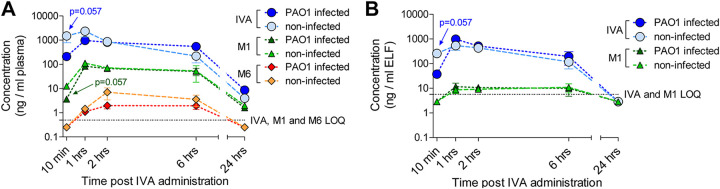
Cystic fibrosis transmembrane conductance regulator (CFTR) modulators improve clinical outcomes with varied efficacies in patients with CF. However, the mutual effects of CFTR modulators and bacterial adaptation, together with antibiotic regimens, can influence clinical outcomes. We evaluated the effects of ivacaftor (IVA), lumacaftor (LUM), tezacaftor, elexacaftor, and a three-modulator combination of elexacaftor, tezacaftor, and ivacaftor (ETI), alone or combined with antibiotics, on sequential CF isolates. IVA and ETI showed direct antimicrobial activities against Staphylococcus aureus but not against Pseudomonas aeruginosa. Additive effects or synergies were observed between the CFTR modulators and antibiotics against both species, independently of adaptation to the CF lung. IVA and LUM were the most effective in potentiating antibiotic activity against S. aureus, while IVA and ETI enhanced mainly polymyxin activity against P. aeruginosa. Next, we evaluated the effect of P. aeruginosa pneumonia on the pharmacokinetics of IVA in mice. IVA and its metabolites in plasma, lung, and epithelial lining fluid were increased by P. aeruginosa infection. Thus, CFTR modulators can have direct antimicrobial properties and/or enhance antibiotic activity against initial and adapted S. aureus and P. aeruginosa isolates. Furthermore, bacterial infection impacts airway exposure to IVA, potentially affecting its efficacy. Our findings suggest optimizing host- and pathogen-directed therapies to improve efficacy for personalized treatment. CFTR modulators have been developed to correct and/or enhance CFTR activity in patients with specific cystic fibrosis (CF) genotypes. However, it is of great importance to identify potential off-targets of these novel therapies to understand how they affect lung physiology in CF. Since bacterial infections are one of the hallmarks of CF lung disease, the effects (if any) of CFTR modulators on bacteria could impact their efficacy. This work highlights a mutual interaction between CFTR modulators and opportunistic bacterial infections; in particular, it shows that (i) CFTR modulators have an antibacterial activity and influence antibiotic efficacy, and (ii) bacterial airway infections affect levels of CFTR modulators in the airways. These findings may help optimize host- and pathogen-directed drug regimens to improve the efficacy of personalized treatment.
囊性纤维化跨膜电导调节因子 (CFTR) 调节剂可改善 CF 患者的临床疗效,但 CFTR 调节剂与细菌适应性以及抗生素方案的相互作用会影响临床疗效。我们评估了伊伐卡托(IVA)、拉卡曲特(LUM)、泰泽卡曲特、艾乐卡曲特以及艾乐卡曲特、泰泽卡曲特和伊伐卡托三联调节剂(ETI)单独或联合抗生素对连续 CF 分离株的影响。IVA 和 ETI 对金黄色葡萄球菌具有直接的抗菌活性,但对铜绿假单胞菌没有。CFTR 调节剂与抗生素对两种细菌的协同作用或增效作用独立于对 CF 肺部的适应性。IVA 和 LUM 对增强金黄色葡萄球菌对抗生素的活性最有效,而 IVA 和 ETI 主要增强多粘菌素对铜绿假单胞菌的活性。接下来,我们评估了铜绿假单胞菌肺炎对 IVA 在小鼠体内药代动力学的影响。铜绿假单胞菌感染增加了 IVA 及其在血浆、肺和上皮衬里液中的代谢物。因此,CFTR 调节剂具有直接的抗菌特性和/或增强初始和适应的金黄色葡萄球菌和铜绿假单胞菌分离株对抗生素的活性。此外,细菌感染会影响气道对 IVA 的暴露,从而可能影响其疗效。我们的研究结果表明,优化宿主和病原体导向的治疗方法以提高疗效,实现个体化治疗。CFTR 调节剂的开发是为了纠正和/或增强特定囊性纤维化 (CF) 基因型患者的 CFTR 活性。然而,确定这些新型疗法的潜在非靶点对于了解它们如何影响 CF 中的肺生理学非常重要。由于细菌感染是 CF 肺部疾病的特征之一,因此 CFTR 调节剂对细菌的影响(如果有的话)可能会影响其疗效。这项工作强调了 CFTR 调节剂与机会性细菌感染之间的相互作用;特别是,它表明(i)CFTR 调节剂具有抗菌活性和影响抗生素疗效,以及(ii)细菌气道感染影响气道中 CFTR 调节剂的水平。这些发现可能有助于优化宿主和病原体导向的药物方案,以提高个体化治疗的疗效。