Sunman Birce, Yalçın Ebru, Erdal Meltem Akgül, Şen Velat, Başkan Azer Kılıç, Kılınç Ayşe Ayzıt, Yazan Hakan, Çakır Erkan, Demir Ayşegül Doğan, Ünal Gökçen, Savaş Suat, Pekcan Sevgi, Korkmaz Merve, Canıtez Yakup, Öztürk Gökçen Kartal, Gülen Figen, Arık Elif, Keskin Özlem, Ersoy Ali, Köse Mehmet, Serbes Mahir, Altıntaş Derya Ufuk, Başaran Abdurrahman Erdem, Bingöl Ayşen, Hocoğlu Zeynep İlkşen, Aslan Ayşe Tana, Yuluğ Demet Polat, Özdemir Ali, Tabakçı Satı Özkan, Tural Dilber Ademhan, Harmancı Koray, Özsezen Beste, Çobanoğlu Nazan, Tongal Sedef Narin, Çaltepe Gönül, Hangül Melih, Aydın Zeynep Gökçe Gayretli, Kılıç Mehmet, Hızal Mina, Baş Nilay, Özcan Gizem, Eyüboğlu Tuğba Şişmanlar, Emiralioğlu Nagehan, Cinel Güzin, Özçelik Uğur, Doğru Deniz
Department of Pediatric Pulmonology, School of Medicine, Hacettepe University, Ankara, Turkey.
Department of Pediatric Pulmonology, Dicle University Faculty of Medicine, Diyarbakir, Turkey.
Pediatr Pulmonol. 2025 Jun;60(6):e71155. doi: 10.1002/ppul.71155.
Modulators have revolutionized cystic fibrosis (CF) management, but their effects on respiratory pathogens remain unclear. This study evaluated changes in lower respiratory tract pathogen detection after modulator therapy in children with CF, registered in the Cystic Fibrosis Registry of Turkey.
This retrospective, multicenter cohort study included children receiving modulator therapy between 2020 and 2022. Chronic respiratory tract colonization rates before and after therapy were compared, along with inhaler treatments, oral steroid, azithromycin use, pulmonary function tests, and hospitalizations for pulmonary exacerbations. The cohort was stratified by age, modulator type, and lung disease severity. Changes in microbiologic data over a 1-year period were also analyzed for children not receiving modulator therapy.
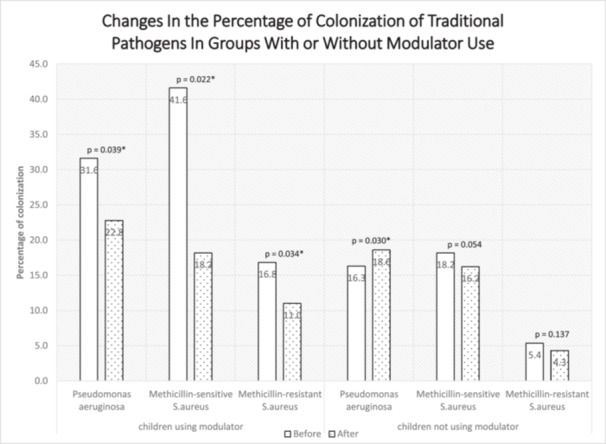
A total of 101 children (mean age 9.95 ± 4.44 years) were included. Following modulator therapy, respiratory cultures of 57 (56.4%) were negative. Among 32 children with chronic Pseudomonas aeruginosa (P. aeruginosa) colonization, 14 (44%) showed negative respiratory cultures after receiving modulator therapy (p = 0.039). Conversion to culture-negative status was significant for methicillin-sensitive Staphylococcus aureus (MSSA) (p = 0.022) and methicillin-resistant Staphylococcus aureus (MRSA) (p = 0.034), with ETI therapy yielding the highest conversion rates. Inhaled antibiotic use for chronic respiratory pathogens decreased significantly (p = 0.039), and spirometry parameters improved (p < 0.001). Among 1232 children not receiving modulators, 180 (14.6%) had negative respiratory cultures when examined at 1-year interval. In the same group, intermittent/chronic P. aeruginosa colonization was negative in 58 cases, while 85 developed new growth, following modulator therapy, with positivity rates rising from 16.3% to 18.5% (p = 0.030). No significant changes in other pathogen detection were observed.
Modulators, particularly ETI, reduced respiratory pathogen detection and improved lung function in children with CF.
调节剂彻底改变了囊性纤维化(CF)的治疗方式,但其对呼吸道病原体的影响仍不明确。本研究评估了在土耳其囊性纤维化登记处登记的CF儿童接受调节剂治疗后下呼吸道病原体检测的变化。
这项回顾性、多中心队列研究纳入了2020年至2022年间接受调节剂治疗的儿童。比较了治疗前后的慢性呼吸道定植率,以及吸入治疗、口服类固醇、阿奇霉素使用、肺功能测试和肺部加重住院情况。该队列按年龄、调节剂类型和肺部疾病严重程度进行分层。还分析了未接受调节剂治疗的儿童在1年期间微生物学数据的变化。
共纳入101名儿童(平均年龄9.95±4.44岁)。调节剂治疗后,57名(56.4%)儿童的呼吸道培养结果为阴性。在32名慢性铜绿假单胞菌(P. aeruginosa)定植的儿童中,14名(44%)在接受调节剂治疗后呼吸道培养结果为阴性(p = 0.039)。对甲氧西林敏感金黄色葡萄球菌(MSSA)(p = 0.022)和耐甲氧西林金黄色葡萄球菌(MRSA)(p = 0.034)而言,转为培养阴性状态具有显著意义,其中依替米星治疗转化率最高。用于慢性呼吸道病原体的吸入抗生素使用显著减少(p = 0.039),肺活量测定参数有所改善(p < 0.001)。在1232名未接受调节剂治疗的儿童中,180名(14.6%)在1年间隔检查时呼吸道培养结果为阴性。在同一组中,58例间歇性/慢性P. aeruginosa定植为阴性,而85例在接受调节剂治疗后出现新的生长,阳性率从16.3%升至18.5%(p = 0.030)。未观察到其他病原体检测有显著变化。
调节剂,尤其是依替米星,减少了CF儿童呼吸道病原体的检测并改善了肺功能。