Department of Radiology, Beijing Chaoyang Hospital, Capital Medical University, Beijing 100020, China.
Key Lab of Medical Engineering for Cardiovascular Disease, Ministry of Education, Beijing 100020, China.
Brain. 2023 Jul 3;146(7):3079-3087. doi: 10.1093/brain/awac500.
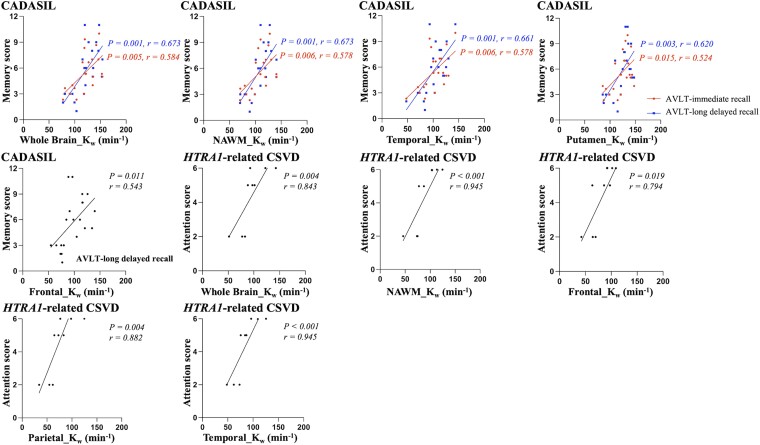
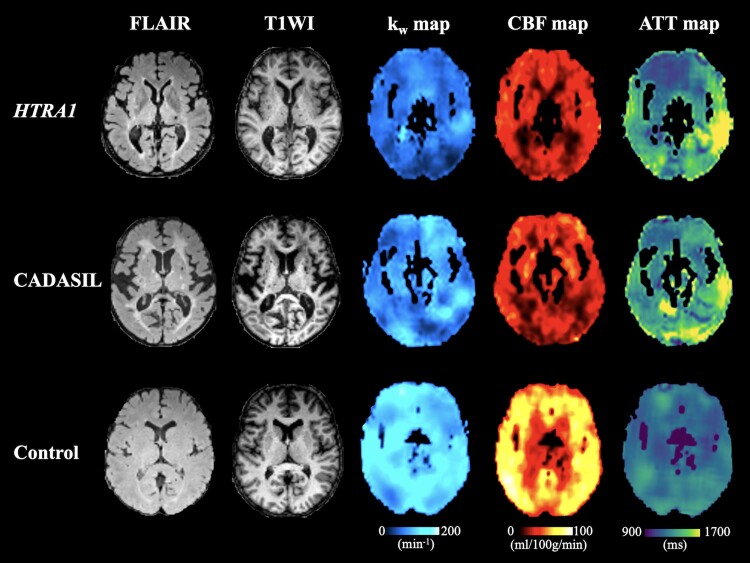
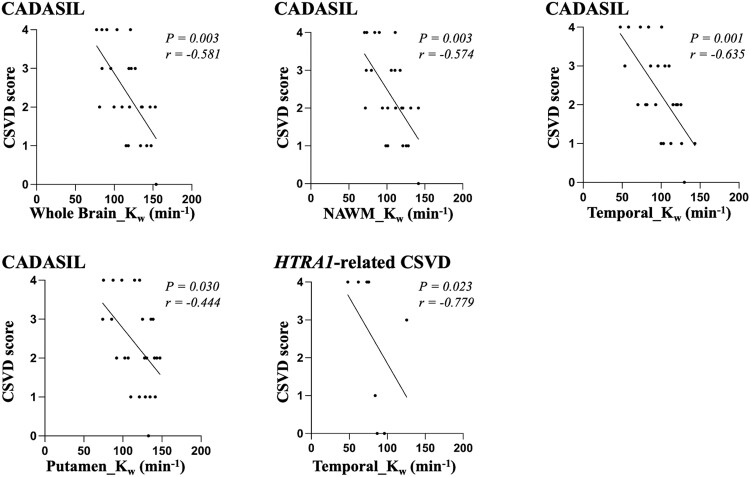
Cerebral autosomal dominant arteriopathy with subcortical infarcts and leukoencephalopathy (CADASIL) and heterozygous HTRA1 mutation-related cerebral small vessel disease (CSVD) are the two types of dominant hereditary CSVD. Blood-brain barrier (BBB) failure has been hypothesized in the pathophysiology of CSVD. However, it is unclear whether there is BBB damage in the two types of hereditary CSVD, especially in heterozygous HTRA1 mutation-related CSVD. In this study, a case-control design was used with two disease groups including CADASIL (n = 24), heterozygous HTRA1 mutation-related CSVD (n = 9) and healthy controls (n = 24). All participants underwent clinical cognitive assessments and brain MRI. Diffusion-prepared pseudo-continuous arterial spin labelling was used to estimate the water exchange rate across the BBB (kw). Correlation and multiple linear regression analyses were used to examine the association between kw and disease burden and neuropsychological performance, respectively. Compared with the healthy controls, kw in the whole brain and multiple brain regions was decreased in both CADASIL and heterozygous HTRA1 mutation-related CSVD patients (Bonferroni-corrected P < 0.007). In the CADASIL group, decreased kw in the whole brain (β = -0.634, P = 0.001), normal-appearing white matter (β = -0.599, P = 0.002) and temporal lobe (β = -0.654, P = 0.001) was significantly associated with higher CSVD score after adjusting for age and sex. Reduced kw in the whole brain was significantly associated with poorer neuropsychological performance after adjusting for age, sex and education in both CADASIL and heterozygous HTRA1 mutation-related CSVD groups (β = 0.458, P = 0.001; β = 0.884, P = 0.008). This study showed that there was decreased water exchange rate across the BBB in both CADASIL and heterozygous HTRA1 mutation-related CSVD patients, suggesting a common pathophysiological mechanism underlying the two types of hereditary CSVD. These results highlight the potential use of kw for monitoring the course of CADASIL and heterozygous HTRA1 mutation-related CSVD, a possibility which should be tested in future research.
伴有皮质下梗死和白质脑病的常染色体显性脑动脉病(CADASIL)和杂合 HTRA1 突变相关的脑小血管病(CSVD)是两种显性遗传性 CSVD 类型。血脑屏障(BBB)功能障碍被认为是 CSVD 的病理生理学基础。然而,在这两种遗传性 CSVD 中,尤其是在杂合 HTRA1 突变相关的 CSVD 中,是否存在 BBB 损伤尚不清楚。在这项研究中,采用病例对照设计,将两个疾病组包括 CADASIL(n=24)、杂合 HTRA1 突变相关 CSVD(n=9)和健康对照组(n=24)。所有参与者均接受临床认知评估和脑 MRI 检查。采用弥散准备伪连续动脉自旋标记技术估计 BBB 水交换率(kw)。分别采用相关性和多元线性回归分析来检测 kw 与疾病负担和神经心理学表现之间的相关性。与健康对照组相比,CADASIL 和杂合 HTRA1 突变相关 CSVD 患者的全脑和多个脑区的 kw 均降低(Bonferroni 校正后 P<0.007)。在 CADASIL 组中,全脑(β=-0.634,P=0.001)、正常外观白质(β=-0.599,P=0.002)和颞叶(β=-0.654,P=0.001)的 kw 降低与 CSVD 评分升高显著相关,校正年龄和性别后。在 CADASIL 和杂合 HTRA1 突变相关 CSVD 组中,全脑的 kw 降低与神经心理学表现较差显著相关,校正年龄、性别和教育程度后(β=0.458,P=0.001;β=0.884,P=0.008)。本研究表明,CADASIL 和杂合 HTRA1 突变相关 CSVD 患者的 BBB 水交换率降低,提示这两种遗传性 CSVD 具有共同的病理生理学机制。这些结果强调了在 CADASIL 和杂合 HTRA1 突变相关 CSVD 监测中使用 kw 的潜在可能性,这一点应该在未来的研究中进行检验。