Shao Xingfeng, Jann Kay, Ma Samantha J, Yan Lirong, Montagne Axel, Ringman John M, Zlokovic Berislav V, Wang Danny J J
Laboratory of FMRI Technology (LOFT), USC Mark & Mary Stevens Neuroimaging and Informatics Institute, Keck School of Medicine, University of Southern California, Los Angeles, CA, United States.
Department of Neurology, Keck School of Medicine, University of Southern California, Los Angeles, CA, United States.
Front Neurosci. 2020 Nov 30;14:571480. doi: 10.3389/fnins.2020.571480. eCollection 2020.
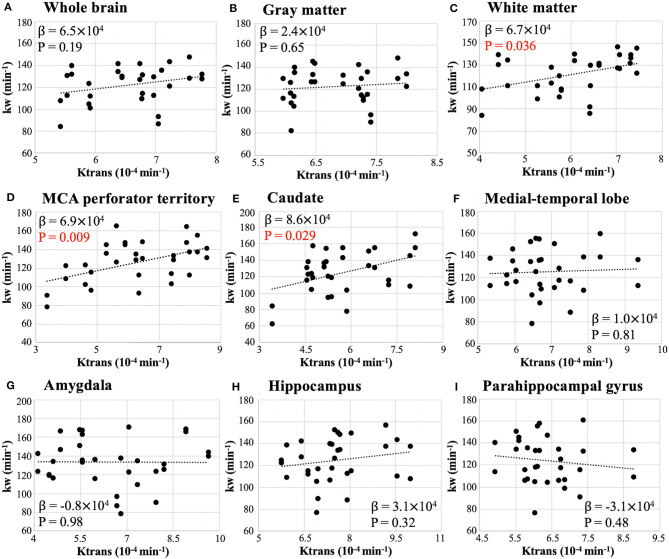
Dynamic contrast-enhanced (DCE) MRI using intravenous injection of gadolinium-based contrast agents (GBCAs) is commonly used for imaging blood-brain barrier (BBB) permeability. Water is an alternative endogenous tracer with limited exchange rate across the BBB. A direct comparison between BBB water exchange rate and BBB permeability to GBCA is missing. The purpose of this study was to directly compare BBB permeability to GBCA (Ktrans and k = Ktrans/Vp) and water exchange rate (kw) in a cohort of elderly subjects at risk of cerebral small vessel disease (cSVD). Ktrans/k and kw were measured by DCE-MRI and diffusion prepared pseudo-continuous arterial spin labeling (DP-pCASL), respectively, at 3 Tesla in 16 elderly subjects (3 male, age = 67.9 ± 3.0 yrs) at risk of cSVD. The test-retest reproducibility of kw measurements was evaluated with repeated scans ~6 weeks apart. Mixed effects linear regression was performed in the whole brain, gray matter (GM), white matter (WM), and 6 subcortical brain regions to investigate associations between Ktrans/k and test-retest kw. In addition, kw and Ktrans/k were compared in normal appearing white matter (NAWM), white matter hyperintensity (WMH) lesions and penumbra. Significant correlation was found between kw and Ktrans only in WM (β = 6.7 × 10, = 0.036), caudate (β = 8.6 × 10, = 0.029), and middle cerebral artery (MCA) perforator territory (β = 6.9 × 10, = 0.009), but not in the whole brain, GM or rest 5 brain regions. Significant correlation was found between kw and k in MCA perforator territory (β = 1.5 × 10, = 0.049), medial-temporal lobe (β = 3.5 × 10, = 0.032), and hippocampus (β = 3.4 × 10, = 0.038), but not in the rest brain regions. Good reproducibility of kw measurements (ICC=0.75) was achieved. Ktrans was significantly lower inside WMH than WMH penumbra (16.2%, = 0.026), and k was significantly lower in NAWM than in the WMH penumbra (20.8%, < 0.001). kw provides a measure of water exchange rate across the BBB with good test-retest reproducibility. The BBB mechanism underlying kw and Ktrans/k is likely to be different, as manifested by correlations in only three brain regions for each pair of comparison between kw and Ktrans or k.
使用静脉注射钆基造影剂(GBCA)的动态对比增强(DCE)磁共振成像(MRI)常用于成像血脑屏障(BBB)的通透性。水是一种内源性示踪剂,其穿过血脑屏障的交换速率有限。目前尚缺乏对血脑屏障水交换速率与血脑屏障对GBCA通透性的直接比较。本研究的目的是在一组有脑小血管疾病(cSVD)风险的老年受试者中,直接比较血脑屏障对GBCA的通透性(Ktrans和k = Ktrans/Vp)和水交换速率(kw)。在16名有cSVD风险的老年受试者(3名男性,年龄 = 67.9 ± 3.0岁)中,分别通过DCE-MRI和扩散准备伪连续动脉自旋标记(DP-pCASL)在3特斯拉磁场下测量Ktrans/k和kw。通过间隔约6周的重复扫描评估kw测量的重测再现性。在全脑、灰质(GM)、白质(WM)和6个皮质下脑区进行混合效应线性回归,以研究Ktrans/k与重测kw之间的关联。此外,还在正常外观白质(NAWM)、白质高信号(WMH)病变和半暗带中比较了kw和Ktrans/k。仅在WM(β = 6.7 × 10,P = 0.036)、尾状核(β = 8.6 × 10,P = 0.029)和大脑中动脉(MCA)穿支区域(β = 6.9 × 10,P = 0.009)发现kw与Ktrans之间存在显著相关性,但在全脑、GM或其余5个脑区未发现。在MCA穿支区域(β = 1.5 × 10,P = 0.049)、内侧颞叶(β = 3.5 × 10,P = 0.032)和海马体(β = 3.4 × 10,P = 0.038)发现kw与k之间存在显著相关性,但在其余脑区未发现。kw测量具有良好的再现性(ICC = 0.75)。WMH内的Ktrans显著低于WMH半暗带(16.2%,P = 0.026),NAWM中的k显著低于WMH半暗带(20.8%,P < 0.001)。kw提供了一种测量穿过血脑屏障的水交换速率的方法,具有良好的重测再现性。kw和Ktrans/k背后的血脑屏障机制可能不同,这在kw与Ktrans或k的每对比较中仅在三个脑区存在相关性中得到体现。