Beijing Key Laboratory of DNA Damage Response and College of Life Sciences, Capital Normal University, Beijing, China.
Guangdong Key Laboratory for Genome Stability & Disease Prevention and Carson International Cancer Center, Marshall Laboratory of Biomedical Engineering, Shenzhen University School of Medicine, Shenzhen, Guangdong, China.
J Biol Chem. 2023 Feb;299(2):102887. doi: 10.1016/j.jbc.2023.102887. Epub 2023 Jan 7.
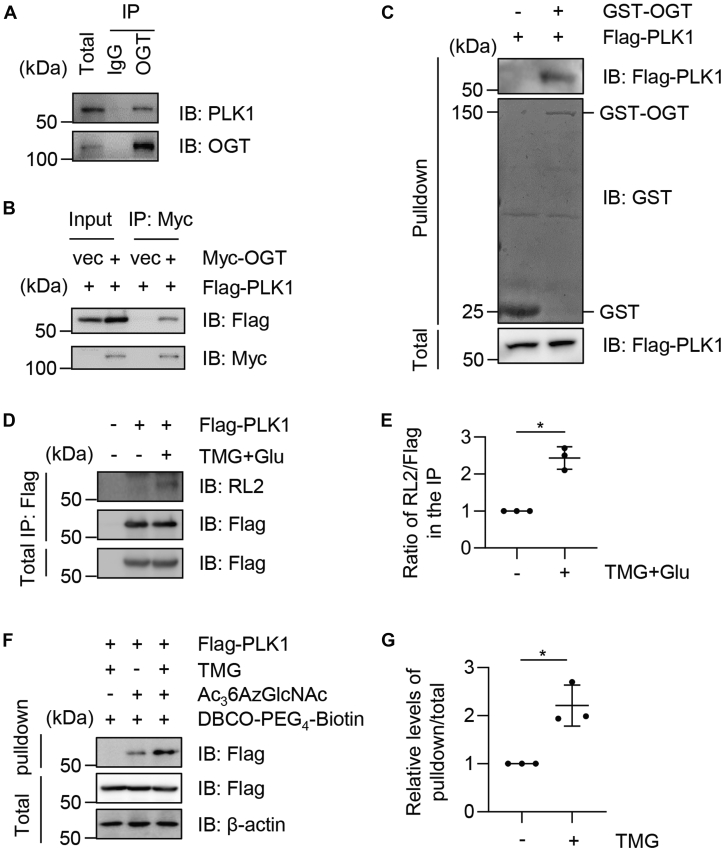
The O-linked β-N-acetylglucosamine (O-GlcNAc) transferase (OGT) mediates intracellular O-GlcNAcylation modification. O-GlcNAcylation occurs on Ser/Thr residues and is important for numerous physiological processes. OGT is essential for dividing mammalian cells and is involved in many human diseases; however, many of its fundamental substrates during cell division remain unknown. Here, we focus on the effect of OGT on polo-like kinase 1 (PLK1), a mitotic master kinase that governs DNA replication, mitotic entry, chromosome segregation, and mitotic exit. We show that PLK1 interacts with OGT and is O-GlcNAcylated. By utilizing stepped collisional energy/higher-energy collisional dissociation mass spectrometry, we found a peptide fragment of PLK1 that is modified by O-GlcNAc. Further mutation analysis of PLK1 shows that the T291A mutant decreases O-GlcNAcylation. Interestingly, T291N is a uterine carcinoma mutant in The Cancer Genome Atlas. Our biochemical assays demonstrate that T291A and T291N both increase PLK1 stability. Using stable H2B-GFP cells, we found that PLK1-T291A and PLK1-T291N mutants display chromosome segregation defects and result in misaligned and lagging chromosomes. In mouse xenograft models, we demonstrate that the O-GlcNAc-deficient PLK1-T291A and PLK1-T291N mutants enhance uterine carcinoma in animals. Hence, we propose that OGT partially exerts its mitotic function through O-GlcNAcylation of PLK1, which might be one mechanism by which elevated levels of O-GlcNAc promote tumorigenesis.
O-连接的β-N-乙酰氨基葡萄糖(O-GlcNAc)转移酶(OGT)介导细胞内 O-GlcNAc 修饰。O-GlcNAc 化发生在丝氨酸/苏氨酸残基上,对许多生理过程都很重要。OGT 对分裂的哺乳动物细胞是必不可少的,并且与许多人类疾病有关;然而,其在细胞分裂过程中的许多基本底物仍然未知。在这里,我们专注于 OGT 对 Polo 样激酶 1(PLK1)的影响,PLK1 是一种有丝分裂主激酶,可控制 DNA 复制、有丝分裂进入、染色体分离和有丝分裂退出。我们发现 PLK1 与 OGT 相互作用并被 O-GlcNAc 修饰。通过利用分步碰撞能/更高能量碰撞解离质谱法,我们发现了被 O-GlcNAc 修饰的 PLK1 的肽片段。进一步的 PLK1 突变分析表明 T291A 突变降低了 O-GlcNAc 化。有趣的是,T291N 是癌症基因组图谱中的子宫癌突变。我们的生化测定表明 T291A 和 T291N 都增加了 PLK1 的稳定性。使用稳定的 H2B-GFP 细胞,我们发现 PLK1-T291A 和 PLK1-T291N 突变体显示染色体分离缺陷,并导致染色体未对准和滞后。在小鼠异种移植模型中,我们证明 O-GlcNAc 缺陷的 PLK1-T291A 和 PLK1-T291N 突变体增强了动物的子宫癌。因此,我们提出 OGT 通过 O-GlcNAc 化 PLK1 部分发挥其有丝分裂功能,这可能是升高的 O-GlcNAc 促进肿瘤发生的一种机制。