Western University, Schulich School of Medicine and Dentistry, Department of Microbiology and Immunology, London, ON, Canada.
Department of Biochemistry, Microbiology and Immunology, Faculty of Medicine, University of Ottawa, Ottawa, ON, Canada.
Nat Commun. 2023 Jan 10;14(1):16. doi: 10.1038/s41467-022-35379-y.
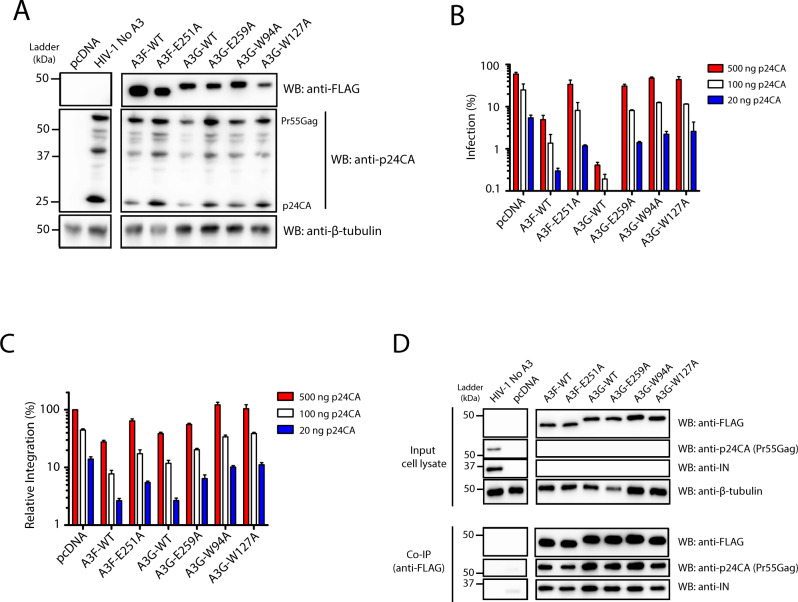
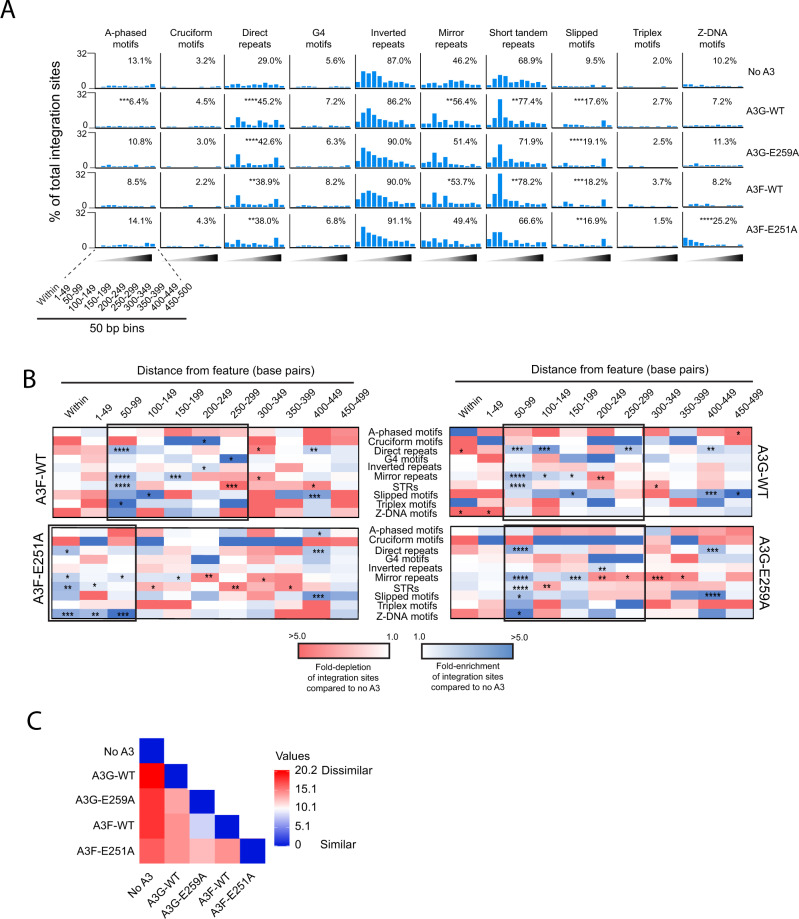
APOBEC3 (A3) proteins are host-encoded deoxycytidine deaminases that provide an innate immune barrier to retroviral infection, notably against HIV-1. Low levels of deamination are believed to contribute to the genetic evolution of HIV-1, while intense catalytic activity of these proteins can induce catastrophic hypermutation in proviral DNA leading to near-total HIV-1 restriction. So far, little is known about how A3 cytosine deaminases might impact HIV-1 proviral DNA integration sites in human chromosomal DNA. Using a deep sequencing approach, we analyze the influence of catalytic active and inactive APOBEC3F and APOBEC3G on HIV-1 integration site selections. Here we show that DNA editing is detected at the extremities of the long terminal repeat regions of the virus. Both catalytic active and non-catalytic A3 mutants decrease insertions into gene coding sequences and increase integration sites into SINE elements, oncogenes and transcription-silencing non-B DNA features. Our data implicates A3 as a host factor influencing HIV-1 integration site selection and also promotes what appears to be a more latent expression profile.
APOBEC3(A3)蛋白是宿主编码的脱氧胞嘧啶脱氨酶,为逆转录病毒感染提供先天免疫屏障,特别是针对 HIV-1。据信,低水平的脱氨作用有助于 HIV-1 的遗传进化,而这些蛋白的强烈催化活性可诱导前病毒 DNA 发生灾难性的超突变,导致 HIV-1 几乎完全受到限制。到目前为止,人们对 A3 胞嘧啶脱氨酶如何影响 HIV-1 前病毒 DNA 整合到人类染色体 DNA 中的位置知之甚少。我们使用深度测序方法分析了催化活性和非活性 APOBEC3F 和 APOBEC3G 对 HIV-1 整合位点选择的影响。在这里,我们表明在病毒的长末端重复区域的末端检测到 DNA 编辑。催化活性和非催化 A3 突变体均减少插入基因编码序列,并增加插入到 SINE 元件、癌基因和转录沉默非 B DNA 特征的整合位点。我们的数据表明 A3 是影响 HIV-1 整合位点选择的宿主因素,并促进了似乎更潜伏的表达谱。