Department of Reproductive Center, Xiangya Hospital, Central South University, Changsha, 410078, Hunan, China.
The Fourth Affiliated Hospital, Zhejiang University School of Medicine, Yiwu, 322000, Zhejiang, China.
Reprod Sci. 2023 Jul;30(7):2177-2187. doi: 10.1007/s43032-022-01159-8. Epub 2023 Jan 10.
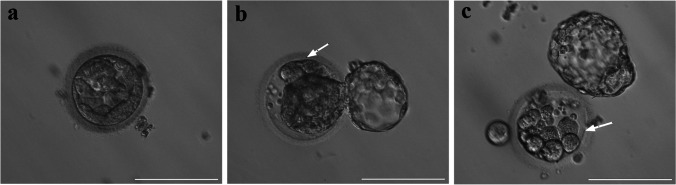
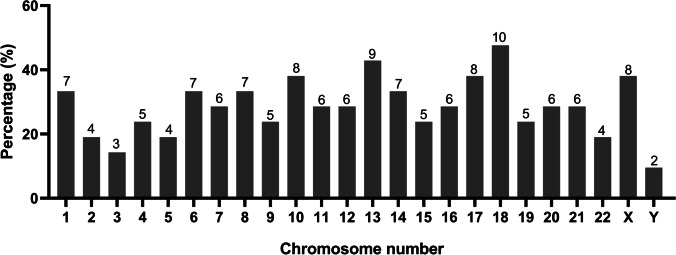
Arrested cells/ cellular debris is component left in the zona pellucida after blastocyst hatching. To identify whether expelling arrested cells/cellular debris from blastocysts is a process of human embryo self-correction by eliminating abnormal cells, 21 pairs of trophectoderm (TE) biopsies and the corresponding arrested cells/cellular debris expelled from the blastocysts from July to December 2020 were collected and analyzed using next-generation sequencing (NGS). Then, the NGS results of TE biopsies and the corresponding arrested cells/cellular debris were compared. We identified that 47.6% of blastocysts (10/21) were aneuploidies and mosaicism. A total of 18 groups of arrested cells/cellular debris (85.7%) expelled from blastocysts were abnormal, including nine aneuploid embryos and nine euploid embryos. In the arrested cells/cellular debris, all the chromosomes were affected. In conclusion, mosaicism and aneuploidies are common features of early embryonic development, and the arrested cells/cellular debris expelled from blastocysts provides evidence of early embryonic self-correction.
被阻滞的细胞/细胞碎片是囊胚孵出后残留在透明带中的成分。为了确定从囊胚中排出被阻滞的细胞/细胞碎片是否是胚胎通过消除异常细胞进行自我修正的过程,我们收集并分析了 2020 年 7 月至 12 月期间 21 对滋养外胚层 (TE) 活检及其相应的从囊胚中排出的被阻滞的细胞/细胞碎片,使用下一代测序 (NGS)。然后,比较了 TE 活检和相应的被阻滞的细胞/细胞碎片的 NGS 结果。我们发现 47.6%(10/21)的囊胚是非整倍体和嵌合体。总共 18 组(85.7%)从囊胚中排出的被阻滞的细胞/细胞碎片是异常的,包括 9 个非整倍体胚胎和 9 个整倍体胚胎。在被阻滞的细胞/细胞碎片中,所有染色体都受到影响。总之,嵌合体和非整倍体是早期胚胎发育的常见特征,从囊胚中排出的被阻滞的细胞/细胞碎片为早期胚胎自我修正提供了证据。