Department of Biology and Ecology, Faculty of Science, University of Ostrava, Ostrava, Czech Republic.
Institute of Microbiology, Academy of Sciences of the Czech Republic, Prague, Czech Republic.
Microbiol Spectr. 2023 Feb 14;11(1):e0316022. doi: 10.1128/spectrum.03160-22. Epub 2023 Jan 11.
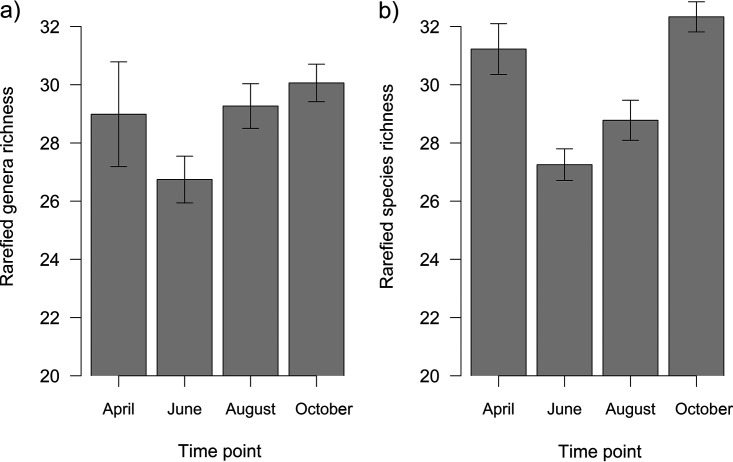
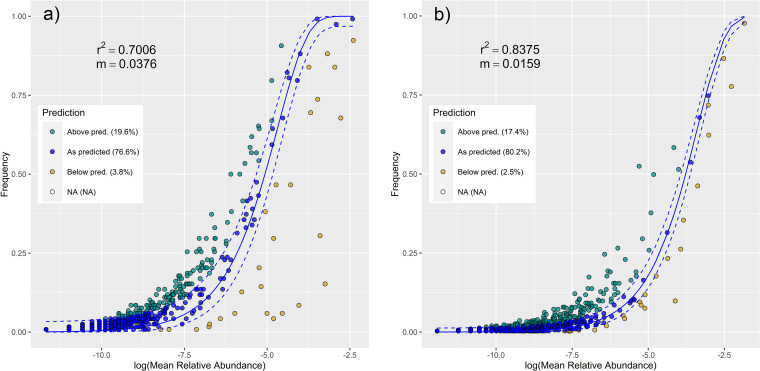
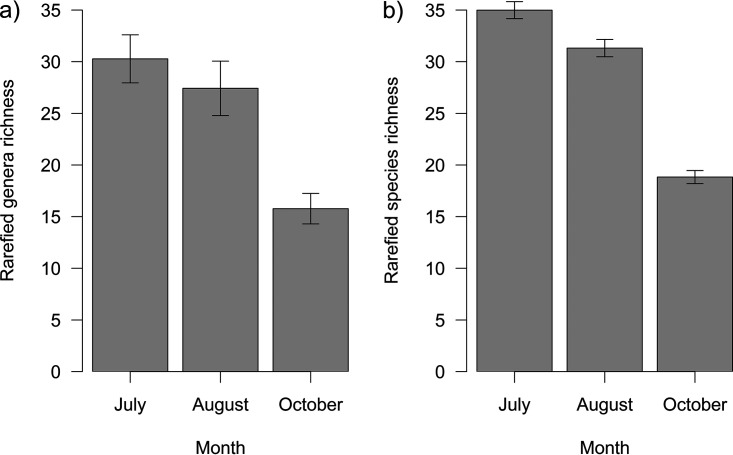
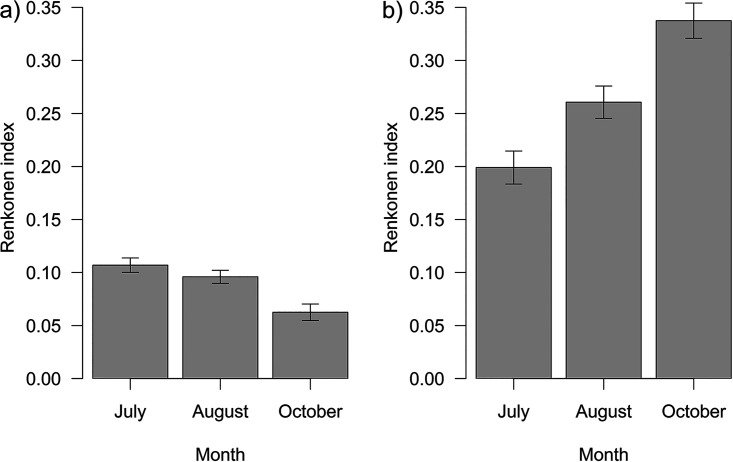
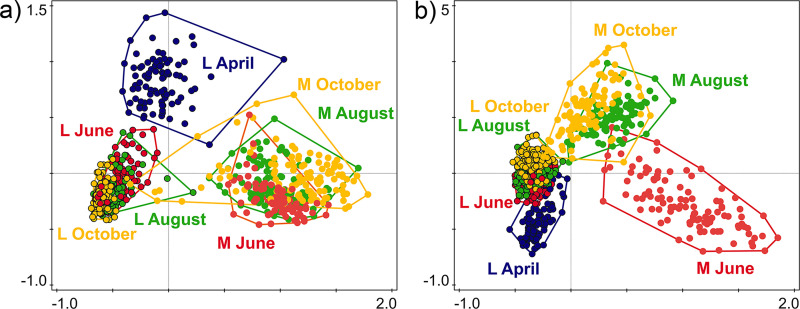
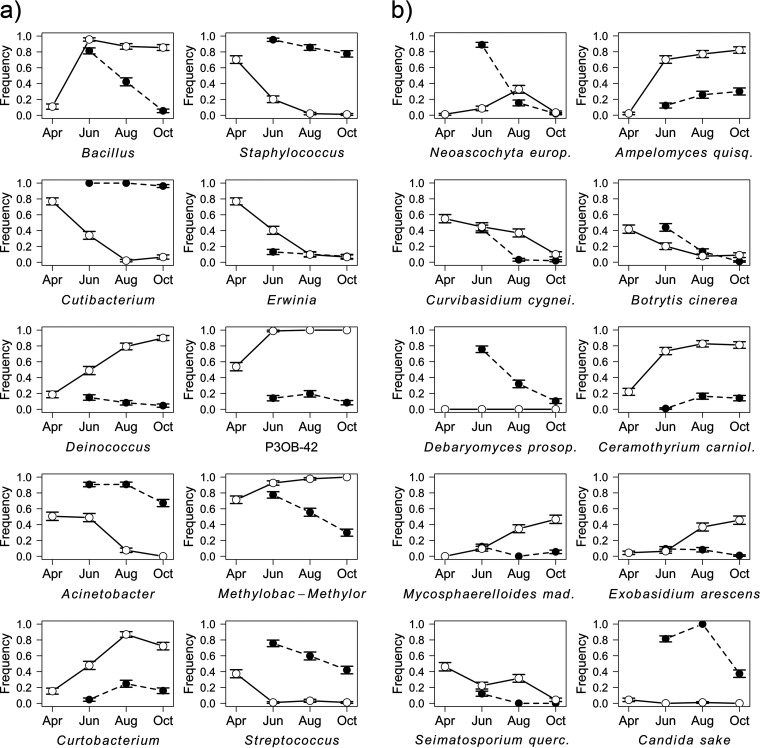
Microorganisms are key mediators of interactions between insect herbivores and their host plants. Despite a substantial interest in studying various aspects of these interactions, temporal variations in microbiomes of woody plants and their consumers remain understudied. In this study, we investigated shifts in the microbiomes of leaf-mining larvae (Insecta: Lepidoptera) and their host trees over one growing season in a deciduous temperate forest. We used 16S and ITS2 rRNA gene metabarcoding to profile the bacterial and fungal microbiomes of leaves and larvae. We found pronounced shifts in the leaf and larval microbiota composition and richness as the season progressed, and bacteria and fungi showed consistent patterns. The quantitative similarity between leaf and larval microbiota was very low for bacteria (9%) and decreased throughout the season, whereas fungal similarity increased and was relatively high (27%). In both leaves and larvae, seasonality, along with host taxonomy, was the most important factor shaping microbial communities. We identified frequently occurring microbial taxa with significant seasonal trends, including those more prevalent in larvae (Streptococcus, Candida sake, Debaryomyces prosopidis, and Neoascochyta europaea), more prevalent in leaves (, Seimatosporium quercinum, Curvibasidium cygneicollum, , Ceramothyrium carniolicum, and Mycosphaerelloides madeirae), and frequent in both leaves and larvae (bacterial strain P3OB-42, , , Acinetobacter, , and Botrytis cinerea). Our results highlight the importance of considering seasonality when studying the interactions between plants, herbivorous insects, and their respective microbiomes, and illustrate a range of microbial taxa persistent in larvae, regardless of their occurrence in the diet. Leaf miners are endophagous insect herbivores that feed on plant tissues and develop and live enclosed between the epidermis layers of a single leaf for their entire life cycle. Such close association is a precondition for the evolution of more intimate host-microbe relationships than those found in free-feeding herbivores. Simultaneous comparison of bacterial and fungal microbiomes of leaves and their tightly linked consumers over time represents an interesting study system that could fundamentally contribute to the ongoing debate on the microbial residence of insect gut. Furthermore, leaf miners are ideal model organisms for interpreting the ecological and evolutionary roles of microbiota in host plant specialization. In this study, the larvae harbored specific microbial communities consisting of core microbiome members. Observed patterns suggest that microbes, especially bacteria, may play more important roles in the caterpillar holobiont than generally presumed.
微生物是昆虫食草动物与其宿主植物之间相互作用的关键介质。尽管人们对研究这些相互作用的各个方面有着浓厚的兴趣,但木质植物及其消费者的微生物组的时间变化仍未得到充分研究。在这项研究中,我们调查了落叶温带森林中一个生长季节内,潜叶虫(昆虫纲:鳞翅目)及其宿主树木的微生物组的变化。我们使用 16S 和 ITS2 rRNA 基因宏条形码来描述叶片和幼虫的细菌和真菌微生物组。我们发现,随着季节的推进,叶片和幼虫微生物群落组成和丰富度发生了明显变化,细菌和真菌表现出一致的模式。叶片和幼虫之间的微生物组的定量相似性对于细菌(9%)非常低,并且整个季节都在下降,而真菌的相似性增加并且相对较高(27%)。在叶片和幼虫中,季节性以及宿主分类学是塑造微生物群落的最重要因素。我们确定了具有显著季节性趋势的经常出现的微生物类群,包括在幼虫中更为普遍的类群(链球菌,假丝酵母,德巴利酵母和欧洲新壳球孢菌),在叶片中更为普遍的类群(,栎生壳多孢菌,,冠囊腔菌,,喀麦隆丝核菌和皮落青霉),以及在叶片和幼虫中都很常见的类群(细菌菌株 P3OB-42,,,不动杆菌,,和灰葡萄孢菌)。我们的结果强调了在研究植物,食草昆虫及其各自微生物组之间的相互作用时考虑季节性的重要性,并说明了在幼虫中持续存在的一系列微生物类群,而不论它们是否存在于饮食中。
潜叶虫是内食性昆虫食草动物,它们以植物组织为食,并在整个生命周期中在单个叶片的表皮层之间发育和生活。这种紧密的联系是比自由取食的食草动物中发现的更密切的宿主-微生物关系进化的前提条件。随着时间的推移,同时比较叶片及其紧密相关的消费者的细菌和真菌微生物组,代表了一个有趣的研究系统,可以从根本上促进关于昆虫肠道中微生物居留的持续争论。此外,潜叶虫是解释微生物组在宿主植物特化中的生态和进化作用的理想模型生物。在这项研究中,幼虫体内存在特定的微生物群落,由核心微生物组成。观察到的模式表明,微生物,特别是细菌,可能在毛虫的整体生物中发挥比通常假定的更重要的作用。