Plain Zoe, Voliotis Margaritis, McArdle Craig A, Tsaneva-Atanasova Krasimira
Department of Mathematics and Living Systems Institute, College of Engineering, Mathematics and Physical Sciences, University of Exeter, Exeter, UK.
University of Bristol, Bristol, UK.
Curr Opin Endocr Metab Res. 2022 Dec;27:100407. doi: 10.1016/j.coemr.2022.100407.
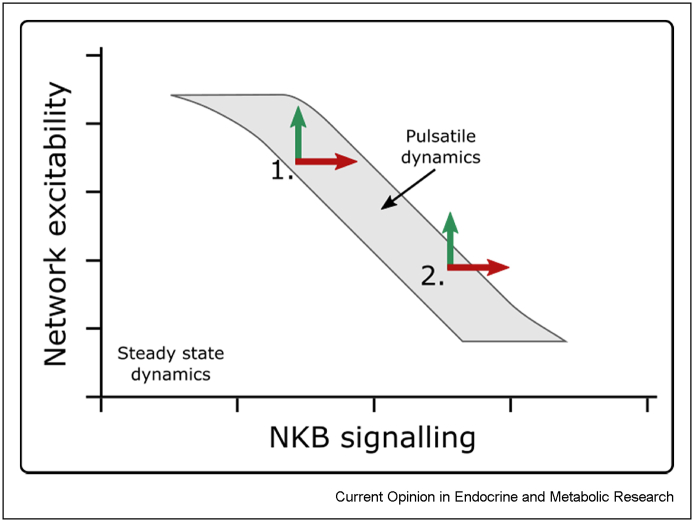
The pulsatile release of gonadotropin-releasing hormone (GnRH) and its frequency are crucial for healthy reproductive function. To understand what drives GnRH pulses, a combination of experimental and mathematical modelling approaches has been used. Early work focussed on the possibility that GnRH pulse generation is an intrinsic feature of GnRH neurons, with autocrine feedback generating pulsatility. However, there is now ample evidence suggesting that a network of upstream neurons secreting kisspeptin, neurokinin-B and dynorphin are the source of this GnRH pulse generator. The interplay of slow positive and negative feedback via neurokinin-B and dynorphin, respectively, allows the network to act as a relaxation oscillator, driving pulsatile secretion of kisspeptin, and consequently, of GnRH and LH. Here, we review the mathematical modelling approaches exploring both scenarios and suggest that with pulsatile GnRH secretion driven by the KNDy pulse generator, autocrine feedback still has the potential to modulate GnRH output.
促性腺激素释放激素(GnRH)的脉冲式释放及其频率对健康的生殖功能至关重要。为了了解驱动GnRH脉冲的因素,人们采用了实验和数学建模方法相结合的方式。早期的研究集中在GnRH脉冲产生是GnRH神经元的固有特征这一可能性上,即自分泌反馈产生脉冲性。然而,现在有充分的证据表明,分泌 kisspeptin、神经激肽B和强啡肽的上游神经元网络是这种GnRH脉冲发生器的来源。分别通过神经激肽B和强啡肽的缓慢正反馈和负反馈的相互作用,使该网络能够作为一个弛豫振荡器,驱动kisspeptin的脉冲式分泌,进而驱动GnRH和促黄体生成素(LH)的脉冲式分泌。在此,我们回顾了探索这两种情况的数学建模方法,并表明在由KNDy脉冲发生器驱动GnRH脉冲式分泌的情况下,自分泌反馈仍有可能调节GnRH的输出。