• 文献检索
  • 文档翻译
  • 深度研究
  • 学术资讯
  • Suppr Zotero 插件Zotero 插件
  • 邀请有礼
  • 套餐&价格
  • 历史记录
应用&插件
Suppr Zotero 插件Zotero 插件浏览器插件Mac 客户端Windows 客户端微信小程序
定价
高级版会员购买积分包购买API积分包
服务
文献检索文档翻译深度研究API 文档MCP 服务
关于我们
关于 Suppr公司介绍联系我们用户协议隐私条款
关注我们

Suppr 超能文献

核心技术专利:CN118964589B侵权必究
粤ICP备2023148730 号-1Suppr @ 2026

文献检索

告别复杂PubMed语法,用中文像聊天一样搜索,搜遍4000万医学文献。AI智能推荐,让科研检索更轻松。

立即免费搜索

文件翻译

保留排版,准确专业,支持PDF/Word/PPT等文件格式,支持 12+语言互译。

免费翻译文档

深度研究

AI帮你快速写综述,25分钟生成高质量综述,智能提取关键信息,辅助科研写作。

立即免费体验

系统评价和荟萃分析 ACEI/ARB 在东亚 COVID-19 患者中的临床结局。

Systematic review and meta-analysis of the clinical outcomes of ACEI/ARB in East-Asian patients with COVID-19.

机构信息

Department of Cardiology, Affiliated Hangzhou First People's Hospital, Zhejiang University School of Medicine, Hangzhou, China.

Research Division, Institute of Mental Health, Singapore, Singapore.

出版信息

PLoS One. 2023 Jan 12;18(1):e0280280. doi: 10.1371/journal.pone.0280280. eCollection 2023.

DOI:10.1371/journal.pone.0280280
PMID:36634085
原文链接:https://pmc.ncbi.nlm.nih.gov/articles/PMC9836310/
Abstract

BACKGROUND

SARS-CoV-2 invades human cells and leads to COVID-19 by direct associating with angiotensin converting enzyme 2 (ACE2) receptors, the level of which may be increased by treatment with angiotensin-converting enzyme inhibitors (ACEIs) and/or angiotensin receptor blockers (ARBs). This meta-analysis aimed to explore the impact of ACEI/ARB treatment on the clinical outcomes of patients with COVID-19 infections among population in the East-Asia region.

METHODS

We collected clinical data published from January 2000 to May 2022 in the English databases including PubMed, Embase, and the Cochrane Library. Two reviewers independently screened and identified studies that met the prespecified criteria. Review Manager 5.3 software was used to perform the meta-analysis.

RESULTS

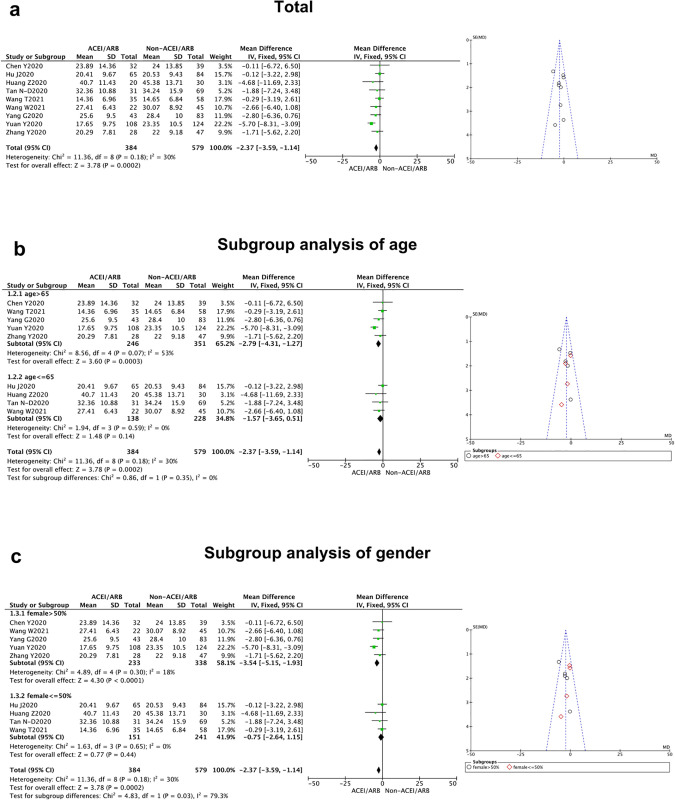
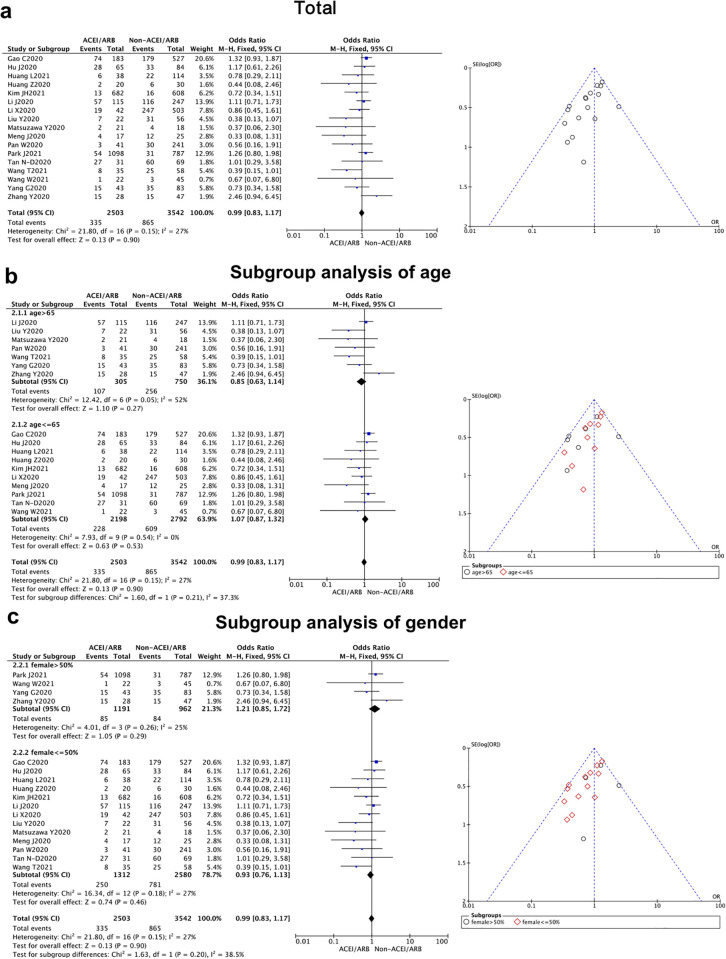
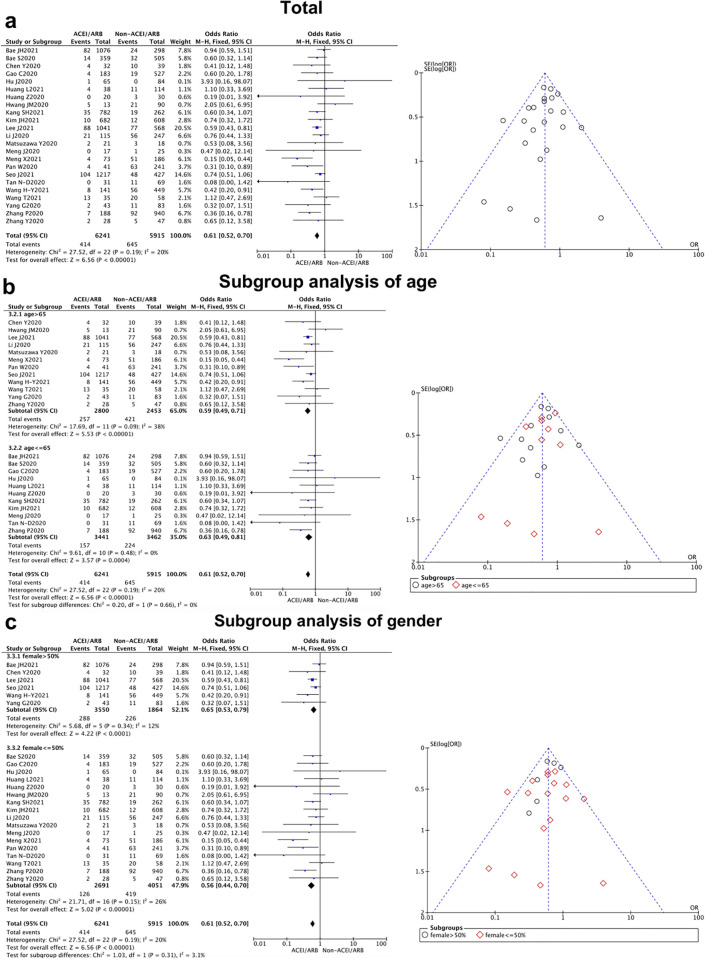
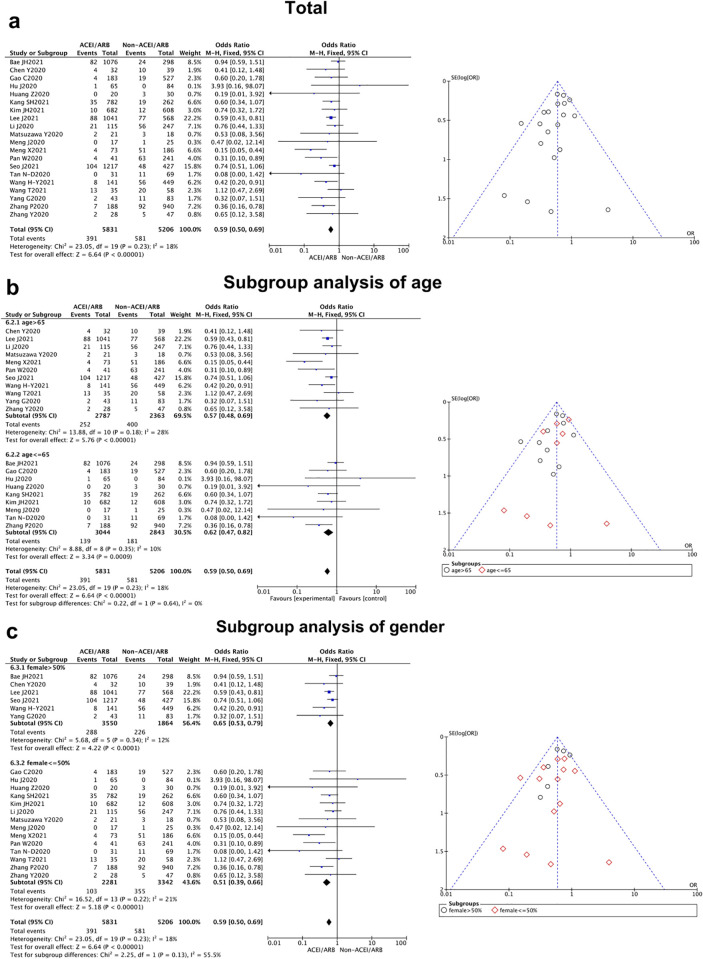
A total of 28 articles were included in this analysis. The results showed that patients who were prescribed with ACEI/ARB had a shorter duration of hospital stay [MD = -2.37, 95%CI (-3.59, -1.14), P = 0.000 2] and a lower mortality rate [OR = 0.61, 95% CI (0.52, 0.70), P<0.000 01] than patients who were not on ACEI/ARB. Furthermore, there was no statistically significant difference in disease severity [OR = 0.99, 95% CI (0.83, 1.17), P = 0.90] between individuals receiving ACEI/ARB or not.

CONCLUSIONS

This meta-analysis suggested that the use of ACEI/ARB was not associated with adverse clinical outcomes in East-Asian Covid-19 patients and a reduced mortality and shorter duration of hospital stay among East-Asian population (especially for female subjects) was found. Thus, ACEI/ARB should be continued in patients infected by Covid-19.

摘要

背景

SARS-CoV-2 通过直接与血管紧张素转换酶 2(ACE2)受体结合而入侵人体细胞,并导致 COVID-19,ACE2 受体的水平可能会因血管紧张素转换酶抑制剂(ACEI)和/或血管紧张素受体阻滞剂(ARB)的治疗而增加。本荟萃分析旨在探讨 ACEI/ARB 治疗对东亚地区人群 COVID-19 感染患者临床结局的影响。

方法

我们收集了 2000 年 1 月至 2022 年 5 月在英文数据库(包括 PubMed、Embase 和 Cochrane Library)发表的临床数据。两名评审员独立筛选并确定符合预设标准的研究。使用 Review Manager 5.3 软件进行荟萃分析。

结果

共有 28 篇文章纳入本分析。结果显示,与未服用 ACEI/ARB 的患者相比,服用 ACEI/ARB 的患者住院时间更短[MD=-2.37,95%CI(-3.59,-1.14),P=0.0002],死亡率更低[OR=0.61,95%CI(0.52,0.70),P<0.00001]。此外,服用 ACEI/ARB 与未服用 ACEI/ARB 的患者之间疾病严重程度无统计学差异[OR=0.99,95%CI(0.83,1.17),P=0.90]。

结论

本荟萃分析表明,ACEI/ARB 的使用与东亚 COVID-19 患者的不良临床结局无关,并且在东亚人群(尤其是女性)中发现死亡率降低和住院时间缩短。因此,感染 COVID-19 的患者应继续使用 ACEI/ARB。

https://cdn.ncbi.nlm.nih.gov/pmc/blobs/8d7f/9836310/7d5f271b711c/pone.0280280.g006.jpg
https://cdn.ncbi.nlm.nih.gov/pmc/blobs/8d7f/9836310/32dba508dd4e/pone.0280280.g001.jpg
https://cdn.ncbi.nlm.nih.gov/pmc/blobs/8d7f/9836310/3d349bbbbb88/pone.0280280.g002.jpg
https://cdn.ncbi.nlm.nih.gov/pmc/blobs/8d7f/9836310/4090b088036d/pone.0280280.g003.jpg
https://cdn.ncbi.nlm.nih.gov/pmc/blobs/8d7f/9836310/77d844701c45/pone.0280280.g004.jpg
https://cdn.ncbi.nlm.nih.gov/pmc/blobs/8d7f/9836310/fac6ef4fa72c/pone.0280280.g005.jpg
https://cdn.ncbi.nlm.nih.gov/pmc/blobs/8d7f/9836310/7d5f271b711c/pone.0280280.g006.jpg
https://cdn.ncbi.nlm.nih.gov/pmc/blobs/8d7f/9836310/32dba508dd4e/pone.0280280.g001.jpg
https://cdn.ncbi.nlm.nih.gov/pmc/blobs/8d7f/9836310/3d349bbbbb88/pone.0280280.g002.jpg
https://cdn.ncbi.nlm.nih.gov/pmc/blobs/8d7f/9836310/4090b088036d/pone.0280280.g003.jpg
https://cdn.ncbi.nlm.nih.gov/pmc/blobs/8d7f/9836310/77d844701c45/pone.0280280.g004.jpg
https://cdn.ncbi.nlm.nih.gov/pmc/blobs/8d7f/9836310/fac6ef4fa72c/pone.0280280.g005.jpg
https://cdn.ncbi.nlm.nih.gov/pmc/blobs/8d7f/9836310/7d5f271b711c/pone.0280280.g006.jpg

相似文献

1
Systematic review and meta-analysis of the clinical outcomes of ACEI/ARB in East-Asian patients with COVID-19.系统评价和荟萃分析 ACEI/ARB 在东亚 COVID-19 患者中的临床结局。
PLoS One. 2023 Jan 12;18(1):e0280280. doi: 10.1371/journal.pone.0280280. eCollection 2023.
2
The use of renin-angiotensin-aldosterone system (RAAS) inhibitors is associated with a lower risk of mortality in hypertensive COVID-19 patients: A systematic review and meta-analysis.血管紧张素转化酶抑制剂(ACEI)和血管紧张素Ⅱ受体拮抗剂(ARB)类药物的使用与高血压合并 COVID-19 患者的死亡率降低相关:系统评价和荟萃分析。
J Med Virol. 2021 Mar;93(3):1370-1377. doi: 10.1002/jmv.26625. Epub 2020 Nov 10.
3
Does taking an angiotensin inhibitor increase the risk for COVID-19? - a systematic review and meta-analysis.服用血管紧张素抑制剂会增加 COVID-19 的风险吗?——系统评价和荟萃分析。
Aging (Albany NY). 2021 Apr 22;13(8):10853-10865. doi: 10.18632/aging.202902.
4
ACEI/ARB use and risk of infection or severity or mortality of COVID-19: A systematic review and meta-analysis.血管紧张素转换酶抑制剂/血管紧张素Ⅱ受体拮抗剂的使用与 COVID-19 感染或严重程度或死亡率风险:系统评价和荟萃分析。
Pharmacol Res. 2020 Aug;158:104927. doi: 10.1016/j.phrs.2020.104927. Epub 2020 May 15.
5
Effect of continuing the use of renin-angiotensin system inhibitors on mortality in patients hospitalized for coronavirus disease 2019: a systematic review, meta-analysis, and meta-regression analysis.连续使用肾素-血管紧张素系统抑制剂对因 2019 年冠状病毒病住院患者死亡率的影响:系统评价、荟萃分析和荟萃回归分析。
BMC Infect Dis. 2023 Jan 24;23(1):53. doi: 10.1186/s12879-023-07994-7.
6
A systematic review and meta-analysis to evaluate the clinical outcomes in COVID-19 patients on angiotensin-converting enzyme inhibitors or angiotensin receptor blockers.系统评价和荟萃分析评估 COVID-19 患者使用血管紧张素转换酶抑制剂或血管紧张素受体阻滞剂的临床结局。
Eur Heart J Cardiovasc Pharmacother. 2021 Mar 15;7(2):148-157. doi: 10.1093/ehjcvp/pvaa064.
7
Meta-analysis of the association between angiotensin pathway inhibitors and COVID-19 severity and mortality.血管紧张素通路抑制剂与 COVID-19 严重程度和死亡率的关联的荟萃分析。
Syst Rev. 2021 Sep 7;10(1):243. doi: 10.1186/s13643-021-01802-6.
8
Angiotensin converting enzyme inhibitors and angiotensin II receptor blockers and outcomes in patients with COVID-19: a systematic review and meta-analysis.血管紧张素转化酶抑制剂和血管紧张素 II 受体阻滞剂与 COVID-19 患者结局的关系:系统评价和荟萃分析。
Expert Rev Cardiovasc Ther. 2020 Dec;18(12):919-930. doi: 10.1080/14779072.2020.1826308. Epub 2020 Oct 5.
9
The divergent protective effects of angiotensin-converting enzyme inhibitors and angiotensin receptor blockers on clinical outcomes of coronavirus disease 2019 (COVID-19): a systematic review and meta-analysis.血管紧张素转换酶抑制剂和血管紧张素受体阻滞剂对 2019 冠状病毒病(COVID-19)临床结局的不同保护作用:系统评价和荟萃分析。
Ann Palliat Med. 2022 Apr;11(4):1253-1263. doi: 10.21037/apm-21-972. Epub 2021 Nov 4.
10
Safety of ACEi and ARB in COVID-19 management: A retrospective analysis.ACEi 和 ARB 在 COVID-19 管理中的安全性:回顾性分析。
Clin Cardiol. 2022 Jul;45(7):759-766. doi: 10.1002/clc.23836. Epub 2022 Apr 28.

引用本文的文献

1
Potential therapeutic and ameliorative effects of ramipril alone and in combination with methylprednisolone for the cytokine releasing syndrome in mice: An in vivo study.雷米普利单独及与甲泼尼龙联合应用对小鼠细胞因子释放综合征的潜在治疗和改善作用:一项体内研究。
Naunyn Schmiedebergs Arch Pharmacol. 2025 May;398(5):5845-5865. doi: 10.1007/s00210-024-03659-7. Epub 2024 Nov 30.
2
Impact of prior antihypertensive treatment on COVID-19 outcomes, by active ingredient.根据活性成分,既往降压治疗对 COVID-19 结局的影响。
Inflammopharmacology. 2024 Jun;32(3):1805-1815. doi: 10.1007/s10787-024-01475-2. Epub 2024 Apr 15.
3

本文引用的文献

1
Impact of Angiotensin-Converting Enzyme Inhibitors and Angiotensin Receptor Blockers on the Inflammatory Response and Viral Clearance in COVID-19 Patients.血管紧张素转换酶抑制剂和血管紧张素受体阻滞剂对COVID-19患者炎症反应和病毒清除的影响
Front Cardiovasc Med. 2021 Aug 19;8:710946. doi: 10.3389/fcvm.2021.710946. eCollection 2021.
2
Distinct Regulation of U-ACE2 and P-ACE2 (Urinary and Plasma Angiotensin-Converting Enzyme 2) in a Japanese General Population.在日本普通人群中 U-ACE2 和 P-ACE2(尿和血浆血管紧张素转换酶 2)的不同调节。
Hypertension. 2021 Sep;78(4):1138-1149. doi: 10.1161/HYPERTENSIONAHA.121.17674. Epub 2021 Aug 23.
3
Association between angiotensin-converting enzyme inhibitor-induced cough and the risk of lung cancer: a Mendelian randomization study.
血管紧张素转换酶抑制剂所致咳嗽与肺癌风险之间的关联:一项孟德尔随机化研究
Front Pharmacol. 2023 Sep 20;14:1267924. doi: 10.3389/fphar.2023.1267924. eCollection 2023.
4
The Renin-Angiotensin System in COVID-19: Can Long COVID Be Predicted?新冠病毒感染中的肾素-血管紧张素系统:能否预测长期新冠症状?
Life (Basel). 2023 Jun 28;13(7):1462. doi: 10.3390/life13071462.
5
Angiotensin-converting enzyme 2 (ACE2) polymorphisms and susceptibility of severe SARS-CoV-2 in a subset of Pakistani population.血管紧张素转化酶 2(ACE2)多态性与巴基斯坦部分人群严重 SARS-CoV-2 易感性的关系。
Virol J. 2023 Jun 12;20(1):120. doi: 10.1186/s12985-023-02091-2.
6
Atherosclerosis, Cardiovascular Disease, and COVID-19: A Narrative Review.动脉粥样硬化、心血管疾病与2019冠状病毒病:一篇叙述性综述
Biomedicines. 2023 Apr 18;11(4):1206. doi: 10.3390/biomedicines11041206.
7
Phase angle and COVID-19: A systematic review with meta-analysis.相位角与 COVID-19:系统评价与荟萃分析。
Rev Endocr Metab Disord. 2023 Jun;24(3):525-542. doi: 10.1007/s11154-023-09793-6. Epub 2023 Mar 24.
Renin-angiotensin system inhibitor is associated with the reduced risk of all-cause mortality in COVID-19 among patients with/without hypertension.
肾素-血管紧张素系统抑制剂与 COVID-19 合并/不合并高血压患者全因死亡率降低相关。
Front Med. 2022 Feb;16(1):102-110. doi: 10.1007/s11684-021-0850-9. Epub 2021 Jul 9.
4
Hypertension, renin-angiotensin-aldosterone-system-blocking agents, and COVID-19.高血压、肾素-血管紧张素-醛固酮系统阻断剂与2019冠状病毒病
Clin Hypertens. 2021 Jun 1;27(1):11. doi: 10.1186/s40885-021-00168-0.
5
Predictors of fatal outcomes among hospitalized COVID-19 patients with pre-existing hypertension in China.中国住院 COVID-19 合并高血压患者的死亡结局预测因素。
Clin Respir J. 2021 Aug;15(8):915-924. doi: 10.1111/crj.13382. Epub 2021 May 20.
6
Effect of renin-angiotensin-aldosterone system inhibitors on Covid-19 patients in Korea.肾素-血管紧张素-醛固酮系统抑制剂对韩国新冠病毒(COVID-19)患者的影响。
PLoS One. 2021 Mar 11;16(3):e0248058. doi: 10.1371/journal.pone.0248058. eCollection 2021.
7
Hypertension in Patients Hospitalized with COVID-19 in Wuhan, China.中国武汉 COVID-19 住院患者的高血压。
Int Heart J. 2021 Mar 30;62(2):337-343. doi: 10.1536/ihj.20-323. Epub 2021 Mar 6.
8
Use of Renin-Angiotensin-Aldosterone System Inhibitors and Severe COVID-19 Outcomes in Patients with Hypertension: A Nationwide Cohort Study.血管紧张素-肾素-醛固酮系统抑制剂在高血压患者中的使用与严重 COVID-19 结局:一项全国性队列研究。
Diabetes Metab J. 2021 May;45(3):430-438. doi: 10.4093/dmj.2020.0279. Epub 2021 Feb 22.
9
Angiotensin-converting enzyme inhibitors (ACEI) or angiotensin receptor blockers (ARBs) may be safe for COVID-19 patients.血管紧张素转化酶抑制剂(ACEI)或血管紧张素受体阻滞剂(ARB)可能对 COVID-19 患者是安全的。
BMC Infect Dis. 2021 Jan 25;21(1):114. doi: 10.1186/s12879-021-05821-5.
10
Clinical outcomes of COVID-19 following the use of angiotensin-converting enzyme inhibitors or angiotensin-receptor blockers among patients with hypertension in Korea: a nationwide study.韩国高血压患者使用血管紧张素转换酶抑制剂或血管紧张素受体阻滞剂后 COVID-19 的临床结局:一项全国性研究。
Epidemiol Health. 2021;43:e2021004. doi: 10.4178/epih.e2021004. Epub 2020 Dec 29.