Collaborative Innovation Center for Diagnosis and Treatment of Infectious Diseases, State Key Laboratory for Diagnosis and Treatment of Infectious Diseases, The First Affiliated Hospital, School of Medicine, Zhejiang University, Hangzhou, Zhejiang, China.
Collaborative Innovation Center for Diagnosis and Treatment of Infectious Diseases, State Key Laboratory for Diagnosis and Treatment of Infectious Diseases, The First Affiliated Hospital, School of Medicine, Zhejiang University, Hangzhou, Zhejiang, China.
Pharmacol Res. 2020 Aug;158:104927. doi: 10.1016/j.phrs.2020.104927. Epub 2020 May 15.
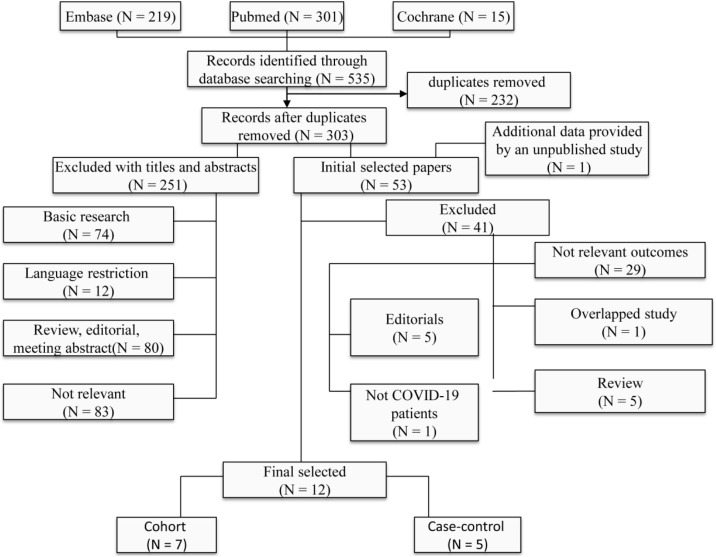
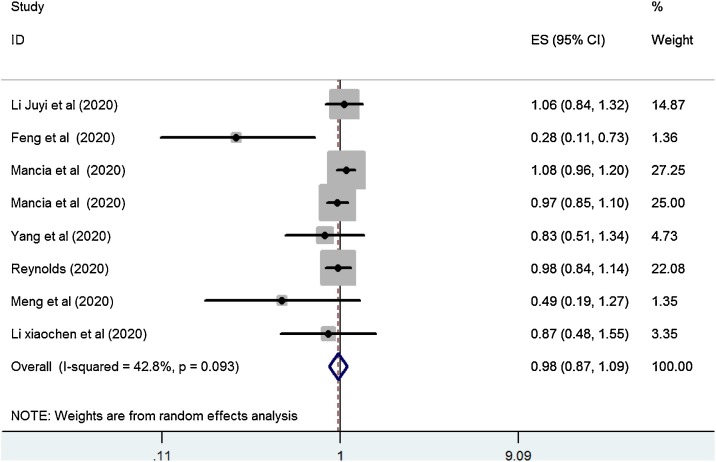
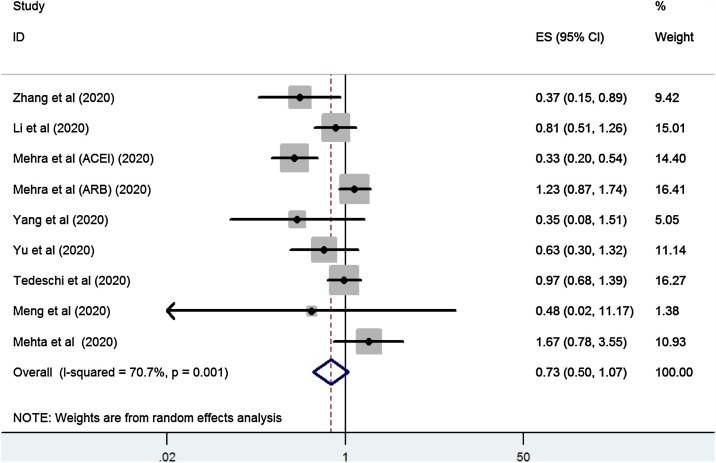
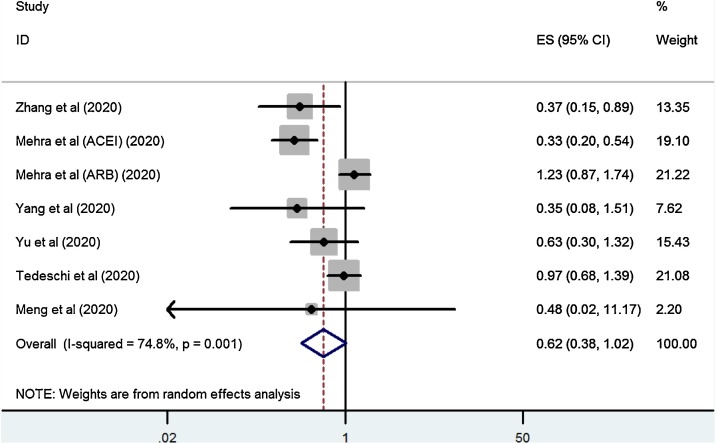
The effects of angiotensin-converting enzyme inhibitors (ACEIs) and angiotensin receptor blockers (ARBs) on the risk of COVID-19 infection and disease progression are yet to be investigated. The relationship between ACEI/ARB use and COVID-19 infection was systematically reviewed. To identify relevant studies that met predetermined inclusion criteria, unrestricted searches of the PubMed, Embase, and Cochrane Library databases were conducted. The search strategy included clinical date published until May 9, 2020. Twelve articles involving more than 19,000 COVID-19 cases were included. To estimate overall risk, random-effects models were adopted. Our results showed that ACEI/ARB exposure was not associated with a higher risk of COVID-19 infection (OR = 0.99; 95 % CI, 0-1.04; P = 0.672). Among those with COVID-19 infection, ACEI/ARB exposure was also not associated with a higher risk of having severe infection (OR = 0.98; 95 % CI, 0.87-1.09; P = 0.69) or mortality (OR = 0.73, 95 %CI, 0.5-1.07; P = 0.111). However, ACEI/ARB exposure was associated with a lower risk of mortality compared to those on non-ACEI/ARB antihypertensive drugs (OR = 0.48, 95 % CI, 0.29-0.81; P = 0.006). In conclusion, current evidence did not confirm the concern that ACEI/ARB exposure is harmful in patientswith COVID-19 infection. This study supports the current guidelines that discourage discontinuation of ACEIs or ARBs in COVID-19 patients and the setting of the COVID-19 pandemic.
血管紧张素转换酶抑制剂(ACEI)和血管紧张素受体阻滞剂(ARB)对 COVID-19 感染和疾病进展风险的影响尚未得到研究。系统回顾了 ACEI/ARB 使用与 COVID-19 感染之间的关系。为了确定符合预定纳入标准的相关研究,对 PubMed、Embase 和 Cochrane Library 数据库进行了无限制搜索。搜索策略包括截至 2020 年 5 月 9 日发表的临床数据。纳入了 12 篇涉及超过 19000 例 COVID-19 病例的文章。为了估计总体风险,采用了随机效应模型。我们的结果表明,ACEI/ARB 暴露与 COVID-19 感染的风险增加无关(OR = 0.99;95 % CI,0-1.04;P = 0.672)。在 COVID-19 感染者中,ACEI/ARB 暴露与严重感染的风险增加也无关(OR = 0.98;95 % CI,0.87-1.09;P = 0.69)或死亡率(OR = 0.73,95 %CI,0.5-1.07;P = 0.111)。然而,与使用非 ACEI/ARB 降压药的患者相比,ACEI/ARB 暴露与死亡率降低相关(OR = 0.48,95 % CI,0.29-0.81;P = 0.006)。总之,目前的证据并未证实 ACEI/ARB 暴露对 COVID-19 感染患者有害的担忧。本研究支持目前的指南,即不鼓励在 COVID-19 患者中停用 ACEI 或 ARB,并在 COVID-19 大流行期间设置。