Department Neurophysics, Philipps-Universität Marburg, 35043 Marburg, Germany
Center for Mind, Brain and Behavior (CMBB), Philipps-Universität Marburg and Justus-Liebig-Universität Giessen, Hans-Meerwein-Straße 6, 35032 Marburg, Germany.
eNeuro. 2022 Dec 20;9(6). doi: 10.1523/ENEURO.0137-21.2022. Print 2022 Nov-Dec.
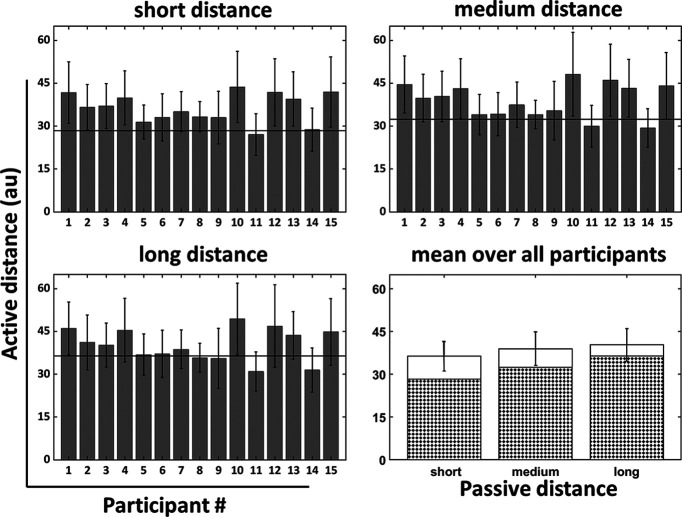
Navigating through an environment requires knowledge about one's direction of self-motion (heading) and traveled distance. Behavioral studies showed that human participants can actively reproduce a previously observed travel distance purely based on visual information. Here, we employed electroencephalography (EEG) to investigate the underlying neural processes. We measured, in human observers, event-related potentials (ERPs) during visually simulated straight-forward self-motion across a ground plane. The participants' task was to reproduce (active condition) double the distance of a previously seen self-displacement (passive condition) using a gamepad. We recorded the trajectories of self-motion during the active condition and played it back to the participants in a third set of trials (replay condition). We analyzed EEG activity separately for four electrode clusters: frontal (F), central (C), parietal (P), and occipital (O). When aligned to self-motion onset or offset, response modulation of the ERPs was stronger, and several ERP components had different latencies in the passive as compared with the active condition. This result is in line with the concept of predictive coding, which implies modified neural activation for self-induced versus externally induced sensory stimulation. We aligned our data also to the times when subjects passed the (objective) single distance d_obj and the (subjective) single distance d_sub. Remarkably, wavelet-based temporal-frequency analyses revealed enhanced theta-band activation for F, P, and O-clusters shortly before passing d_sub. This enhanced activation could be indicative of a navigation related representation of subjective distance. More generally, our study design allows to investigate subjective perception without interfering neural activation because of the required response action.
在环境中导航需要了解自身运动方向(航向)和已行驶距离。行为研究表明,人类参与者可以仅基于视觉信息主动再现先前观察到的行驶距离。在此,我们采用脑电图(EEG)来研究潜在的神经过程。我们在人类观察者中测量了在视觉模拟的水平面上直线自我运动期间的事件相关电位(ERP)。参与者的任务是使用游戏手柄再现(主动条件)先前看到的自我位移的两倍距离(被动条件)。我们在主动条件下记录了自我运动的轨迹,并在第三组试验(重放条件)中向参与者播放。我们分别分析了四个电极簇的 EEG 活动:额(F)、中央(C)、顶(P)和枕(O)。当与自我运动开始或结束对齐时,ERP 的响应调制更强,并且在被动条件下,几个 ERP 成分的潜伏期与主动条件不同。这一结果与预测编码的概念一致,该概念意味着自我引起的神经激活与外部引起的感官刺激不同。我们还将数据与受试者通过(客观)单个距离 d_obj 和(主观)单个距离 d_sub 的时间对齐。值得注意的是,基于小波的时频分析显示,在接近通过 d_sub 之前,F、P 和 O 簇的θ带激活增强。这种增强的激活可能表明主观距离的导航相关表示。更一般地说,我们的研究设计允许在不干扰由于所需响应动作而引起的神经激活的情况下研究主观感知。