UCL Institute of Ophthalmology, University College London, London EC1V 9EL, UK; Neuroscience Paris-Seine - Institut de biologie Paris-Seine, Sorbonne Universités, INSERM, CNRS, Paris, France; Laboratoire des systèmes perceptifs, DEC, ENS, PSL University, CNRS, 75005 Paris, France.
UCL Institute of Ophthalmology, University College London, London EC1V 9EL, UK; UCL Institute of Behavioural Neuroscience, Department of Experimental Psychology, University College London, London WC1H 0AP, UK.
Curr Biol. 2020 Oct 5;30(19):3811-3817.e6. doi: 10.1016/j.cub.2020.07.006. Epub 2020 Aug 6.
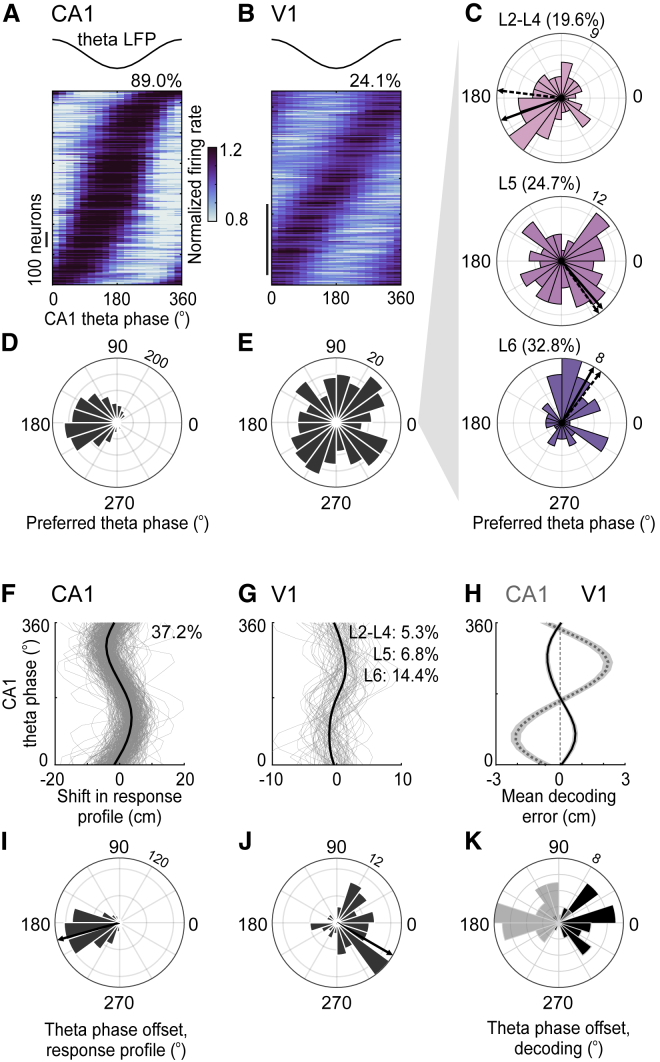
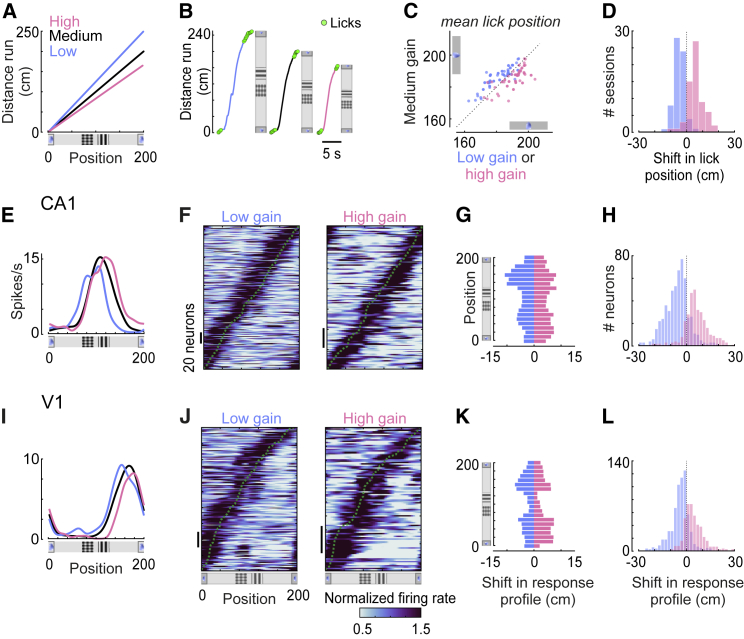
The visual responses of neurons in the primary visual cortex (V1) are influenced by the animal's position in the environment [1-5]. V1 responses encode positions that co-fluctuate with those encoded by place cells in hippocampal area CA1 [2, 5]. This correlation might reflect a common influence of non-visual spatial signals on both areas. Place cells in CA1, indeed, do not rely only on vision; their place preference depends on the physical distance traveled [6-11] and on the phase of the 6-9 Hz theta oscillation [12, 13]. Are V1 responses similarly influenced by these non-visual factors? We recorded V1 and CA1 neurons simultaneously while mice performed a spatial task in a virtual corridor by running on a wheel and licking at a reward location. By changing the gain that couples the wheel movement to the virtual environment, we found that ∼20% of V1 neurons were influenced by the physical distance traveled, as were ∼40% of CA1 place cells. Moreover, the firing rate of ∼24% of V1 neurons was modulated by the phase of theta oscillations recorded in CA1 and the response profiles of ∼7% of V1 neurons shifted spatially across the theta cycle, analogous to the phase precession observed in ∼37% of CA1 place cells. The influence of theta oscillations on V1 responses was more prominent in putative layer 6. These results reveal that, in a familiar environment, sensory processing in V1 is modulated by the key non-visual signals that influence spatial coding in the hippocampus.
初级视皮层(V1)神经元的视觉反应受到动物在环境中位置的影响[1-5]。V1 反应编码与海马 CA1 区位置细胞编码的位置共同波动的位置[2,5]。这种相关性可能反映了非视觉空间信号对这两个区域的共同影响。事实上,CA1 中的位置细胞不仅依赖于视觉;它们的位置偏好取决于行驶的物理距离[6-11]和 6-9 Hz θ 振荡的相位[12,13]。V1 反应是否同样受到这些非视觉因素的影响?当老鼠在虚拟走廊中通过在轮子上奔跑和舔奖励位置来执行空间任务时,我们同时记录 V1 和 CA1 神经元。通过改变将轮子运动耦合到虚拟环境的增益,我们发现约 20%的 V1 神经元受到行驶物理距离的影响,约 40%的 CA1 位置细胞也是如此。此外,约 24%的 V1 神经元的放电率受到 CA1 中记录的θ 振荡相位的调制,并且约 7%的 V1 神经元的反应特征在θ 周期中空间上发生偏移,类似于在约 37%的 CA1 位置细胞中观察到的相位超前。θ 振荡对 V1 反应的影响在假定的第 6 层中更为明显。这些结果表明,在熟悉的环境中,V1 中的感觉处理受到影响海马空间编码的关键非视觉信号的调制。