
基于3D铁/碳化硅催化剂的结构化反应器:理解混合效应。
Structured Reactors Based on 3D Fe/SiC Catalysts: Understanding the Effects of Mixing.
作者信息
Vega Gonzalo, Quintanilla Asuncion, López Pablo, Belmonte Manuel, Casas Jose A
机构信息
Department of Chemical Engineering, Universidad Autónoma de Madrid, Campus de Cantoblanco, C/Francisco Tomás y Valiente 7, 28049 Madrid, Spain.
Institute of Ceramics and Glass (ICV-CSIC), Campus de Cantoblanco, C/Kelsen 5, 28049 Madrid, Spain.
出版信息
Ind Eng Chem Res. 2022 Aug 17;61(32):11678-11690. doi: 10.1021/acs.iecr.2c01611. Epub 2022 Aug 8.
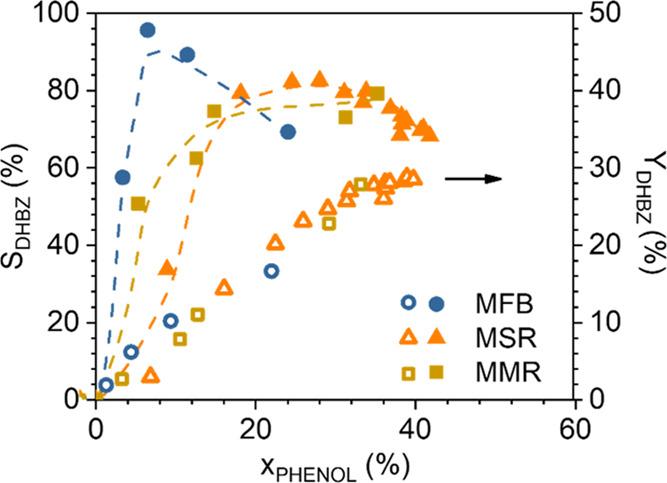
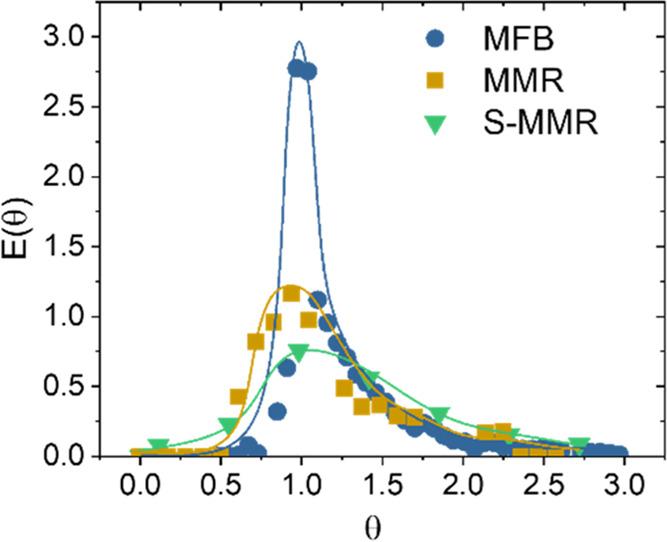
The application of structured reactors provides a number of advantages in chemical processes. In this paper, two different three-dimensional (3D) Fe/SiC catalysts with a square cell geometry have been manufactured by Robocasting: monoliths ( = 14 and = 15 mm) and meshes ( = 24 and = 2 mm) and studied in the catalytic phenol oxidation by hydrogen peroxide (HO) for the sustainable production of dihydroxybenzenes (DHBZ). The fluid dynamics, catalytic performance, reaction rates, external mass transport limitation, and catalyst stability have been compared in three different reactors, monolithic fixed-bed reactor, multimesh fixed-bed reactor, and monolithic stirrer reactor, at selected operating conditions. The results show that the mechanical stirring of the 3D Fe/SiC monoliths avoids the external mass transfer limitation caused by the presence of oxygen bubbles in the channels (produced from the HO · species in autoscavenging radical reactions). In addition, the backmixing has a positive effect on the efficient consumption of HO but an adverse effect on the phenol selectivity to DHBZ since they are overoxidized to tar products at longer contact times. On the other hand, the wall porosity, and not the backmixing, affects the susceptibility of the 3D Fe/SiC catalyst to the Fe leaching, as occurs in the mesh structures. In conclusion, the monoliths operating under plug-flow and external mass transfer limitation in the monolithic fixed-bed reactor (MFB) provide an outstanding phenol selectivity to DHBZ and catalyst stability.
结构化反应器在化学过程中的应用具有诸多优势。在本文中,通过3D打印制造了两种具有方形单元几何结构的不同三维(3D)Fe/SiC催化剂:整体式(边长 = 14和 = 15毫米)和网格式(边长 = 24和 = 2毫米),并研究了其在过氧化氢(HO)催化苯酚氧化反应中用于可持续生产二羟基苯(DHBZ)的性能。在选定的操作条件下,对整体式固定床反应器、多网格式固定床反应器和整体式搅拌反应器这三种不同反应器中的流体动力学、催化性能、反应速率、外部传质限制和催化剂稳定性进行了比较。结果表明,对3D Fe/SiC整体式催化剂进行机械搅拌可避免通道中因氧气气泡(由自清除自由基反应中的HO·物种产生)的存在而导致的外部传质限制。此外,返混对HO的有效消耗有积极影响,但对苯酚生成DHBZ的选择性有不利影响,因为在较长接触时间下它们会过度氧化成焦油产物。另一方面,与返混不同,壁面孔隙率会影响3D Fe/SiC催化剂对铁浸出的敏感性,网格式结构中就会出现这种情况。总之,在整体式固定床反应器(MFB)中在平推流和外部传质限制条件下运行的整体式催化剂对DHBZ具有出色的苯酚选择性和催化剂稳定性。




 Zotero 插件