Verzè Michela, Pluchino Monica, Leonetti Alessandro, Corianò Matilde, Bonatti Francesco, Armillotta Maria P, Perrone Fabiana, Casali Miriam, Minari Roberta, Tiseo Marcello
Medical Oncology Unit, University Hospital of Parma, Parma, Italy.
Department of Medicine and Surgery, University of Parma, Parma, Italy.
Transl Lung Cancer Res. 2022 Dec;11(12):2588-2600. doi: 10.21037/tlcr-22-390.
Operable stage I-III non-small cell lung cancer (NSCLC) has a high risk of recurrence, mainly due to remnant clones of the disease defined as minimal residual disease (MRD). Adjuvant chemotherapy has a limited efficacy in reducing the risk of relapse, and prognostic as well as predictive biomarkers in this context are currently missing.
We performed a systematic review to evaluate the state of the art about the role of circulating tumor DNA detection through liquid biopsy for the assessment of MRD in resected early-stage NSCLC patients.
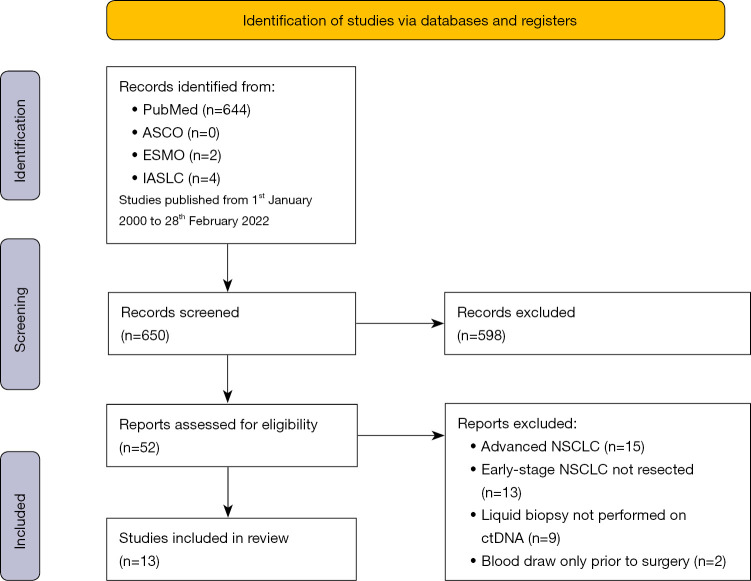
Among the 650 studies identified, 13 were eligible and included. Although highly heterogeneous, all the studies demonstrated a poor prognosis in patients with post-operative MRD, with a detection rate ranging from 6% to 45%. MRD detection preceded radiographic/clinical recurrence by a mean of 5.5 months. MRD positive patients were most likely to benefit from adjuvant treatment in terms of recurrence-free survival (RFS). Consistently, adjuvant therapy did not minimize the risk of relapse in the MRD negative group.
Liquid biopsy has a relevant role in assessing post-surgical MRD in resected NSCLC. Since currently there are no criteria other than stage and risk factors for the choice of adjuvant treatment in this setting, post-operative assessment of MRD through liquid biopsy might be a promising approach to guide the decision.
可手术切除的Ⅰ-Ⅲ期非小细胞肺癌(NSCLC)复发风险高,主要源于疾病残留克隆,即微小残留病(MRD)。辅助化疗在降低复发风险方面疗效有限,目前尚缺乏该情况下的预后及预测生物标志物。
我们进行了一项系统评价,以评估通过液体活检检测循环肿瘤DNA在评估切除的早期NSCLC患者MRD中的作用的现有技术水平。
在检索到的650项研究中,13项符合纳入标准。尽管研究具有高度异质性,但所有研究均表明术后MRD患者预后较差,检测率为6%至45%。MRD检测比影像学/临床复发平均提前5.5个月。就无复发生存期(RFS)而言,MRD阳性患者最有可能从辅助治疗中获益。同样,辅助治疗并未降低MRD阴性组的复发风险。
液体活检在评估切除的NSCLC术后MRD方面具有重要作用。由于目前在这种情况下选择辅助治疗除了分期和风险因素外没有其他标准,通过液体活检对MRD进行术后评估可能是指导决策的一种有前景的方法。