Tambunan Betty Agustina, Ugrasena I Dewa Gede, Aryati Aryati
Doctoral Program of Medical Science, Faculty of Medicine, Universitas Airlangga, Surabaya, Indonesia.
Department of Clinical Pathology, Faculty of Medicine, Universitas Airlangga, Surabaya, Indonesia.
Int J Gen Med. 2023 Jan 5;16:47-56. doi: 10.2147/IJGM.S397317. eCollection 2023.
Antibody formation in transfusion-dependent thalassemia is associated with chronic hemolysis and repeated transfusions. Hemolysis produces heme, which mediates B-cell differentiation into plasma cells and produces antibodies influenced by interleukin-21 (IL-21).
This study aimed to compare IL-21 levels, plasma cell percentage, and red blood cell antibodies between positive and negative allo-autoantibody thalassemia before and after hemin administration.
This research employed a quasi-experimental nonequivalent control group pre-test and post-test design performed from April to November 2021 at Soetomo Academic Hospital in Surabaya, Indonesia. Heparinized blood samples of 5 mL and 4 mL and EDTA blood samples of 3 mL were taken from positive (29 patients) and negative (28 patients) allo-autoantibody thalassemia participants. Hemin 20 µM was added to 5 mL of heparinized blood, incubated for 2 hours, prepared into peripheral blood mononuclear cells (PBMCs), and cultured for 3 days. The percentage of plasma cells (CD38+CD184+) of cultured and uncultured PBMCs was measured by BD FACSCalibur Flow Cytometer. IL-21 levels of plasma and supernatants were measured with Sandwich Enzyme-Linked Immunosorbent Assay by Elabscience. Red blood cell antibodies were detected by QWALYS 3 E.M. Technology. Autoantibodies were determined by the Grifols gel tube method.
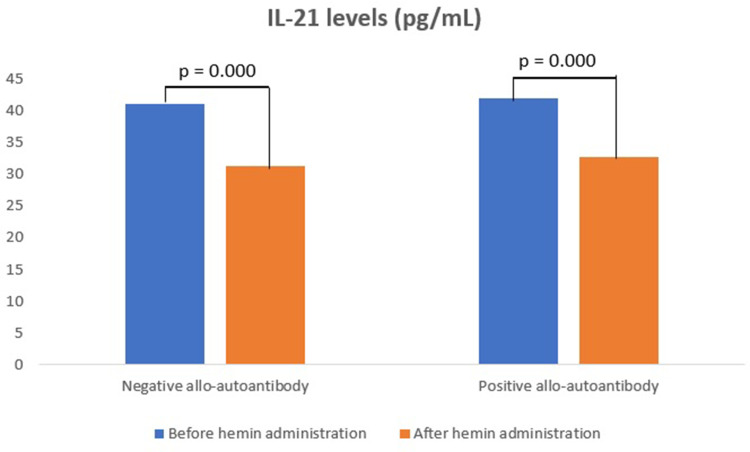
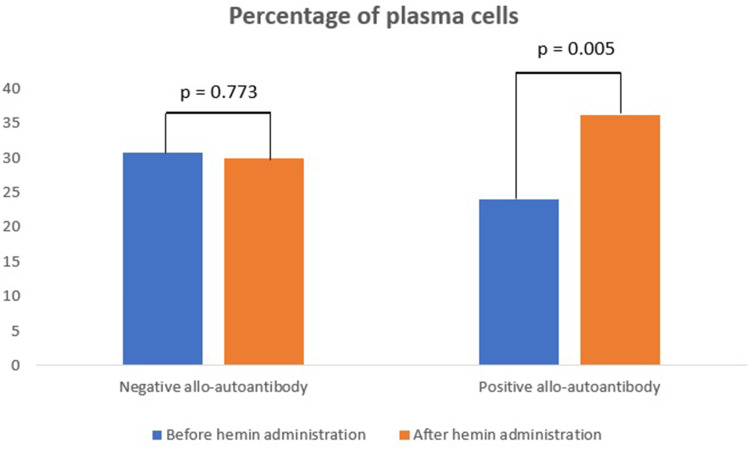
IL-21 levels were significantly different in the positive and negative allo-autoantibody thalassemia groups after hemin administration. The percentage of plasma cells in the positive allo-autoantibody group increased significantly after the administration of hemin. The percentage of plasma cells between thalassemia groups was not significantly different before the hemin administration but increased significantly after it. Red blood cell antibodies after the administration of hemin were significantly different in the negative allo-autoantibody group but not significantly different in the positive allo-autoantibody group.
Hemin administration affected IL-21 levels, plasma cell percentage, and antibody formation in positive and negative allo-auto antibody thalassemia.
输血依赖型地中海贫血中的抗体形成与慢性溶血和反复输血有关。溶血产生血红素,血红素介导B细胞分化为浆细胞并产生受白细胞介素-21(IL-21)影响的抗体。
本研究旨在比较给予血红素前后,同种异体自身抗体阳性和阴性地中海贫血患者的IL-21水平、浆细胞百分比和红细胞抗体。
本研究采用准实验非等效对照组前测和后测设计,于2021年4月至11月在印度尼西亚泗水的苏托莫学术医院进行。从同种异体自身抗体阳性(29例患者)和阴性(28例患者)的地中海贫血参与者中采集5 mL肝素化血液样本、4 mL肝素化血液样本和3 mL乙二胺四乙酸(EDTA)血液样本。将20 µM血红素加入5 mL肝素化血液中,孵育2小时,制备成外周血单个核细胞(PBMC),并培养3天。通过BD FACSCalibur流式细胞仪测量培养和未培养的PBMC中浆细胞(CD38+CD184+)的百分比。采用Elabscience的夹心酶联免疫吸附测定法测量血浆和上清液中的IL-21水平。通过QWALYS 3 E.M.技术检测红细胞抗体。采用Grifols凝胶管法测定自身抗体。
给予血红素后,同种异体自身抗体阳性和阴性地中海贫血组的IL-21水平存在显著差异。给予血红素后,同种异体自身抗体阳性组的浆细胞百分比显著增加。给予血红素前,地中海贫血组之间的浆细胞百分比无显著差异,但给予后显著增加。给予血红素后,同种异体自身抗体阴性组的红细胞抗体有显著差异,但同种异体自身抗体阳性组无显著差异。
给予血红素会影响同种异体自身抗体阳性和阴性地中海贫血患者的IL-21水平、浆细胞百分比和抗体形成。