
基于放射治疗的肝细胞癌治疗新分期模型:一项全国多中心研究
New Staging Model for Radiation-based Hepatocellular Carcinoma Treatment: A National Multicenter Study.
作者信息
Su Ting-Shi, Liang Shi-Xiong, Li Li-Qing, Liu Qiu-Hua, Duan Xue-Zhang, Sun Jing, Zeng Hai, Zhu Hai-Sheng, Li Jian-Xu, Zhu Xiao-Fei, Zhuang Hong-Qing, Liang Ping, Huang Yong
机构信息
Department of Radiation Oncology, Guangxi Medical University Cancer Hospital, Nanning, Guangxi, China.
Department of Radiation Oncology, Ruikang Hospital, Nanning, Guangxi, China.
出版信息
J Clin Transl Hepatol. 2023 Apr 28;11(2):341-349. doi: 10.14218/JCTH.2022.00002. Epub 2022 May 24.
BACKGROUND AND AIMS
The study aimed to create a new staging model for radiotherapy-based treatment for prognostic hepatocellular carcinoma (HCC) classification.
METHODS
The training cohort comprised 658 patients receiving stereotactic body radiotherapy and external validation cohort comprised 533 patients receiving three-dimensional conformal radiotherapy and intensity-modulated radiotherapy. We established a modified staging system as follows: stage I, solitary nodule without macrovascular invasion, or 2-3 nodules no more than 3.0 cm apart, and performance status (PS) 0-2 (Ia: ALBI-1 grade; Ib: ALBI-2 or 3 grade); stage II: 2-3 nodules with any one nodule more than 3.0-cm apart, or ≥4 nodules, and performance status 0-2 (IIa: ALBI-1 grade; IIb: ALBI-2 grade); stage III: macrovascular invasion, regional lymph node metastasis or distant metastasis, and performance status 0-2 (IIIa: ALBI-1 grade; IIIb: ALBI-2 grade); stage IV: performance status 3-4, or performance status 0-2 with ALBI-3 grade. We analyzed long-term overall survival based on different stages.
RESULTS
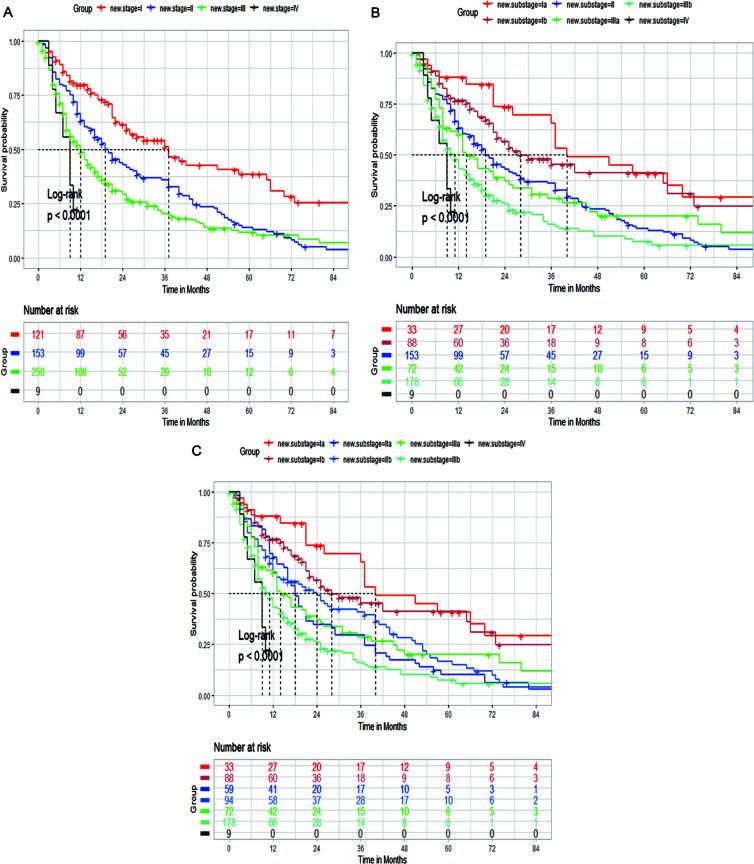
The staging model showed an excellent ability to discriminate patients according to four stages and seven substages with notably different curves in the training and validation cohort. The median survival decreased from stages I to IV with 63.0 months in stage I (not reached in Ia, and 53.0 months in Ib), 24.0 months in stage II (28.0 months in IIa, and 22.0 months in IIb), 11.0 months in stage III (18.0 months in IIIa, and 9.0 months in IIIb), and less than 9.0 months in stage IV in the training cohort.
CONCLUSIONS
The modified staging model may provide an alternative for clinical radiation oncologists.
背景与目的
本研究旨在创建一种新的分期模型,用于基于放射治疗的预后肝细胞癌(HCC)分类治疗。
方法
训练队列包括658例接受立体定向体部放射治疗的患者,外部验证队列包括533例接受三维适形放射治疗和调强放射治疗的患者。我们建立了如下改良分期系统:I期,孤立结节且无大血管侵犯,或2 - 3个结节间距不超过3.0 cm,体能状态(PS)为0 - 2(Ia:ALBI - 1级;Ib:ALBI - 2或3级);II期:2 - 3个结节,其中任何一个结节间距超过3.0 cm,或≥4个结节,体能状态为0 - 2(IIa:ALBI - 1级;IIb:ALBI - 2级);III期:大血管侵犯、区域淋巴结转移或远处转移,体能状态为0 - 2(IIIa:ALBI - 1级;IIIb:ALBI - 2级);IV期:体能状态为3 - 4,或体能状态为0 - 2且为ALBI - 3级。我们分析了不同分期的长期总生存期。
结果
该分期模型在训练队列和验证队列中显示出根据四个阶段和七个亚阶段区分患者的卓越能力,各阶段曲线差异显著。训练队列中,中位生存期从I期到IV期逐渐降低,I期为63.0个月(Ia期未达到,Ib期为53.0个月),II期为24.0个月(IIa期为28.0个月,IIb期为22.0个月),III期为11.0个月(IIIa期为18.0个月,IIIb期为9.0个月),IV期小于9.0个月。
结论
改良分期模型可能为临床放射肿瘤学家提供一种选择。


 Zotero 插件