
贝派地酸对已确诊心血管疾病患者心血管益处的评估。
Estimated cardiovascular benefits of bempedoic acid in patients with established cardiovascular disease.
作者信息
Gunn Laura H, McKay Ailsa J, Feng Amy, Louie Michael J, Ballantyne Christie M, Ray Kausik K
机构信息
Department of Public Health Sciences & School of Data Science, University of North Carolina at Charlotte, Charlotte, NC, USA.
Department of Primary Care and Public Health, Imperial College London, London, UK.
出版信息
Atheroscler Plus. 2022 May 28;49:20-27. doi: 10.1016/j.athplu.2022.05.003. eCollection 2022 Aug.
BACKGROUND AND AIMS
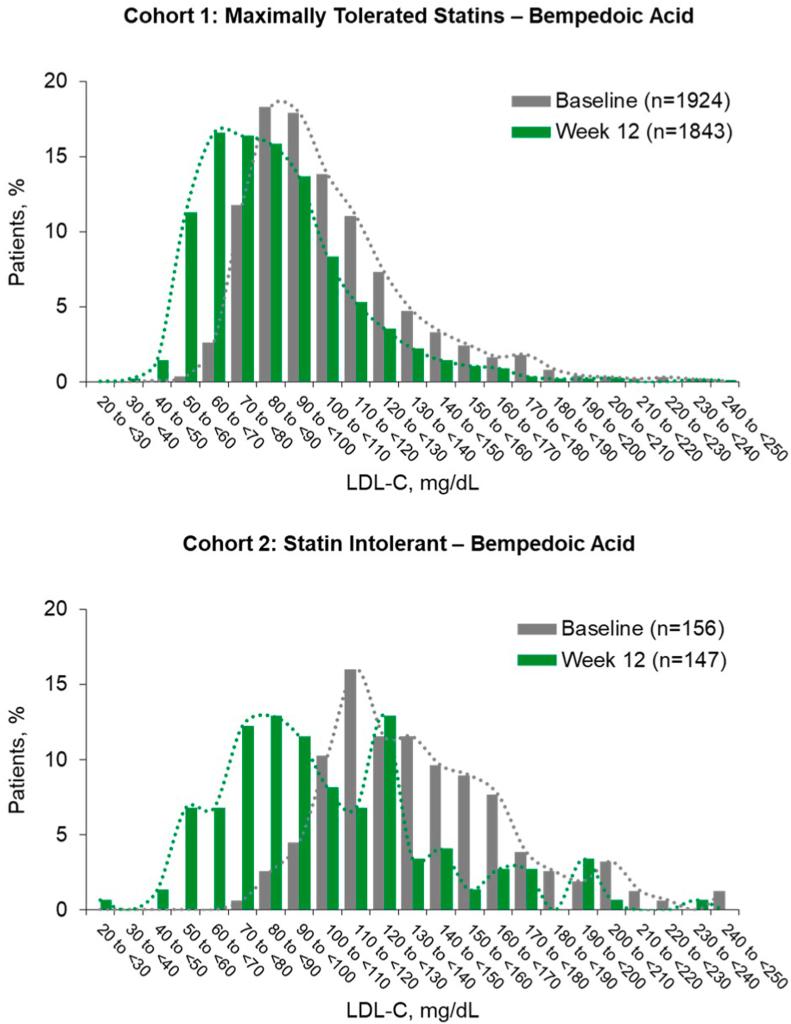
Cardiovascular outcomes trials have demonstrated that lowering low-density lipoprotein cholesterol (LDL-C) reduces the risk for future cardiovascular events. We assessed the potential cardiovascular benefits of bempedoic acid through a simulation study in patients with atherosclerotic cardiovascular disease (ASCVD) and elevated LDL-C.
METHODS
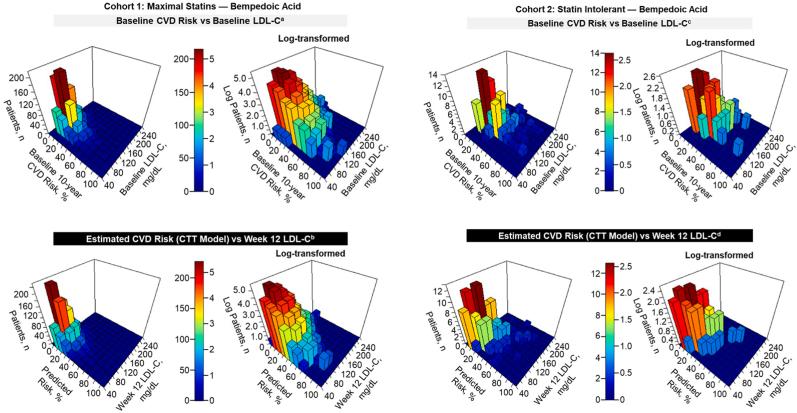
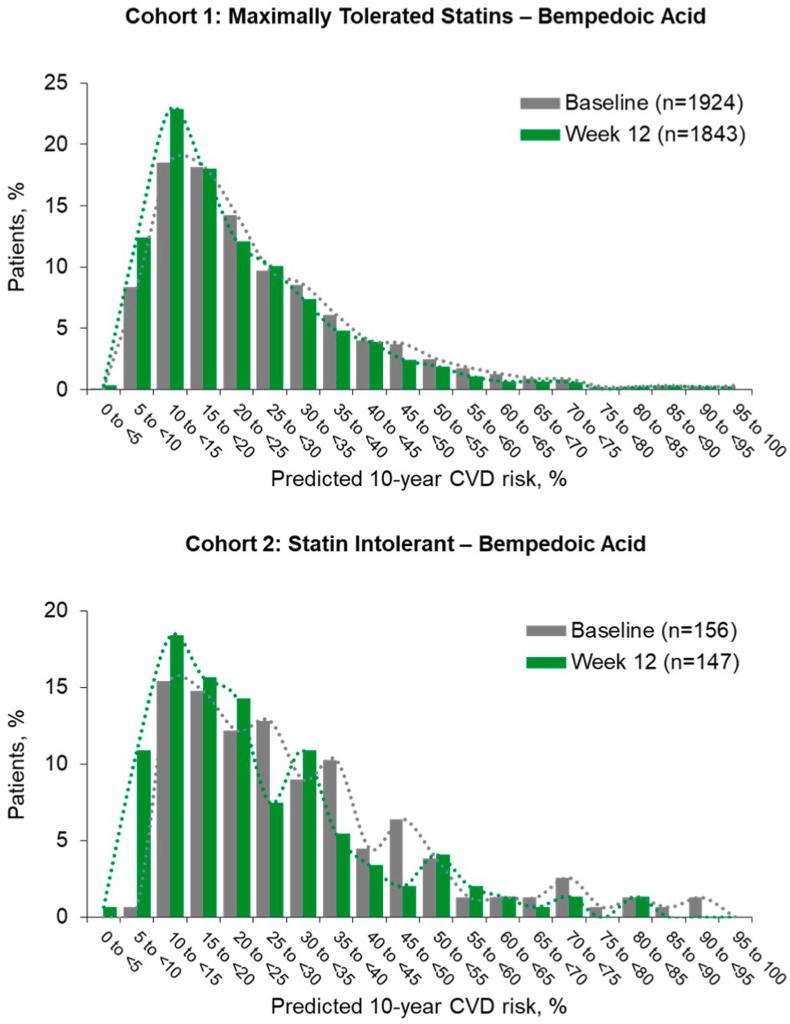
The validated SMART prediction model was used to estimate the baseline 10-year risk of three-point major adverse cardiovascular events (cardiovascular death, non-fatal myocardial infarction, and non-fatal stroke) in patients with ASCVD who were enrolled in four Phase 3, randomized, placebo-controlled bempedoic acid studies. The predicted change in 10-year cardiovascular risk associated with bempedoic acid was estimated for each patient based on the Cholesterol Treatment Trialists' model. Data were analyzed in two cohorts: Cohort 1 included mostly patients treated with moderate-high intensity statins, and Cohort 2 included patients who were intolerant of more than low-intensity statin.
RESULTS
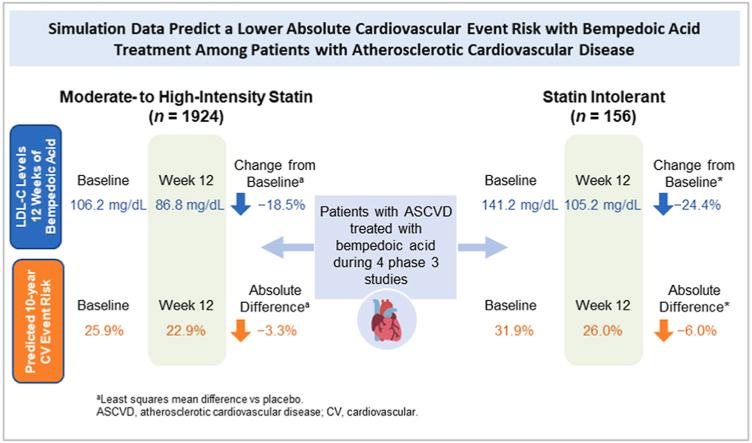
A total of 2884 patients were included in Cohort 1 and 226 in Cohort 2. Weighted average baseline 10-year cardiovascular event risk was 26.1% and 31.6% for Cohorts 1 and 2, respectively. The least squares mean percent difference (95% confidence interval (CI) of the predicted absolute change in 10-year cardiovascular event risk with bempedoic acid was -3.3% (-3.7% to -2.9%) for patients in Cohort 1 and -6.0% (-7.7% to -4.3%) for patients in Cohort 2 compared with placebo (p < 0.0001 for both).
CONCLUSIONS
Among patients with ASCVD who could potentially benefit from additional LDL-C lowering, our simulation predicted a lower absolute cardiovascular event risk after initiating bempedoic acid as compared with placebo.
背景与目的
心血管结局试验表明,降低低密度脂蛋白胆固醇(LDL-C)可降低未来心血管事件的风险。我们通过一项模拟研究评估了贝派地酸对动脉粥样硬化性心血管疾病(ASCVD)且LDL-C升高患者的潜在心血管益处。
方法
使用经过验证的SMART预测模型,估计参加四项3期随机、安慰剂对照贝派地酸研究的ASCVD患者发生三点主要不良心血管事件(心血管死亡、非致死性心肌梗死和非致死性卒中)的基线10年风险。根据胆固醇治疗试验者模型,为每位患者估计与贝派地酸相关的10年心血管风险预测变化。数据在两个队列中进行分析:队列1主要包括接受中高强度他汀类药物治疗的患者,队列2包括不耐受超过低强度他汀类药物的患者。
结果
队列1共纳入2884例患者,队列2共纳入226例患者。队列1和队列2的加权平均基线10年心血管事件风险分别为26.1%和31.6%。与安慰剂相比,队列1患者使用贝派地酸后10年心血管事件风险预测绝对变化的最小二乘平均百分比差异(95%置信区间[CI])为-3.3%(-3.7%至-2.9%),队列2患者为-6.0%(-7.7%至-4.3%)(两者p<0.0001)。
结论
在可能从进一步降低LDL-C中获益的ASCVD患者中,我们的模拟预测,与安慰剂相比,开始使用贝派地酸后绝对心血管事件风险更低。
 Zotero 插件