Moquet Laura, Jobart Benoit, Fontaine Romuald, Delatte Hélène
CIRAD, UMR PVBMT Saint-Pierre Réunion.
FDGDON Saint-Paul Réunion.
Ecol Evol. 2023 Jan 11;13(1):e9742. doi: 10.1002/ece3.9742. eCollection 2023 Jan.
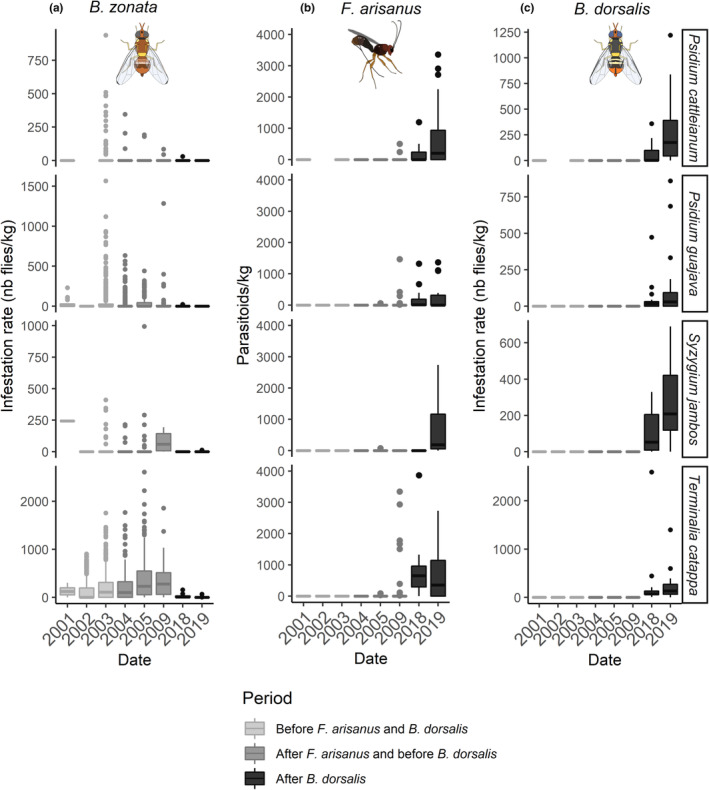
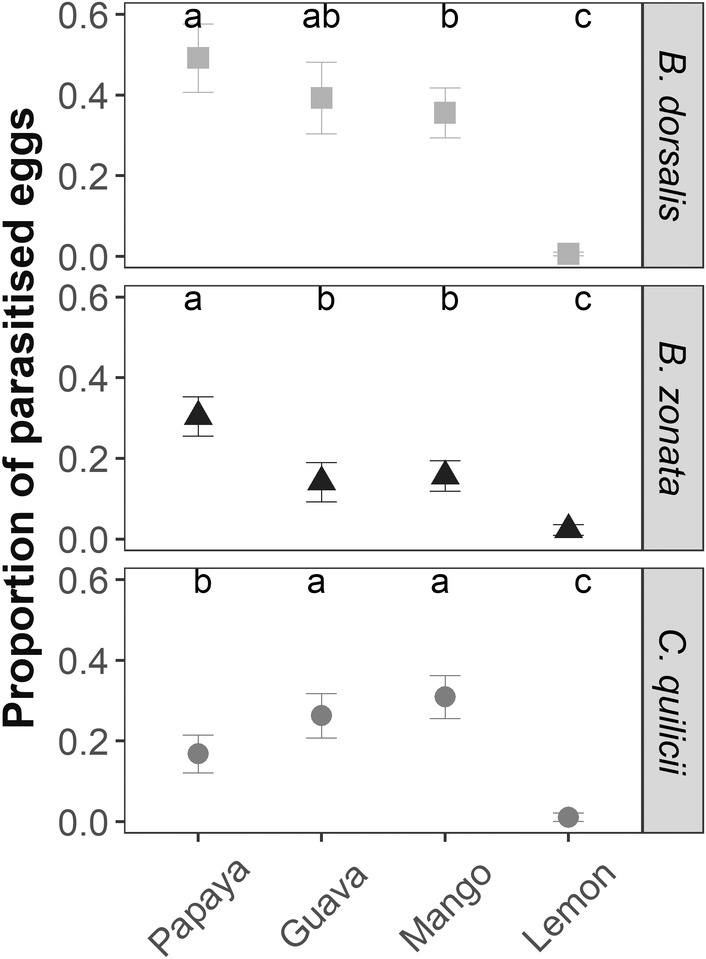
When several polyphagous herbivore species share a parasitoid, the tri-trophic interaction networks can be difficult to predict. In addition to direct effects, the parasitoid may influence the herbivore community by mediating indirect interactions among hosts. The plant species can also modulate the parasitoid preference for a specific host. One of the indirect effects is apparent competition, a negative interaction between individuals as a result of the action of shared natural enemies. Here, we focus on the interactions between the parasitoid (Braconidae) and two generalist fruit fly pests: and (Tephritidae). This parasitoid was introduced into La Réunion in 2003 to control populations of and can also interact with since its invasion in 2017. Our main objective is to characterize the tri-trophic interactions between , fruit fly and host plant species. We developed a long-term field database of fruit collected before and after the parasitoid introduction and after the invasion in order to compare parasitism rate and fruit fly infestation for the different periods. In laboratory assays, we investigated how the combination of fruit fly species and fruit can influence the preference of . In the field, before the invasion of , the parasitism rate of was low and had a little impact on the fruit fly infestation rate. After the invasion, we observed an increase in parasitism rate from 5% to 17%. A bioassay showed that females of could discriminate between eggs of different fruit fly and host plant species. The host plant species preference changed in relation to the fruit fly species inoculated. Field observations and laboratory experiments suggest the possible existence of apparent competition between and via .
当几种多食性食草动物物种共享一种寄生蜂时,三营养级相互作用网络可能难以预测。除了直接影响外,寄生蜂可能通过介导宿主之间的间接相互作用来影响食草动物群落。植物物种也可以调节寄生蜂对特定宿主的偏好。间接影响之一是表观竞争,即由于共享天敌的作用,个体之间产生的负相互作用。在这里,我们关注寄生蜂(茧蜂科)与两种多食性果蝇害虫之间的相互作用:[此处原文缺失两种果蝇害虫的具体名称]和[此处原文缺失两种果蝇害虫的具体名称](实蝇科)。这种寄生蜂于2003年被引入留尼汪岛以控制[此处原文缺失第一种果蝇害虫的具体名称]的种群数量,并且自2017年[此处原文缺失第二种果蝇害虫的具体名称]入侵以来,它也能与之相互作用。我们的主要目标是描述[此处原文缺失第一种果蝇害虫的具体名称]、果蝇与寄主植物物种之间的三营养级相互作用。我们建立了一个长期的田间数据库,记录寄生蜂引入之前和之后以及[此处原文缺失第二种果蝇害虫的具体名称]入侵之后收集的果实,以便比较不同时期的寄生率和果蝇侵染率。在实验室试验中,我们研究了果蝇物种和果实的组合如何影响[此处原文缺失寄生蜂的具体名称]的偏好。在田间,在[此处原文缺失第二种果蝇害虫的具体名称]入侵之前,[此处原文缺失第一种果蝇害虫的具体名称]的寄生率很低,对果蝇侵染率影响很小。在[此处原文缺失第二种果蝇害虫的具体名称]入侵之后,我们观察到寄生率从5%增加到了17%。一项生物测定表明,[此处原文缺失寄生蜂的具体名称]的雌性能够区分不同果蝇和寄主植物物种的卵。寄主植物物种的偏好随着接种的果蝇物种而变化。田间观察和实验室实验表明,[此处原文缺失第一种果蝇害虫的具体名称]和[此处原文缺失第二种果蝇害虫的具体名称]之间可能通过[此处原文缺失寄生蜂的具体名称]存在表观竞争。