School of Cardiovascular & Metabolic Health, University of Glasgow, U.K.
Emergency Medicine and Hypertension, DIMED, Università degli Studi di Padova, Italy.
Clin Sci (Lond). 2023 Feb 14;137(3):239-250. doi: 10.1042/CS20220609.
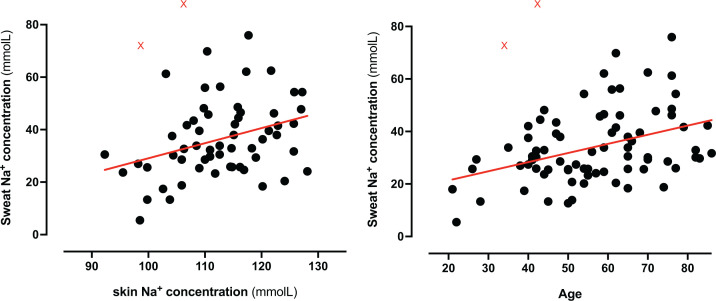
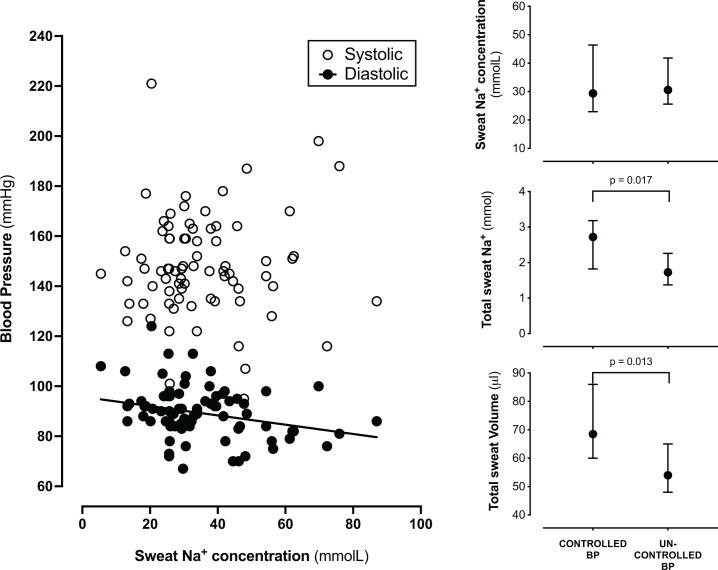
Increasing evidence suggests excess skin Na+ accumulation in hypertension; however, the role of skin-specific mechanisms of local Na+/water regulation remains unclear. We investigated the association between measures of sweat and trans-epidermal water loss (TEWL) with Na+ content in the skin ([Na+]skin) and clinical characteristics in consecutive hypertensive patients. We obtained an iontophoretic pilocarpine-induced sweat sample, a skin punch biopsy for chemical analysis, and measures of TEWL from the upper limbs. Serum vascular endothelial growth factor-c (VEGF-c) and a reflectance measure of haemoglobin skin content served as surrogates of skin microvasculature. In our cohort (n = 90; age 21-86 years; females = 49%), sweat composition was independent of sex and BMI. Sweat Na+ concentration ([Na+]sweat) inversely correlated with [K+]sweat and was higher in patients on ACEIs/ARBs (P < 0.05). A positive association was found between [Na+]sweat and [Na+]skin, independent of sex, BMI, estimated Na+ intake and use of ACEi/ARBs (Padjusted = 0.025); both closely correlated with age (P < 0.01). Office DBP, but not SBP, inversely correlated with [Na+]sweat independent of other confounders (Padjusted = 0.03). Total sweat volume and Na+ loss were lower in patients with uncontrolled office BP (Padjusted < 0.005 for both); sweat volume also positively correlated with serum VEGF-c and TEWL. Lower TEWL was paralleled by lower skin haemoglobin content, which increased less after vasodilatory pilocarpine stimulation when BMI was higher (P = 0.010). In conclusion, measures of Na+ and water handling/regulation in the skin were associated with relevant clinical characteristics, systemic Na+ status and blood pressure values, suggesting a potential role of the skin in body-fluid homeostasis and therapeutic targeting of hypertension.
越来越多的证据表明,高血压患者皮肤中钠离子(Na+)蓄积过多;然而,皮肤局部钠/水调节的特定机制的作用仍不清楚。我们研究了连续高血压患者的汗液和经皮水分丢失(TEWL)测量值与皮肤中钠离子([Na+]skin)含量及临床特征之间的关系。我们采集了离子电渗法诱导的毛果芸香碱汗液样本、皮肤活检进行化学分析以及上肢 TEWL 测量。血清血管内皮生长因子-c(VEGF-c)和血红蛋白皮肤含量的反射测量值作为皮肤微血管的替代物。在我们的队列中(n=90;年龄 21-86 岁;女性=49%),汗液成分与性别和 BMI 无关。汗液中钠离子浓度([Na+]sweat)与钾离子浓度([K+]sweat)呈负相关,且在服用血管紧张素转换酶抑制剂/血管紧张素受体阻滞剂(ACEIs/ARBs)的患者中更高(P<0.05)。[Na+]sweat 与 [Na+]skin 之间呈正相关,与性别、BMI、估计的钠摄入量和 ACEi/ARBs 的使用无关(Padjusted=0.025);且两者均与年龄密切相关(P<0.01)。诊室舒张压(DBP),而非收缩压(SBP),与其他混杂因素独立相关,呈负相关(Padjusted=0.03)。在诊室血压控制不佳的患者中,总汗液量和 Na+流失量更低(两者调整后均 P<0.005);汗液量也与血清 VEGF-c 和 TEWL 呈正相关。TEWL 越低,皮肤血红蛋白含量越低,而 BMI 较高时,经血管扩张剂毛果芸香碱刺激后皮肤血红蛋白含量的增加量越低(P=0.010)。总之,皮肤中钠和水的处理/调节的测量值与相关临床特征、全身钠状态和血压值有关,提示皮肤在体液平衡和高血压治疗靶点中可能发挥作用。