
自然与建筑教学:学生主导的热带地区仿生创新记录
Teaching Nature and Architecture: Student-Led Account of Biomimicry Innovations in the Tropics.
作者信息
Arumugam Girirajan, Abidin Siti Norzaini Zainal, Kusumo Camelia May Li, Jain Anuj
机构信息
School of Architecture, Building and Design, Taylor's University, Subang Jaya 47100, Malaysia.
Biomimicry Singapore Network and bioSEA Pte. Ltd., 68 Chestnut Avenue, Singapore 679521, Singapore.
出版信息
Biomimetics (Basel). 2023 Jan 1;8(1):13. doi: 10.3390/biomimetics8010013.
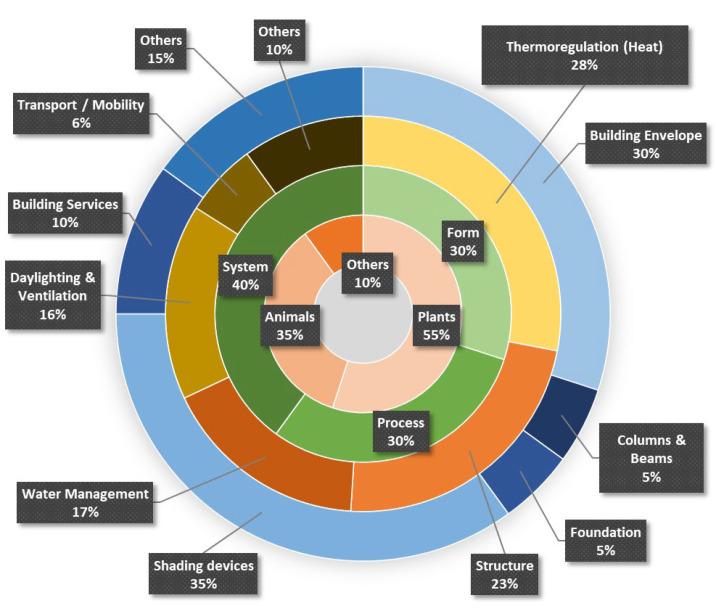
The built environment has a huge carbon footprint, and decarbonizing it is essential in driving our sustainability efforts. We take the approach of biomimicry by working with Master of Architecture students from Taylor's University in Malaysia. The students partake in a 14-week Nature and Architecture design module at the university where they develop biomimicry solutions for the built environment with a focus on sustainability. The students undergo a three-step process of scoping the design problem in the tropical climate and urban context, researching the biological literature, abstracting design ideas, and finally, developing prototypes. The module presents an opportunity for students to study nature and immerse in experiential learning in the megadiverse geographies of Malaysia and wider tropical southeast Asia. This paper describes the student works developed in various module runs from 2017 to 2022 under the supervision of the authors. Selected student projects were analyzed thematically, curated, and classified by frequently occurring themes. Finally, their design implications and challenges faced are presented. We found the following five themes to be most commonly chosen by the students-thermoregulation, structure making, water management, daylighting and ventilation, and transport and mobility. Lastly, we also conducted postgraduation student surveys on their learnings from the module. Through our synthesis, we discuss how student works can bridge the gap of applying biomimicry into practice and the limitations thereof in mainstreaming the practice in the built environment of tropical southeast Asia.
建筑环境的碳足迹巨大,使其脱碳对于推动我们的可持续发展努力至关重要。我们通过与马来西亚泰勒大学的建筑学硕士学生合作,采用了仿生学方法。这些学生参加了该大学为期14周的“自然与建筑”设计模块课程,在课程中他们为建筑环境开发以可持续性为重点的仿生学解决方案。学生们经历了一个三步流程:在热带气候和城市背景下界定设计问题、研究生物学文献、提炼设计理念,最后开发原型。该模块为学生提供了一个机会,让他们在马来西亚及更广泛的热带东南亚地区的生物多样性丰富的地域中研究自然并沉浸于体验式学习。本文描述了在作者指导下,2017年至2022年不同模块课程中开展的学生作品。对选定的学生项目进行了主题分析、策划,并按照频繁出现的主题进行了分类。最后,展示了它们的设计启示以及面临的挑战。我们发现学生们最常选择的五个主题是:温度调节、结构构建、水资源管理、采光与通风以及交通与机动性。最后,我们还对学生毕业后关于该模块学习情况进行了调查。通过我们的综合分析,我们讨论了学生作品如何能够弥合将仿生学应用于实践的差距以及在热带东南亚建筑环境中将该实践主流化方面的局限性。





 Zotero 插件