Department of Cardiovascular and Metabolic Sciences, Lerner Research Institute, Cleveland Clinic, Cleveland, OH.
Department of Mechanical and Aerospace Engineering, Case Western Reserve University, Cleveland, OH.
Blood Adv. 2023 May 9;7(9):1739-1753. doi: 10.1182/bloodadvances.2022008498.
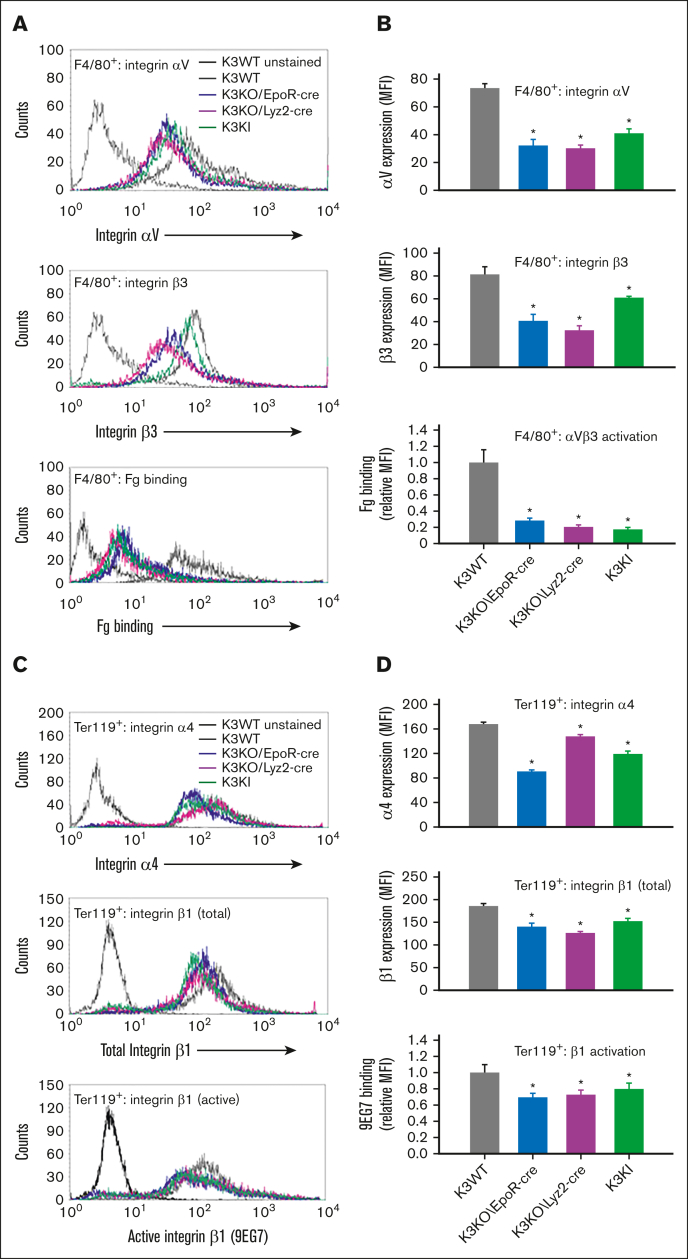
Kindlin-3 (K3) is critical for the activation of integrin adhesion receptors in hematopoietic cells. In humans and mice, K3 deficiency is associated with impaired immunity and bone development, bleeding, and aberrant erythrocyte shape. To delineate how K3 deficiency (K3KO) contributes to anemia and misshaped erythrocytes, mice deficient in erythroid (K3KO∖EpoR-cre) or myeloid cell K3 (K3KO∖Lyz2cre), knockin mice expressing mutant K3 (Q597W598 to AA) with reduced integrin-activation function (K3KI), and control wild-type (WT) K3 mice were studied. Both K3-deficient strains and K3KI mice showed anemia at baseline, reduced response to erythropoietin stimulation, and compromised recovery after phenylhydrazine (PHZ)-induced hemolytic anemia as compared with K3WT. Erythroid K3KO and K3 (Q597W598 to AA) showed arrested erythroid differentiation at proerythroblast stage, whereas macrophage K3KO showed decreased erythroblast numbers at all developmental stages of terminal erythroid differentiation because of reduced erythroblastic island (EBI) formation attributable to decreased expression and activation of erythroblast integrin α4β1 and macrophage αVβ3. Peripheral blood smears of K3KO∖EpoR-cre mice, but not of the other mouse strains, showed numerous aberrant tear drop-shaped erythrocytes. K3 deficiency in these erythrocytes led to disorganized actin cytoskeleton, reduced deformability, and increased osmotic fragility. Mechanistically, K3 directly interacted with F-actin through an actin-binding site K3-LK48. Taken together, these findings document that erythroid and macrophage K3 are critical contributors to erythropoiesis in an integrin-dependent manner, whereas F-actin binding to K3 maintains the membrane cytoskeletal integrity and erythrocyte biconcave shape. The dual function of K3 in erythrocytes and in EBIs establish an important functional role for K3 in normal erythroid function.
Kindlin-3(K3)对于造血细胞中整合素黏附受体的激活至关重要。在人类和小鼠中,K3 缺乏与免疫和骨骼发育受损、出血以及红细胞形状异常有关。为了阐明 K3 缺乏(K3KO)如何导致贫血和畸形红细胞,研究了缺乏红细胞(K3KO∖EpoR-cre)或髓样细胞 K3(K3KO∖Lyz2cre)的小鼠、表达突变 K3(Q597W598 突变为 AA)的 K3 敲入小鼠(其整合素激活功能降低)和对照野生型(WT)K3 小鼠。与 K3WT 相比,两种 K3 缺乏株和 K3KI 小鼠在基线时就表现出贫血,对促红细胞生成素刺激的反应降低,并且在用苯肼(PHZ)诱导溶血性贫血后恢复能力受损。红细胞 K3KO 和 K3(Q597W598 突变为 AA)在原红细胞阶段表现出红细胞分化停滞,而巨噬细胞 K3KO 在红细胞终末分化的所有发育阶段中都表现出红细胞数量减少,这是由于红系细胞整合素 α4β1 和巨噬细胞 αVβ3 的表达和激活减少,导致红系细胞岛(EBI)形成减少所致。K3KO∖EpoR-cre 小鼠的外周血涂片,但不是其他小鼠株的外周血涂片,显示出许多异常的泪滴状红细胞。这些红细胞中的 K3 缺乏导致肌动蛋白细胞骨架紊乱、变形性降低和渗透性脆性增加。从机制上讲,K3 通过一个位于 K3-LK48 的肌动蛋白结合位点直接与 F-肌动蛋白相互作用。总之,这些发现表明,红细胞和巨噬细胞中的 K3 以整合素依赖性方式对红细胞生成至关重要,而 K3 与 F-肌动蛋白的结合维持了细胞膜细胞骨架的完整性和红细胞双凹形。K3 在红细胞和 EBI 中的双重功能确立了 K3 在正常红细胞功能中的重要功能作用。