Department of Radiology, Union Hospital, Tongji Medical College, Huazhong University of Science and Technology, No. 1277 Jiefang Avenue, Wuhan, 430022, China.
Hubei Key Laboratory of Molecular Imaging, Wuhan, 430022, China.
Sci Rep. 2023 Jan 17;13(1):934. doi: 10.1038/s41598-022-27238-z.
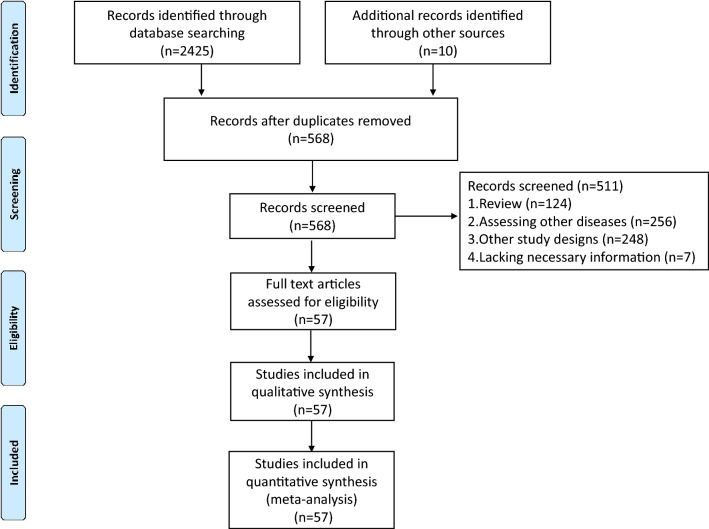
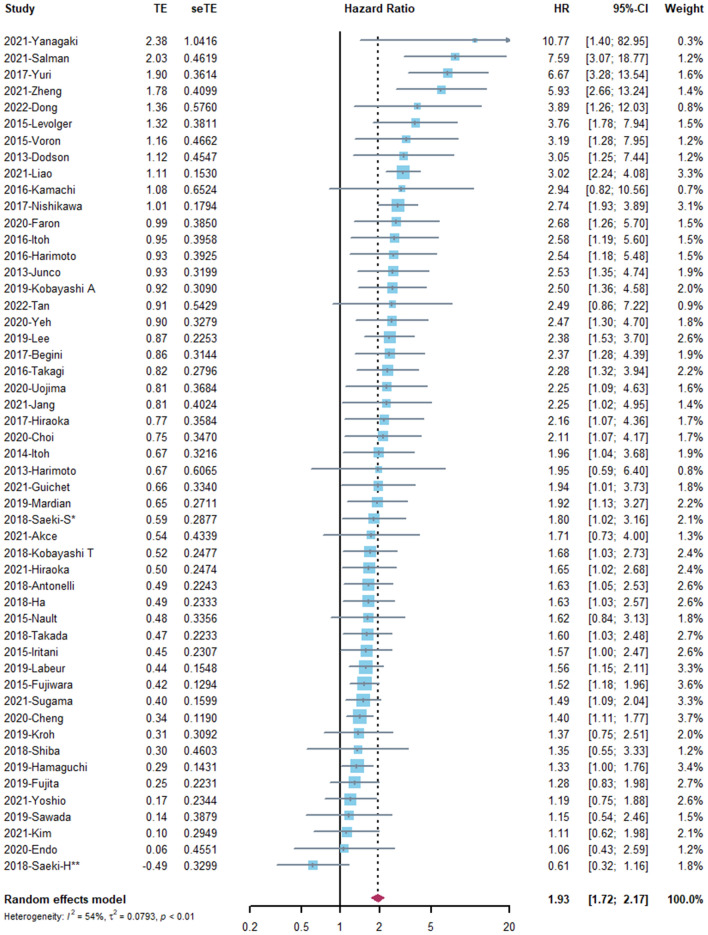
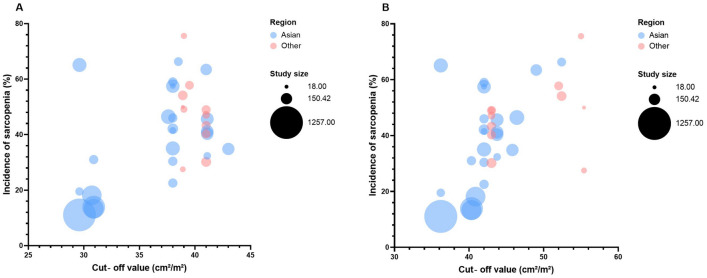
Although numerous studies have reported the association between sarcopenia and the prognosis of hepatocellular carcinoma (HCC) patients, there is lack of a newer and more comprehensive meta-analysis. Herein, a comprehensive literature search was performed on PubMed, Web of Science, the Cochrane Library, and Embase databases to identify relevant studies published up to February 2022. The outcomes were overall survival (OS), recurrence, progression-free survival, tumor response, severe postoperative complications, and toxicity of drugs. A total of 57 studies involving 9790 HCC patients were included in the meta-analysis. The pooled prevalence of sarcopenia in HCC patients was 41.7% (95% CI 36.2-47.2%). Results demonstrated that sarcopenia was significantly associated with impaired OS (HR: 1.93, 95% CI 1.73-2.17, P < 0.001), higher risk of tumor recurrence (HR: 1.75, 95% CI 1.56-1.96, P < 0.001), lower objective response rate (OR: 0.37 95% CI 0.17-0.81, P = 0.012), and more drug-related adverse events (OR: 2.23, 95% CI 1.17-4.28, P = 0.015) in HCC patients. The subgroup analyses revealed that the OS of patients at the early stage of tumor was more severely affected by sarcopenia than for patients at other stages. Moreover, the presence of cirrhosis and Child Pugh class B increased the hazard of mortality from sarcopenia. This study has shown that sarcopenia is highly associated with poor prognosis in HCC patients. In addition, cirrhosis and poor liver functional reserve increase the danger of sarcopenia. OS was more impaired in HCC patients with sarcopenia at early stage of tumor than at other tumor stages.
尽管有大量研究报道了肌肉减少症与肝细胞癌(HCC)患者预后之间的关系,但缺乏更新和更全面的荟萃分析。在此,我们对 PubMed、Web of Science、Cochrane Library 和 Embase 数据库进行了全面的文献检索,以确定截至 2022 年 2 月发表的相关研究。研究结果包括总生存期(OS)、复发、无进展生存期、肿瘤反应、严重术后并发症和药物毒性。共有 57 项研究纳入了 9790 例 HCC 患者,纳入荟萃分析。HCC 患者肌肉减少症的总患病率为 41.7%(95%CI 36.2-47.2%)。结果表明,肌肉减少症与 OS 受损显著相关(HR:1.93,95%CI 1.73-2.17,P<0.001)、肿瘤复发风险增加(HR:1.75,95%CI 1.56-1.96,P<0.001)、客观反应率降低(OR:0.37,95%CI 0.17-0.81,P=0.012)和更多的药物相关不良事件(OR:2.23,95%CI 1.17-4.28,P=0.015)。亚组分析显示,肿瘤早期患者的 OS 受肌肉减少症的影响比其他阶段的患者更严重。此外,肝硬化和 Child Pugh 分级 B 增加了肌肉减少症导致死亡的风险。本研究表明,肌肉减少症与 HCC 患者的不良预后高度相关。此外,肝硬化和肝功能储备不良增加了肌肉减少症的危险。与其他肿瘤阶段相比,肿瘤早期存在肌肉减少症的 HCC 患者的 OS 受损更为严重。