Department of Population Studies, School of Humanities and Social Sciences, University of Zambia, Lusaka, Zambia.
Demography and Population Studies Programme, Schools of Public Health and Social Sciences, University of the Witwatersrand, Johannesburg, South Africa.
BMC Womens Health. 2023 Jan 17;23(1):21. doi: 10.1186/s12905-023-02168-8.
Child marriage has long been a public health concern around the world, because it has the potential to deprive adolescent girls of their sexual reproductive health rights and limits their ability to reach their full potential in life. The prevalence of child marriage has been consistently higher in sub-Saharan Africa than elsewhere. However, fewer studies have explored the influence of both individual and community-level influences on early marriage in sub-Saharan Africa. This study, therefore, examined individual and community-level factors associated with child marriages in Zambia.
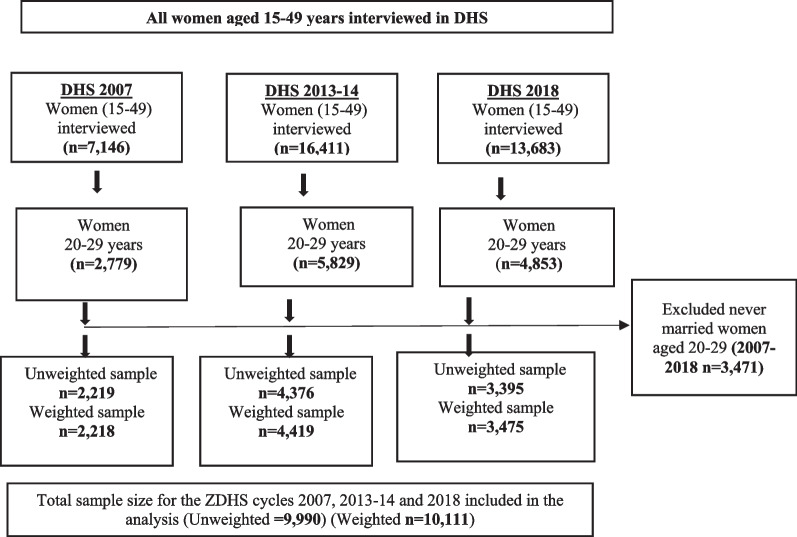
Data came from the Zambia Demographic and Health Surveys (ZDHS) conducted in 2007, 2013-14 and 2018. A pooled weighted sample of 9990 women aged 20-29 years was used in the analysis. Stata software version 17 was used to perform statistical analysis, taking into account complex survey design. The association between individual- and community- level factors and early marital behavior was assessed using multilevel logistic regression models.
The prevalence of child marriage among women aged 20-29 was 44.4 percent (95% CI: 42.1, 46.7) in 2018, declining from 51.5 percent (95% CI: 48.9, 54.0) in 2007. Women with secondary or higher level of education [aOR = 0.36, 95% CI = 0.26-0.49] and [aOR = 0.07, 95% CI = 0.03-0.18] and those whose age at first birth was (15-19 year) or (20-29 years) were associated with less likelihood of experiencing child marriage. Communities with a high percentage of women who gave birth at a young age [aOR = 1.36, 95% CI = 1.15-1.62] were more likely to experience child marriage. Individual and community-level characteristics accounted for 35% of the overall variations in communities' likelihood of experiencing early marriage. Even after controlling for both individual and community-level influences, the intra-class correlation revealed that around 4.5 percent of the overall variations remained unexplained.
Prevalence of child marriage has reduced over the years but is still high in Zambia. Both individual and community- level factors influenced child marriage in Zambia. There is a need to strengthen strategies that keep girls in school to delay their exposure to early sexual debut and child marriage. Designing of reproductive health interventions in the country should consider integration of community factors such as economic insecurity and access to reproductive health information.
童婚一直是全球公共卫生关注的问题,因为它有可能剥夺少女的性生殖健康权利,并限制她们充分发挥潜力的能力。在撒哈拉以南非洲,童婚的流行率一直高于其他地区。然而,很少有研究探讨个人和社区层面的因素对撒哈拉以南非洲早婚的影响。因此,本研究调查了赞比亚与童婚相关的个人和社区层面的因素。
数据来自于 2007 年、2013-14 年和 2018 年进行的赞比亚人口与健康调查(ZDHS)。分析中使用了年龄在 20-29 岁之间的 9990 名女性的加权汇总样本。采用 Stata 软件版本 17 进行统计分析,考虑了复杂的调查设计。使用多水平逻辑回归模型评估个人和社区层面因素与早期婚姻行为之间的关联。
2018 年,20-29 岁女性的童婚患病率为 44.4%(95%置信区间:42.1,46.7),低于 2007 年的 51.5%(95%置信区间:48.9,54.0)。接受过中等或高等教育的妇女[aOR=0.36,95%置信区间=0.26-0.49]和[aOR=0.07,95%置信区间=0.03-0.18]以及初育年龄为(15-19 岁)或(20-29 岁)的妇女发生童婚的可能性较低。初育年龄较早的妇女比例较高的社区[aOR=1.36,95%置信区间=1.15-1.62]更有可能发生童婚。个人和社区层面的特征解释了社区发生早婚可能性的 35%的总体差异。即使在控制了个人和社区层面的影响后,类内相关系数显示,约有 4.5%的总体差异仍无法解释。
赞比亚的童婚流行率多年来有所下降,但仍居高不下。个人和社区层面的因素都影响了赞比亚的童婚。需要加强让女孩留在学校的策略,以推迟她们接触早期性行为和童婚。该国制定生殖健康干预措施时,应考虑纳入经济不安全和获得生殖健康信息等社区因素。