Department of Population Science, Jatiya Kabi Kazi Nazrul Islam University, Mymensingh, Bangladesh.
Department of Human Resource Management, Jatiya Kabi Kazi Nazrul Islam University, Mymensingh, Bangladesh.
PLoS One. 2024 Oct 30;19(10):e0312755. doi: 10.1371/journal.pone.0312755. eCollection 2024.
Early marriage, defined as marriage under the age of 18, is widely recognized as a human rights violation with deleterious consequences on women's health and well-being. It persists as a significant global public health issue, predominantly being practiced in South Asian countries. In Countries like Bangladesh, this practice contributes to an increase in early pregnancies among women of reproductive age, further exacerbating adverse maternal and child health outcomes. While certain predictors of early marriage are recognized, additional investigation is warranted due to diverse socio-economic and demographic circumstances. This study, therefore, aimed to identify the prevalence and determinants of early marriage among women in Bangladesh.
This study included a total weighted sample of 18,228 married women aged 18 to 49 years, extracted from the most recent nationally representative Bangladesh Demography and Health Survey (2017-18). We estimated the survey weighted pooled prevalence of early marriage among women and stratified by their different characteristics. We used multilevel mixed-effect binary logistic regression model and estimated the odds ratios (ORs) with their 95% confidence intervals (CIs) to identify the individual-, household-, and community-level factors associated with early marriage practice. All analyses were performed by Stata software version 18.
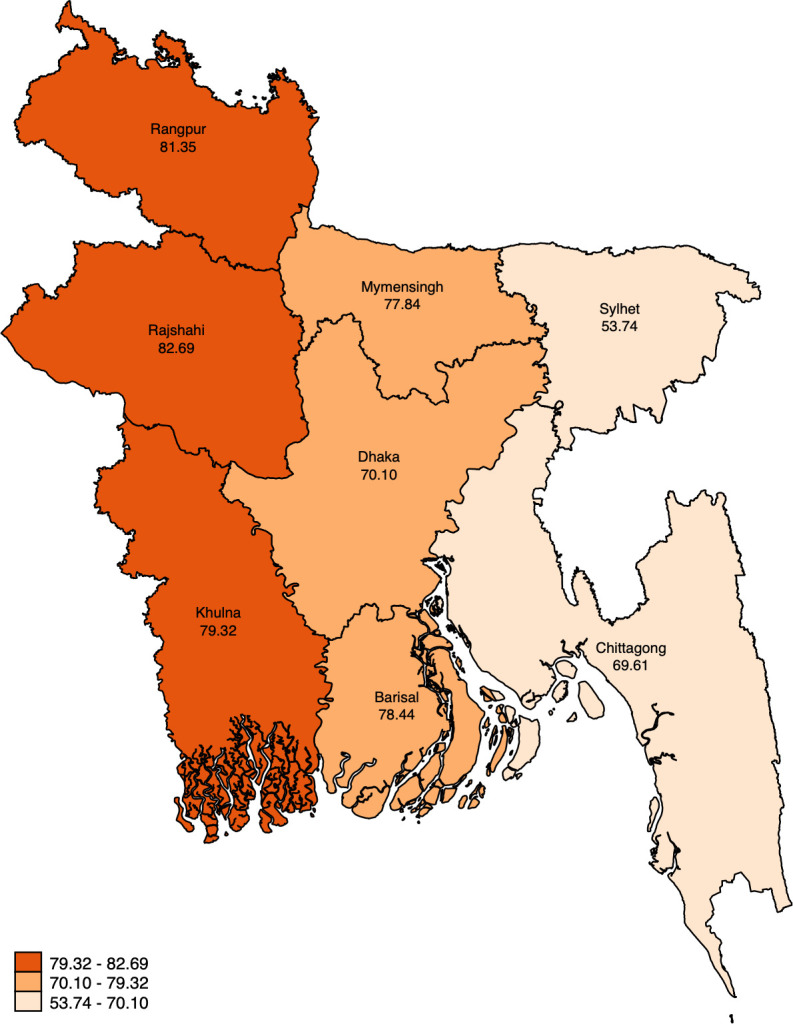
Overall, 74.27% [95% CI: 73.15, 75.35] women got married before reaching the age of 18 years. Early marriage was more prevalent in Rajshahi (82.69%), Rangpur (81.35%), and Khulna division (79.32%). Women with higher education (OR = 0.10, 95% CI: 0.08, 0.12), husband's higher education (OR = 0.57, 95% CI: 0.48, 0.67), and non-Muslim women (OR = 0.46, 95% CI: 0.40, 0.52) were associated with a lower likelihood of experiencing early marriage. Compared to those household heads aged ≤35 years, the likelihood of early marriage among women was lower for those household heads aged 36-55 years (OR = 0.84, 95% CI: 0.76, 0.93) and >55 years (OR = 0.78, 95% CI: 0.69-0.88). Women aged 18-24 years (OR = 1.24, 95% CI: 1.10, 1.40), husbands with agricultural occupation (OR = 1.22, 95% CI:1.06, 1.41), middle wealth index level (OR = 1.14, 95% CI: 1.02, 1.28), family size five or more (OR = 1.21, 95% CI: 1.11, 1.31), and rural residence (OR = 1.17, 95% CI: 1.04, 1.30) were more likely to experience early marriage.
This study underscores the alarming prevalence of early marriage among women in Bangladesh, with three-fourths experiencing early marriage, particularly in specific regions. Notably, women education and older household heads were significantly associated with a reduced likelihood of early marriage. Our findings suggest that culturally sensitive interventions should focus on empowering older household heads, alongside initiatives to increase awareness among younger household heads, and enhance education, particularly in rural and impoverished households. These efforts could potentially alter socio-cultural practices and reduce early marriage in Bangladesh.
早婚是指 18 岁以下的婚姻,被广泛认为是对妇女健康和福祉的一种侵犯人权的行为,对妇女的健康和福祉有不利影响。它仍然是一个重大的全球公共卫生问题,主要存在于南亚国家。在孟加拉国等国家,这种做法导致生育年龄妇女的早育增加,进一步加剧了母婴健康不良后果。虽然已经认识到某些早婚的预测因素,但由于社会经济和人口状况的多样性,需要进一步调查。因此,本研究旨在确定孟加拉国妇女早婚的流行率和决定因素。
本研究包括从最近一次全国代表性的孟加拉国人口与健康调查(2017-18 年)中抽取的 18228 名 18 至 49 岁已婚妇女的总加权样本。我们估计了妇女早婚的调查加权总流行率,并按其不同特征进行分层。我们使用多水平混合效应二项逻辑回归模型,并估计了优势比(ORs)及其 95%置信区间(CIs),以确定与早婚实践相关的个体、家庭和社区层面的因素。所有分析均由 Stata 软件版本 18 完成。
总体而言,74.27%[95%置信区间:73.15,75.35]的妇女在 18 岁之前结婚。在拉杰沙希(82.69%)、朗布尔(81.35%)和库尔纳(79.32%),早婚更为普遍。受过高等教育的妇女(OR=0.10,95%置信区间:0.08,0.12)、丈夫受过高等教育(OR=0.57,95%置信区间:0.48,0.67)和非穆斯林妇女(OR=0.46,95%置信区间:0.40,0.52)与早婚的可能性较低有关。与 35 岁以下的户主相比,36-55 岁(OR=0.84,95%置信区间:0.76,0.93)和 55 岁以上(OR=0.78,95%置信区间:0.69,0.88)的妇女早婚的可能性较低。18-24 岁的妇女(OR=1.24,95%置信区间:1.10,1.40)、丈夫从事农业职业(OR=1.22,95%置信区间:1.06,1.41)、中等财富指数水平(OR=1.14,95%置信区间:1.02,1.28)、家庭规模为五人或以上(OR=1.21,95%置信区间:1.11,1.31)和农村居住(OR=1.17,95%置信区间:1.04,1.30)的妇女更有可能早婚。
本研究强调了孟加拉国妇女早婚的惊人流行率,四分之三的妇女经历过早婚,特别是在特定地区。值得注意的是,妇女教育和年长的户主与早婚的可能性降低显著相关。我们的研究结果表明,需要关注文化敏感的干预措施,以增强年长的户主的能力,同时提高年轻户主的认识,并加强教育,特别是在农村和贫困家庭。这些努力可能会改变社会文化习俗,减少孟加拉国的早婚现象。
