• 文献检索
  • 文档翻译
  • 深度研究
  • 学术资讯
  • Suppr Zotero 插件Zotero 插件
  • 邀请有礼
  • 套餐&价格
  • 历史记录
应用&插件
Suppr Zotero 插件Zotero 插件浏览器插件Mac 客户端Windows 客户端微信小程序
定价
高级版会员购买积分包购买API积分包
服务
文献检索文档翻译深度研究API 文档MCP 服务
关于我们
关于 Suppr公司介绍联系我们用户协议隐私条款
关注我们

Suppr 超能文献

核心技术专利:CN118964589B侵权必究
粤ICP备2023148730 号-1Suppr @ 2026

文献检索

告别复杂PubMed语法,用中文像聊天一样搜索,搜遍4000万医学文献。AI智能推荐,让科研检索更轻松。

立即免费搜索

文件翻译

保留排版,准确专业,支持PDF/Word/PPT等文件格式,支持 12+语言互译。

免费翻译文档

深度研究

AI帮你快速写综述,25分钟生成高质量综述,智能提取关键信息,辅助科研写作。

立即免费体验

利用埃塞俄比亚 2016 年人口与健康调查数据集预测育龄妇女的避孕措施中断情况:一种机器学习方法。

Prediction of contraceptive discontinuation among reproductive-age women in Ethiopia using Ethiopian Demographic and Health Survey 2016 Dataset: A Machine Learning Approach.

机构信息

Department of Health Informatics, School of Public Health, College of Medicine and Health Science, Wollo University, Dessie, Ethiopia.

Department of Information Technology, College of Engineering, IT and Environment, Charles Darwin University, Darwin, Australia.

出版信息

BMC Med Inform Decis Mak. 2023 Jan 17;23(1):9. doi: 10.1186/s12911-023-02102-w.

DOI:10.1186/s12911-023-02102-w
PMID:36650511
原文链接:https://pmc.ncbi.nlm.nih.gov/articles/PMC9843668/
Abstract

BACKGROUND

Globally, 38% of contraceptive users discontinue the use of a method within the first twelve months. In Ethiopia, about 35% of contraceptive users also discontinue within twelve months. Discontinuation reduces contraceptive coverage, family planning program effectiveness and contributes to undesired fertility. Hence understanding potential predictors of contraceptive discontinuation is crucial to reducing its undesired outcomes. Predicting the risk of discontinuing contraceptives is also used as an early-warning system to notify family planning programs. Thus, this study could enable to predict and determine the predictors for contraceptive discontinuation in Ethiopia.

METHODOLOGY

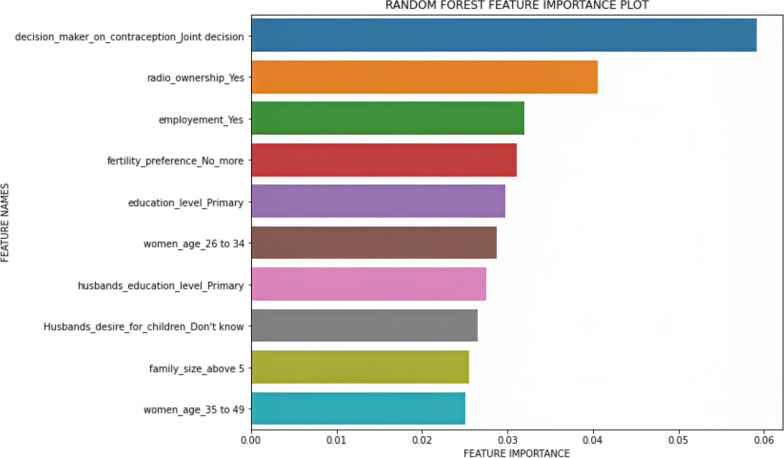
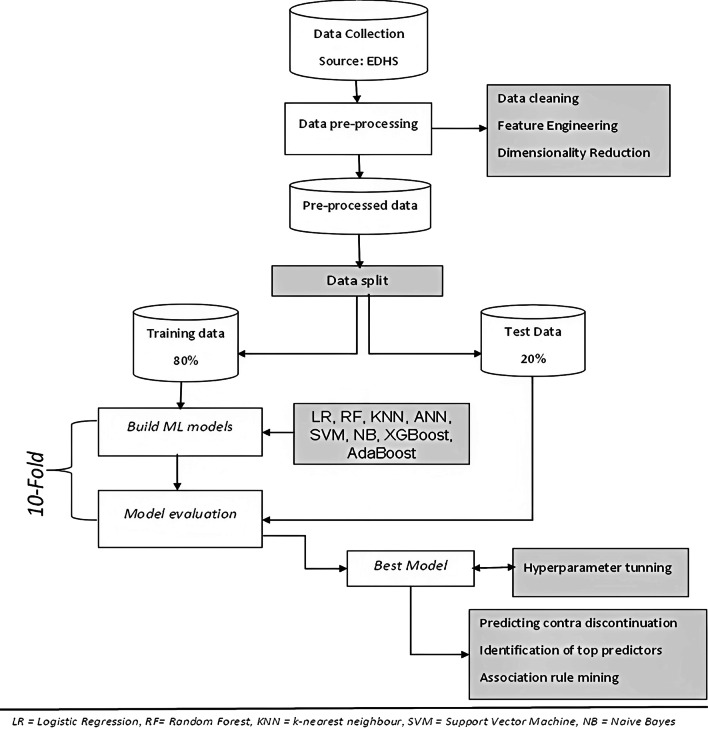
Secondary data analysis was done on the 2016 Ethiopian Demographic and Health Survey. Eight machine learning algorithms were employed on a total sample of 5885 women and evaluated using performance metrics to predict and identify important predictors of discontinuation through python software. Feature importance method was used to select top predictors of contraceptive discontinuation. Finally, association rule mining was applied to discover the relationship between contraceptive discontinuation and its top predictors by using R statistical software.

RESULT

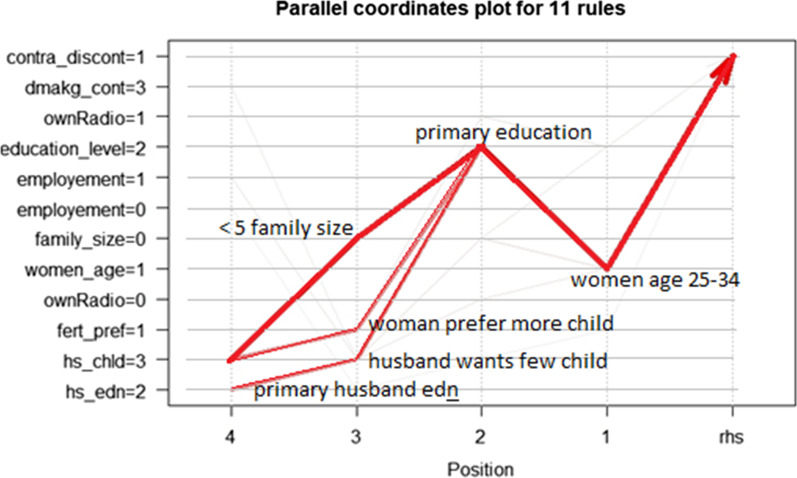
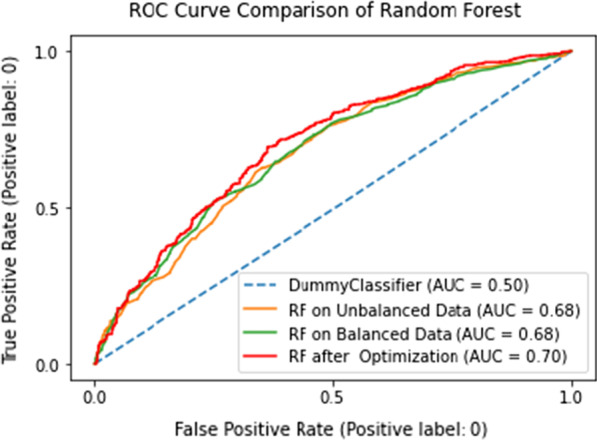
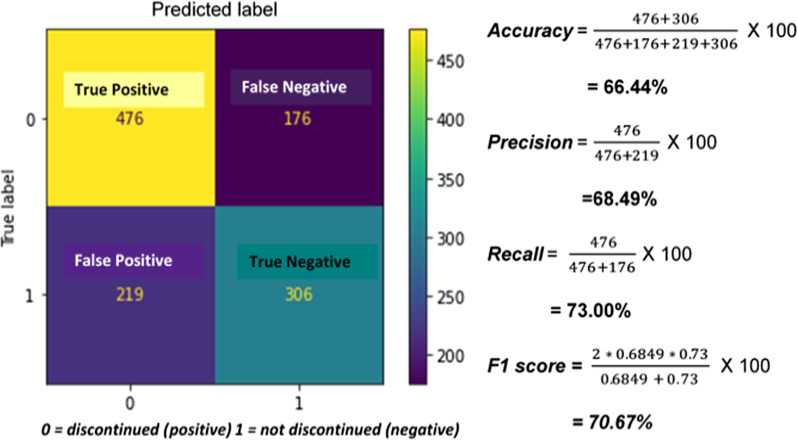
Random forest was the best predictive model with 68% accuracy which identified the top predictors of contraceptive discontinuation. Association rule mining identified women's age, women's education level, family size, husband's desire for children, husband's education level, and women's fertility preference as predictors most frequently associated with contraceptive discontinuation.

CONCLUSION

Results have shown that machine learning algorithms can accurately predict the discontinuation status of contraceptives, making them potentially valuable as decision-support tools for the relevant stakeholders. Through association rule mining analysis of a large dataset, our findings also revealed previously unknown patterns and relationships between contraceptive discontinuation and numerous predictors.

摘要

背景

在全球范围内,38%的避孕使用者在头十二个月内停止使用某种方法。在埃塞俄比亚,约 35%的避孕使用者也在十二个月内停止使用。停止使用会降低避孕覆盖率、计划生育方案的效果,并导致意外怀孕。因此,了解潜在的避孕方法停止使用的预测因素对于减少其不良后果至关重要。预测停止使用避孕药具的风险也可用作预警系统,通知计划生育方案。因此,本研究可以预测和确定埃塞俄比亚避孕方法停止使用的预测因素。

方法

对 2016 年埃塞俄比亚人口与健康调查的二次数据进行了分析。总共对 5885 名妇女进行了 8 种机器学习算法的评估,并使用性能指标进行评估,以通过 python 软件预测和确定停止使用的重要预测因素。使用特征重要性方法选择停止使用避孕药具的最重要预测因素。最后,应用关联规则挖掘方法,通过 R 统计软件发现停止使用避孕药具与其最重要预测因素之间的关系。

结果

随机森林是最具预测性的模型,准确率为 68%,确定了停止使用避孕药具的最重要预测因素。关联规则挖掘确定了妇女年龄、妇女教育程度、家庭规模、丈夫对孩子的愿望、丈夫教育程度和妇女生育意愿是与停止使用避孕药具最常相关的预测因素。

结论

结果表明,机器学习算法可以准确预测避孕药具的停用状态,因此它们可能成为相关利益相关者的决策支持工具。通过对大型数据集的关联规则挖掘分析,我们的研究结果还揭示了以前未知的避孕方法停止使用和众多预测因素之间的模式和关系。
https://cdn.ncbi.nlm.nih.gov/pmc/blobs/364f/9843875/c52663100356/12911_2023_2102_Fig8_HTML.jpg
https://cdn.ncbi.nlm.nih.gov/pmc/blobs/364f/9843875/1d799f8ec776/12911_2023_2102_Fig1_HTML.jpg
https://cdn.ncbi.nlm.nih.gov/pmc/blobs/364f/9843875/b21d2169b561/12911_2023_2102_Fig2_HTML.jpg
https://cdn.ncbi.nlm.nih.gov/pmc/blobs/364f/9843875/fcf5b54c497c/12911_2023_2102_Fig3_HTML.jpg
https://cdn.ncbi.nlm.nih.gov/pmc/blobs/364f/9843875/969c241175b4/12911_2023_2102_Fig4_HTML.jpg
https://cdn.ncbi.nlm.nih.gov/pmc/blobs/364f/9843875/fce3f902e01f/12911_2023_2102_Fig5_HTML.jpg
https://cdn.ncbi.nlm.nih.gov/pmc/blobs/364f/9843875/ebb5b6b1c638/12911_2023_2102_Fig6_HTML.jpg
https://cdn.ncbi.nlm.nih.gov/pmc/blobs/364f/9843875/da785ebb5f3d/12911_2023_2102_Fig7_HTML.jpg
https://cdn.ncbi.nlm.nih.gov/pmc/blobs/364f/9843875/c52663100356/12911_2023_2102_Fig8_HTML.jpg
https://cdn.ncbi.nlm.nih.gov/pmc/blobs/364f/9843875/1d799f8ec776/12911_2023_2102_Fig1_HTML.jpg
https://cdn.ncbi.nlm.nih.gov/pmc/blobs/364f/9843875/b21d2169b561/12911_2023_2102_Fig2_HTML.jpg
https://cdn.ncbi.nlm.nih.gov/pmc/blobs/364f/9843875/fcf5b54c497c/12911_2023_2102_Fig3_HTML.jpg
https://cdn.ncbi.nlm.nih.gov/pmc/blobs/364f/9843875/969c241175b4/12911_2023_2102_Fig4_HTML.jpg
https://cdn.ncbi.nlm.nih.gov/pmc/blobs/364f/9843875/fce3f902e01f/12911_2023_2102_Fig5_HTML.jpg
https://cdn.ncbi.nlm.nih.gov/pmc/blobs/364f/9843875/ebb5b6b1c638/12911_2023_2102_Fig6_HTML.jpg
https://cdn.ncbi.nlm.nih.gov/pmc/blobs/364f/9843875/da785ebb5f3d/12911_2023_2102_Fig7_HTML.jpg
https://cdn.ncbi.nlm.nih.gov/pmc/blobs/364f/9843875/c52663100356/12911_2023_2102_Fig8_HTML.jpg

相似文献

1
Prediction of contraceptive discontinuation among reproductive-age women in Ethiopia using Ethiopian Demographic and Health Survey 2016 Dataset: A Machine Learning Approach.利用埃塞俄比亚 2016 年人口与健康调查数据集预测育龄妇女的避孕措施中断情况:一种机器学习方法。
BMC Med Inform Decis Mak. 2023 Jan 17;23(1):9. doi: 10.1186/s12911-023-02102-w.
2
Modern contraceptive utilisation and its associated factors among reproductive age women in high fertility regions of Ethiopia: a multilevel analysis of Ethiopia Demographic and Health Survey.现代避孕方法的利用及其在高生育率地区埃塞俄比亚育龄妇女中的相关因素:一项基于埃塞俄比亚人口与健康调查的多层次分析。
BMJ Open. 2023 Feb 14;13(2):e066432. doi: 10.1136/bmjopen-2022-066432.
3
Employing supervised machine learning algorithms for classification and prediction of anemia among youth girls in Ethiopia.运用有监督机器学习算法对埃塞俄比亚少女贫血症进行分类和预测。
Sci Rep. 2024 Apr 20;14(1):9080. doi: 10.1038/s41598-024-60027-4.
4
Machine learning modeling for identifying predictors of unmet need for family planning among married/in-union women in Ethiopia: Evidence from performance monitoring and accountability (PMA) survey 2019 dataset.用于识别埃塞俄比亚已婚/同居女性计划生育未满足需求预测因素的机器学习建模:来自2019年绩效监测与问责制(PMA)调查数据集的证据
PLOS Digit Health. 2023 Oct 17;2(10):e0000345. doi: 10.1371/journal.pdig.0000345. eCollection 2023 Oct.
5
Magnitude and factors for method discontinuation and switching among long acting reversible contraceptive users in health facilities of Southern Ethiopia.在埃塞俄比亚南部的医疗机构中,长效可逆避孕措施使用者停止使用和转换方法的规模和因素。
Reprod Health. 2022 Feb 19;19(1):47. doi: 10.1186/s12978-022-01357-2.
6
Factors associated with early long-acting reversible contraceptives discontinuation in Ethiopia: evidence from the 2016 Ethiopian demographic and health survey.埃塞俄比亚长效可逆避孕药早期停用的相关因素:来自2016年埃塞俄比亚人口与健康调查的证据。
Arch Public Health. 2020 Jul 1;78:36. doi: 10.1186/s13690-020-00419-w. eCollection 2020.
7
Modern contraceptive utilization and associated factors among reproductive-age women in Ethiopia: evidence from 2016 Ethiopia demographic and health survey.现代避孕方法的利用及其在埃塞俄比亚育龄妇女中的相关因素:来自 2016 年埃塞俄比亚人口与健康调查的证据。
BMC Womens Health. 2020 Mar 26;20(1):61. doi: 10.1186/s12905-020-00923-9.
8
Prevalence of married women's decision-making autonomy on contraceptive use and its associated factors in high fertility regions of Ethiopia: a multilevel analysis using EDHS 2016 data.埃塞俄比亚高生育率地区已婚妇女避孕使用决策自主权的流行情况及其相关因素:基于 EDHS 2016 数据的多水平分析。
BMC Public Health. 2023 Jan 11;23(1):83. doi: 10.1186/s12889-023-15009-y.
9
Employing advanced supervised machine learning approaches for predicting micronutrient intake status among children aged 6-23 months in Ethiopia.采用先进的监督式机器学习方法预测埃塞俄比亚6至23个月大儿童的微量营养素摄入状况。
Front Nutr. 2024 Jun 11;11:1397399. doi: 10.3389/fnut.2024.1397399. eCollection 2024.
10
Discontinuation rate of long-acting reversible contraceptives and associated factors among reproductive-age women in Butajira town, Central Ethiopia.埃塞俄比亚布塔吉拉镇育龄妇女中长效可逆避孕措施的停用率及其相关因素。
Womens Health (Lond). 2022 Jan-Dec;18:17455057221104656. doi: 10.1177/17455057221104656.

引用本文的文献

1
Predicting antiretroviral therapy adherence status of adult HIV-positive patients using machine-learning Northwest, Ethiopia, 2025.使用机器学习预测埃塞俄比亚西北部2025年成年HIV阳性患者的抗逆转录病毒治疗依从性状况
BMC Med Inform Decis Mak. 2025 Jul 10;25(1):259. doi: 10.1186/s12911-025-03106-4.
2
Explainable machine learning algorithms to identify predictors of intention to use family planning among women of reproductive-age in Ethiopia: Evidence from the Performance Monitoring and Accountability (PMA) 2021 survey data set.用于识别埃塞俄比亚育龄妇女计划生育使用意愿预测因素的可解释机器学习算法:来自2021年绩效监测与问责制(PMA)调查数据集的证据。
BMJ Public Health. 2025 Apr 17;3(1):e000962. doi: 10.1136/bmjph-2024-000962. eCollection 2025.
3

本文引用的文献

1
Discontinuation rate of long-acting reversible contraceptives and associated factors among reproductive-age women in Butajira town, Central Ethiopia.埃塞俄比亚布塔吉拉镇育龄妇女中长效可逆避孕措施的停用率及其相关因素。
Womens Health (Lond). 2022 Jan-Dec;18:17455057221104656. doi: 10.1177/17455057221104656.
2
Machine learning-based risk factor analysis and prevalence prediction of intestinal parasitic infections using epidemiological survey data.基于机器学习的肠道寄生虫感染风险因素分析及流行预测:利用流行病学调查数据。
PLoS Negl Trop Dis. 2022 Jun 14;16(6):e0010517. doi: 10.1371/journal.pntd.0010517. eCollection 2022 Jun.
3
Machine-learning algorithm to predict home delivery after antenatal care visit among reproductive age women in East Africa.用于预测东非育龄妇女产前检查后家庭分娩情况的机器学习算法
Front Glob Womens Health. 2025 Jun 5;6:1461475. doi: 10.3389/fgwh.2025.1461475. eCollection 2025.
4
Predictors of community-based health insurance enrollment among reproductive-age women in Ethiopia based on the EDHS 2019 dataset: a study using SHAP analysis technique, 2024.基于2019年埃塞俄比亚人口与健康调查数据集的育龄妇女社区医疗保险参保预测因素:一项使用SHAP分析技术的研究,2024年
Front Public Health. 2025 Mar 20;13:1448055. doi: 10.3389/fpubh.2025.1448055. eCollection 2025.
5
Ensemble learning to predict short birth interval among reproductive-age women in Ethiopia: evidence from EDHS 2016-2019.集成学习预测埃塞俄比亚育龄妇女的短生育间隔:来自2016 - 2019年埃塞俄比亚人口与健康调查的证据
BMC Pregnancy Childbirth. 2025 Feb 5;25(1):121. doi: 10.1186/s12884-025-07248-1.
6
Prediction of stunting and its socioeconomic determinants among adolescent girls in Ethiopia using machine learning algorithms.使用机器学习算法预测埃塞俄比亚青春期女孩发育迟缓情况及其社会经济决定因素。
PLoS One. 2025 Jan 24;20(1):e0316452. doi: 10.1371/journal.pone.0316452. eCollection 2025.
7
Exploring machine learning algorithms to predict not using modern family planning methods among reproductive age women in East Africa.探索机器学习算法以预测东非育龄妇女不使用现代计划生育方法的情况。
BMC Health Serv Res. 2024 Dec 18;24(1):1595. doi: 10.1186/s12913-024-11932-x.
8
Spatial variations and predictors of overweight/obesity among under-five children in Ethiopia: A geographically weighted regression analysis of the 2019 Ethiopian Mini Demographic and Health Survey.埃塞俄比亚五岁以下儿童超重/肥胖的空间变化及其预测因素:2019 年埃塞俄比亚迷你人口与健康调查的地理加权回归分析。
PLoS One. 2024 Oct 14;19(10):e0312025. doi: 10.1371/journal.pone.0312025. eCollection 2024.
9
Prediction of delayed breastfeeding initiation among mothers having children less than 2 months of age in East Africa: application of machine learning algorithms.预测东非 2 个月以下婴儿母亲延迟开始母乳喂养:机器学习算法的应用。
Front Public Health. 2024 Sep 2;12:1413090. doi: 10.3389/fpubh.2024.1413090. eCollection 2024.
10
Prediction of childbearing tendency in women on the verge of marriage using machine learning techniques.使用机器学习技术预测即将步入婚姻的女性的生育倾向。
Sci Rep. 2024 Sep 6;14(1):20811. doi: 10.1038/s41598-024-71854-w.
Age, sex, residence, and region-specific differences in prevalence and patterns of multimorbidity among older Chinese: evidence from Chinese Longitudinal Healthy Longevity Survey.
中国老年人口多模态共病的流行率和模式在年龄、性别、居住和地区方面的差异:来自中国健康长寿纵向研究的证据。
BMC Public Health. 2022 Jun 4;22(1):1116. doi: 10.1186/s12889-022-13506-0.
4
Obesity is negatively associated with dental caries among children and adolescents in Huizhou: a cross-sectional study.肥胖与惠州儿童和青少年的龋齿呈负相关:一项横断面研究。
BMC Oral Health. 2022 Mar 17;22(1):76. doi: 10.1186/s12903-022-02105-5.
5
Magnitude and associated factors of early Implanon discontinuation among rural women in public health facilities of central Ethiopia: a community-based cross-sectional study.在埃塞俄比亚中部公共卫生机构中,农村妇女提前取出 Implanon 的情况及其相关因素:一项基于社区的横断面研究。
BMC Womens Health. 2022 Mar 14;22(1):72. doi: 10.1186/s12905-022-01651-y.
6
Magnitude and factors for method discontinuation and switching among long acting reversible contraceptive users in health facilities of Southern Ethiopia.在埃塞俄比亚南部的医疗机构中,长效可逆避孕措施使用者停止使用和转换方法的规模和因素。
Reprod Health. 2022 Feb 19;19(1):47. doi: 10.1186/s12978-022-01357-2.
7
The Application and Comparison of Machine Learning Models for the Prediction of Breast Cancer Prognosis: Retrospective Cohort Study.机器学习模型在乳腺癌预后预测中的应用与比较:回顾性队列研究
JMIR Med Inform. 2022 Feb 18;10(2):e33440. doi: 10.2196/33440.
8
Factors affecting motorcycle crash casualty severity at signalized and non-signalized intersections in Ghana: Insights from a data mining and binary logit regression approach.影响加纳信号交叉口和非信号交叉口摩托车事故严重程度的因素:数据挖掘和二项逻辑回归方法的见解。
Accid Anal Prev. 2022 Feb;165:106517. doi: 10.1016/j.aap.2021.106517. Epub 2021 Dec 9.
9
Feature Importance of Acute Rejection among Black Kidney Transplant Recipients by Utilizing Random Forest Analysis: An Analysis of the UNOS Database.利用随机森林分析评估黑人肾移植受者急性排斥反应的特征重要性:对器官共享联合网络(UNOS)数据库的分析
Medicines (Basel). 2021 Nov 2;8(11):66. doi: 10.3390/medicines8110066.
10
A Machine Learning Framework for Balancing Training Sets of Sensor Sequential Data Streams.用于平衡传感器序列数据流训练集的机器学习框架。
Sensors (Basel). 2021 Oct 18;21(20):6892. doi: 10.3390/s21206892.