Fekadu Gedefaw Abeje, Omigbodun Akinyinka O, Roberts Olumuyiwa A, Yalew Alemayehu Worku
Pan African University, Institute of Life and Earth Sciences (including Health and Agriculture), University of Ibadan, Ibadan, Nigeria.
College of Medicine and Health Sciences, School of Public Health, Bahir Dar University, Bahir Dar, Ethiopia.
Arch Public Health. 2020 Jul 1;78:36. doi: 10.1186/s13690-020-00419-w. eCollection 2020.
Ethiopia is struggling to achieve the 2020 family planning target. But the current contraceptive prevalence uptake is low and dominated by short-acting methods. Contraceptive discontinuation rate is also high. This analysis was done to identify the reasons and factors associated with long-acting and reversible contraceptives (LARC) discontinuation in Ethiopia.
The unit of analysis was LARC-use episodes in the 5 years preceding the survey, generated from the 2016 Ethiopian Demographic and Health Survey data. A total of 1385 LARC episodes were included. Data analysis was done using STATA 15. The event file generated from the contraceptive calendar was merged to the original data set to identify factors associated with LARC discontinuation. Univariate, bivariate and inferential analyses were done for 12 months LARC discontinuation.
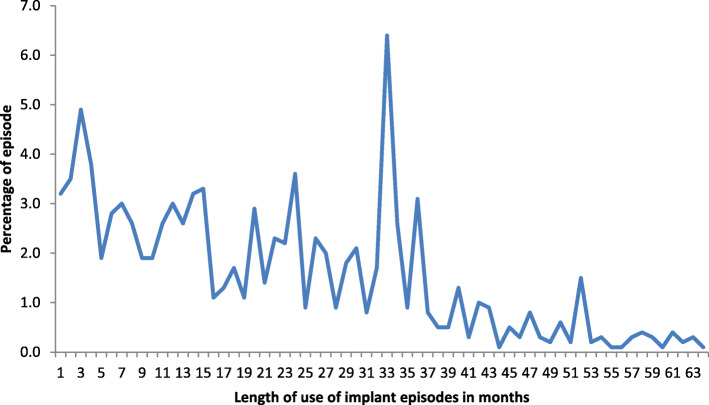
Approximately 82% of LARC episodes were implants. About 45% of intrauterine device (IUD) and 61% of implant episodes were discontinued by 36 months. Side effects and the desire to become pregnant were the main reasons for discontinuation. Women aged 25-34 (HR = 0.26; 95% CI: 0.20-0.35) and those aged 35-49 (HR = 0.17; 95%CI: 0.11-0.26), women who participated in decision-making partially (HR = 0.53; 95%CI: 0.37-0.78), or fully (HR = 0.55; 95%CI: 0.40-0.74) and primiparous women (HR = 0.53, 95%CI: 0.33-0.86) had a lower hazard of discontinuing LARCs. On the other hand, women who had only primary education (HR = 1.32; 95%CI: 1.02-1.72) and women who were not sure about their fertility intention (HR = 2.11; 95%C: 1.28-3.46) had a higher likelihood of discontinuing these methods.
Majority of LARC episodes were discontinued early, mainly due to the desire for pregnancy or experience of side effects. Older women, particularly those involved in household decision-making, and primipara were less likely to discontinue LARC. Women with only primary education and those uncertain about their fertility intention had a higher likelihood of discontinuation. Family planning service providers should focus on fertility intention and side effects when counseling women for contraceptive choice. Improving women's participation in household decision-making may decrease LARC discontinuation in Ethiopia.
埃塞俄比亚正在努力实现2020年计划生育目标。但目前的避孕普及率较低,且以短效方法为主。避孕措施的停用率也很高。进行这项分析是为了确定埃塞俄比亚长效可逆避孕方法(LARC)停用的原因及相关因素。
分析单位是调查前5年的LARC使用情况,数据来自2016年埃塞俄比亚人口与健康调查。共纳入1385个LARC使用情况。使用STATA 15进行数据分析。将避孕日历生成 的事件文件与原始数据集合并,以确定与LARC停用相关的因素。对LARC停用12个月的情况进行单变量、双变量和推断分析。
约82%的LARC使用情况为皮下埋植剂。到36个月时,约45%的宫内节育器(IUD)和61%的皮下埋植剂使用情况被停用。副作用和怀孕意愿是停用的主要原因。25 - 34岁的女性(风险比[HR]=0.26;95%置信区间[CI]:0.20 - 0.35)和35 - 49岁的女性(HR = 0.17;95%CI:0.11 - 0.26)、部分参与决策(HR = 0.53;95%CI:0.37 - 0.78)或完全参与决策(HR = 0.55;95%CI:0.40 - 0.74)的女性以及初产妇(HR = 0.53,95%CI:0.33 - 0.86)停用LARC的风险较低。另一方面,仅接受过小学教育的女性(HR = 1.32;95%CI:1.02 - 1.72)和不确定自己生育意愿的女性(HR = 2.11;95%CI:1.28 - 3.46)停用这些方法的可能性更高。
大多数LARC使用情况早期就被停用,主要是由于怀孕意愿或副作用经历。年龄较大的女性,特别是参与家庭决策的女性以及初产妇停用LARC的可能性较小。仅接受过小学教育的女性和不确定自己生育意愿的女性停用的可能性更高。计划生育服务提供者在为女性提供避孕选择咨询时应关注生育意愿和副作用。提高女性对家庭决策的参与度可能会降低埃塞俄比亚LARC的停用率。