Division of Pulmonary and Critical Care Medicine, Department of Internal Medicine, University of Michigan, 1500 E Medical Center Dr. Floor 3 Reception C, Ann Arbor, MI, 48109, USA.
UH/CVC Department of Respiratory Care, University of Michigan, Ann Arbor, MI, USA.
Crit Care. 2023 Jan 17;27(1):21. doi: 10.1186/s13054-023-04315-x.
In patients with acute respiratory distress syndrome undergoing mechanical ventilation, positive end-expiratory pressure (PEEP) can lead to recruitment or overdistension. Current strategies utilized for PEEP titration do not permit the distinction. Electric impedance tomography (EIT) detects and quantifies the presence of both collapse and overdistension. We investigated whether using EIT-guided PEEP titration leads to decreased mechanical power compared to high-PEEP/FiO2 tables.
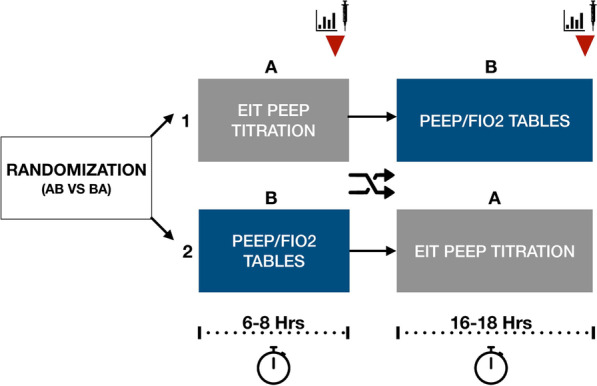
A single-center, randomized crossover pilot trial comparing EIT-guided PEEP selection versus PEEP selection using the High-PEEP/FiO table in patients with moderate-severe acute respiratory distress syndrome. The primary outcome was the change in mechanical power after each PEEP selection strategy. Secondary outcomes included changes in the 4 × driving pressure + respiratory rate (4 ΔP, + RR index) index, driving pressure, plateau pressure, PaO/FiO ratio, and static compliance.
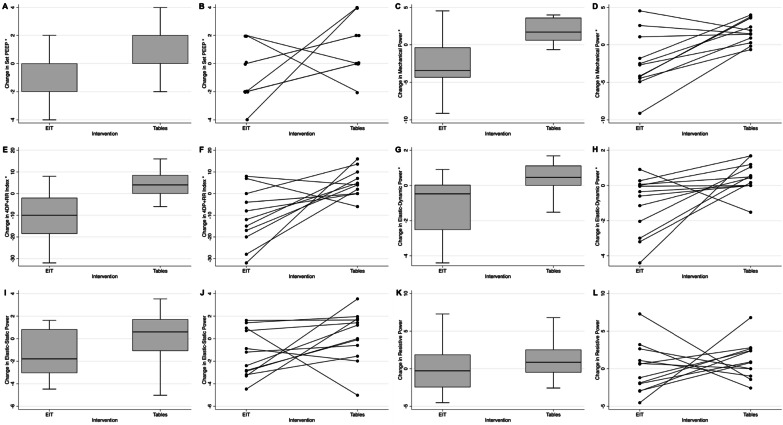
EIT was consistently associated with a decrease in mechanical power compared to PEEP/FiO tables (mean difference - 4.36 J/min, 95% CI - 6.7, - 1.95, p = 0.002) and led to lower values in the 4ΔP + RR index (- 11.42 J/min, 95% CI - 19.01, - 3.82, p = 0.007) mainly driven by a decrease in the elastic-dynamic power (- 1.61 J/min, - 2.99, - 0.22, p = 0.027). The elastic-static and resistive powers were unchanged. Similarly, EIT led to a statistically significant change in set PEEP (- 2 cmHO, p = 0.046), driving pressure, (- 2.92 cmH2O, p = 0.003), peak pressure (- 6.25 cmHO, p = 0.003), plateau pressure (- 4.53 cmHO, p = 0.006), and static respiratory system compliance (+ 7.93 ml/cmHO, p = 0.008).
In patients with moderate-severe acute respiratory distress syndrome, EIT-guided PEEP titration reduces mechanical power mainly through a reduction in elastic-dynamic power. Trial registration This trial was prospectively registered on Clinicaltrials.gov (NCT03793842) on January 4th, 2019.
在接受机械通气治疗的急性呼吸窘迫综合征患者中,呼气末正压(PEEP)可导致肺复张或过度膨胀。目前用于 PEEP 滴定的策略无法区分这两种情况。电阻抗断层成像(EIT)可检测和量化肺萎陷和过度膨胀的存在。我们研究了与高 PEEP/FiO2 表相比,使用 EIT 指导的 PEEP 滴定是否会导致机械功率降低。
一项单中心、随机交叉先导试验,比较了 EIT 指导的 PEEP 选择与高 PEEP/FiO 表指导的 PEEP 选择在中重度急性呼吸窘迫综合征患者中的应用。主要结局是每种 PEEP 选择策略后机械功率的变化。次要结局包括 4×驱动压+呼吸频率(4ΔP,+RR 指数)指数、驱动压、平台压、PaO/FiO 比值和静态顺应性的变化。
EIT 与 PEEP/FiO 表相比,始终与机械功率降低相关(平均差异-4.36 J/min,95%置信区间-6.7,-1.95,p=0.002),并导致 4ΔP+RR 指数降低(-11.42 J/min,95%置信区间-19.01,-3.82,p=0.007),主要是由于弹性-动力功率降低(-1.61 J/min,-2.99,-0.22,p=0.027)。弹性静力学和阻力功率没有变化。同样,EIT 导致设定 PEEP(-2 cmHO,p=0.046)、驱动压(-2.92 cmH2O,p=0.003)、峰值压(-6.25 cmHO,p=0.003)、平台压(-4.53 cmHO,p=0.006)和静态呼吸系统顺应性(+7.93 ml/cmHO,p=0.008)的统计学显著变化。
在中重度急性呼吸窘迫综合征患者中,EIT 指导的 PEEP 滴定通过降低弹性-动力功率主要降低机械功率。
本试验于 2019 年 1 月 4 日在 Clinicaltrials.gov(NCT03793842)上进行了前瞻性注册。