National Institute of Animal Biotechnology (NIAB), Hyderabad, Telangana, India.
Graduate Studies, Regional Centre for Biotechnology (RCB), Faridabad, Haryana, India.
Microbiol Spectr. 2023 Feb 14;11(1):e0250222. doi: 10.1128/spectrum.02502-22. Epub 2023 Jan 18.
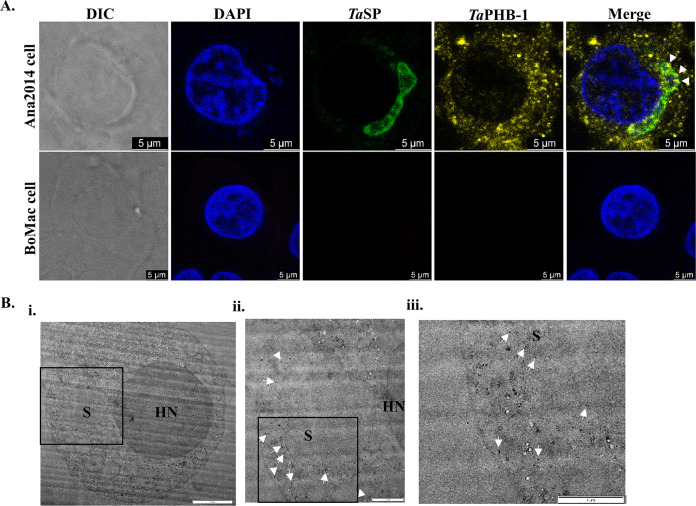
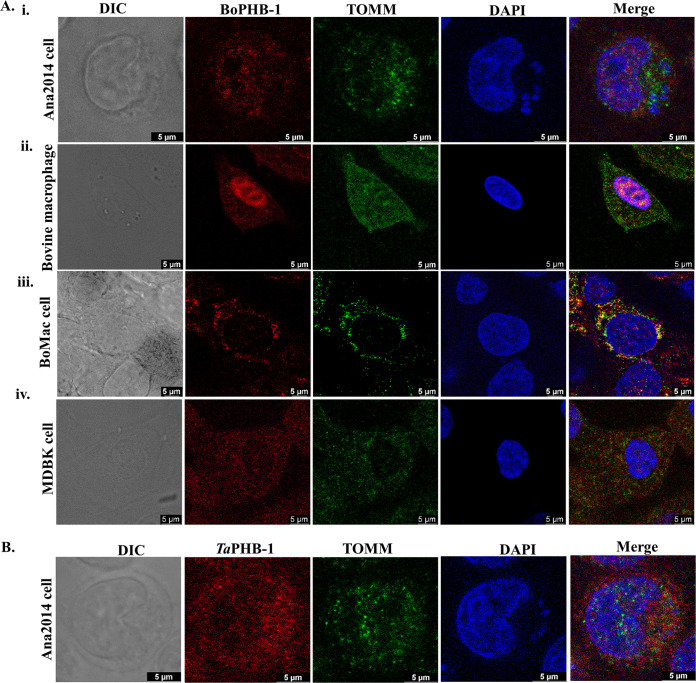
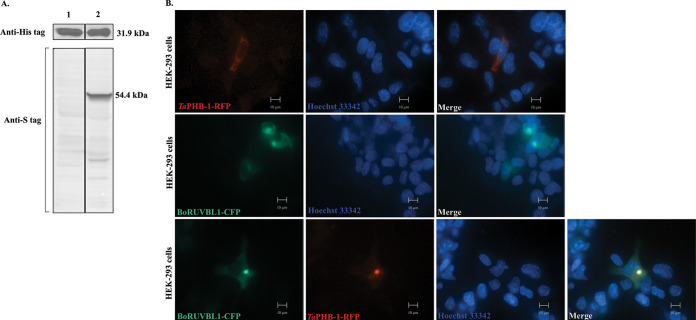
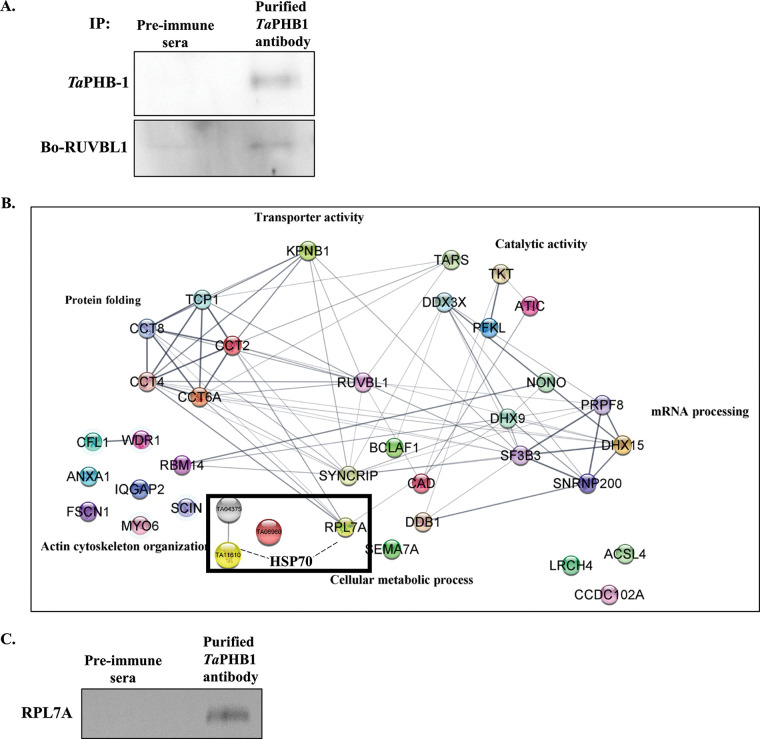
Theileriosis is a tick-borne disease caused by Theileria annulata, an intracellular parasite that belongs to the phylum Apicomplexa. The infective forms of the parasite to cattle are sporozoites that are introduced into the host when the infected ticks take a blood meal. The sporozoites selectively invade bovine B cells, macrophages, or monocytes, leading to their cellular transformation. The parasite factors involved in the host cell transformation are not well explored. In pursuit of this, we revisited the probable secretome of the parasite and, following a stringent downscaling criterion, have identified prohibitin (PHB-1) as one of factors secreted into the host cells. Interestingly, in infected cells, PHB-1 localized both on the parasite surface and in the host cytoplasm, and independent approaches such as coimmunoprecipitation, yeast two-hybrid screening (Y2H), and liquid chromatography-tandem mass spectrometry (LC-MS/MS) confirmed RuvB-like AAA ATPase 1 (RUVBL-1) as one of its interacting partners. Further, the infection does not affect the localization of bovine prohibitin. Mitigating the expression of bovine RUVBL-1 precluded the translocation of PHB-1 in the host cell cytoplasm without affecting the host cell viability. Taken together, we report for the first time a unique interaction of PHB-1 with bovine RUVBL-1 that is likely needed to cause cancer-like hallmarks during theileriosis. Theileria annulata is an apicomplexan parasite that causes tropical theileriosis in cattle. It is the only eukaryotic pathogen able to cause cellular transformation of host cells yielding a cancer-like phenotype. The parasite factors responsible for the transformation of the host cell are largely unknown. This study demonstrates for the first time the partial role of prohibitin (PHB-1) in maintaining the transformed state of the host cell and its interaction with RuvB-like AAA ATPase 1 (RUVBL-1) in a -infected bovine cell line. Interestingly, the knockdown of bovine RUVBL-1 rendered the parasites metabolically inactive, implying that the identified interaction is critical for parasite survival. This study contributes to our understanding the -host interactions and offers scope for novel therapeutic interventions to control theileriosis.
环形泰勒虫病是一种由环形泰勒虫引起的蜱传疾病,环形泰勒虫是一种属于顶复门的细胞内寄生虫。感染牛的寄生虫的感染形式是裂殖子,当受感染的蜱吸食血液时,裂殖子就会进入宿主。裂殖子选择性地侵入牛的 B 细胞、巨噬细胞或单核细胞,导致它们的细胞转化。参与宿主细胞转化的寄生虫因子尚未得到很好的探索。为了研究这个问题,我们重新研究了寄生虫的可能分泌组,并按照严格的缩小标准,鉴定出抑制素(PHB-1)是分泌到宿主细胞中的一种因子。有趣的是,在感染细胞中,PHB-1既定位在寄生虫表面,也定位在宿主细胞质中,并且通过免疫共沉淀、酵母双杂交筛选(Y2H)和液相色谱-串联质谱(LC-MS/MS)等独立方法证实 RuvB 样 AAA ATP 酶 1(RUVBL-1)是其相互作用伙伴之一。此外,感染不会影响牛抑制素的定位。减轻牛 RUVBL-1 的表达可防止 PHB-1 在宿主细胞质中的易位,而不影响宿主细胞活力。综上所述,我们首次报告了 PHB-1 与牛 RUVBL-1 的独特相互作用,这种相互作用可能是环形泰勒虫病引起类似癌症特征所必需的。环形泰勒虫是一种引起热带泰勒虫病的顶复门寄生虫,它是唯一能够导致宿主细胞转化产生类似癌症表型的真核病原体。负责宿主细胞转化的寄生虫因子在很大程度上是未知的。本研究首次证明了抑制素(PHB-1)在维持宿主细胞转化状态中的部分作用及其与 RuvB 样 AAA ATP 酶 1(RUVBL-1)在感染牛细胞系中的相互作用。有趣的是,牛 RUVBL-1 的敲低使寄生虫代谢失活,这意味着鉴定出的相互作用对寄生虫的生存至关重要。本研究有助于我们理解 -宿主相互作用,并为控制泰勒虫病提供了新的治疗干预的范围。