Institute of Biodiversity, Animal Health and Comparative Medicine, University of Glasgow, UK.
Department of Veterinary Parasitology, Nagpur Veterinary College, Maharashtra Animal and Fisheries Sciences University, Nagpur, India.
Infect Genet Evol. 2019 Nov;75:103972. doi: 10.1016/j.meegid.2019.103972. Epub 2019 Jul 22.
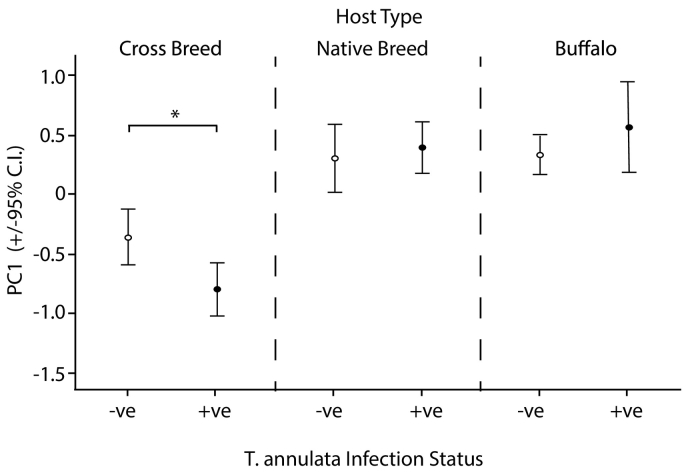
Tick-borne pathogens (TBP) are a major source of production loss and a welfare concern in livestock across the globe. Consequently, there is a trade-off between keeping animals that are tolerant to TBP infection, but are less productive than more susceptible breeds. Theileria annulata is a major TBP of bovines, with different host types (i.e. exotic and native cattle breeds, and buffalo) displaying demonstrable differences in clinical susceptibility to infection. However, the extent to which these differences are driven by genetic/physiological differences between hosts, or by different parasite populations/genotypes preferentially establishing infection in different host breeds and species is unclear. In this study, three different bovine host types in India were blood sampled to test for the presence of various TBP, including Theileria annulata, to determine whether native cattle (Bos indicus breeds), crossbreed cattle (Bos taurus x Bos indicus breeds) or water buffalo (Bubalus bubalis) differ in the physiological consequences of infection. Population genetic analyses of T. annulata isolated from the three different host types was also performed, using a panel of mini- and micro-satellite markers, to test for sub-structuring of the parasite population among host types. We discovered that compared to other host types, "carrier" crossbreed cattle showed a higher level of haematological pathology when infected with T. annulata. Despite this finding, we found no evidence for differences in the genotypes of T. annulata infecting different host types, although buffalo appeared to harbour fewer mixed parasite genotype infections, indicating they are not the major reservoir of parasite diversity. The apparent tolerance/resistance of native breed cattle and buffalo to the impacts of T. annulata infection is thus most likely to be driven by host genotype, rather than differences in the parasite population. Our results suggest that an improved understanding of the genetic factors that underpin disease resistance could help to ameliorate future economic loss due to TBP or tropical theileriosis.
蜱传病原体(TBP)是全球范围内家畜生产损失和福利问题的主要来源。因此,在保持对 TBP 感染具有耐受性但生产性能低于更易感品种的动物之间存在权衡。环形泰勒虫是牛的主要 TBP,不同的宿主类型(即外来牛品种和本地牛品种以及水牛)在感染的临床易感性方面表现出明显的差异。然而,这些差异在多大程度上是由宿主之间的遗传/生理差异驱动的,或者是由不同的寄生虫种群/基因型优先在不同的宿主品种和物种中建立感染驱动的,目前尚不清楚。在这项研究中,从印度的三种不同的牛宿主类型中采集血液样本,以检测各种 TBP 的存在,包括环形泰勒虫,以确定本地牛(印度野牛品种)、杂交牛(黄牛 x 印度野牛品种)或水牛(印度水牛)在感染的生理后果上是否存在差异。还使用微卫星标记面板对从三种不同宿主类型中分离出的 T. annulata 进行了种群遗传分析,以检验寄生虫种群在宿主类型之间的亚结构。我们发现,与其他宿主类型相比,携带 T. annulata 感染的杂交牛“携带者”表现出更高水平的血液病理学。尽管有这一发现,但我们没有发现感染不同宿主类型的 T. annulata 基因型存在差异的证据,尽管水牛似乎携带的混合寄生虫基因型感染较少,表明它们不是寄生虫多样性的主要宿主。因此,本地牛品种和水牛对 T. annulata 感染的影响的明显耐受性/抵抗力很可能是由宿主基因型而不是寄生虫种群的差异驱动的。我们的研究结果表明,更好地了解支持疾病抗性的遗传因素,可能有助于减轻未来由于 TBP 或热带泰勒虫病而造成的经济损失。