School of Health and Related Research, The University of Sheffield, Regent Court, 30 Regent Street, Sheffield, S1 4DA, UK.
ConnectHEOR Ltd, London, UK.
Pharmacoeconomics. 2023 Mar;41(3):227-237. doi: 10.1007/s40273-022-01229-4. Epub 2023 Jan 18.
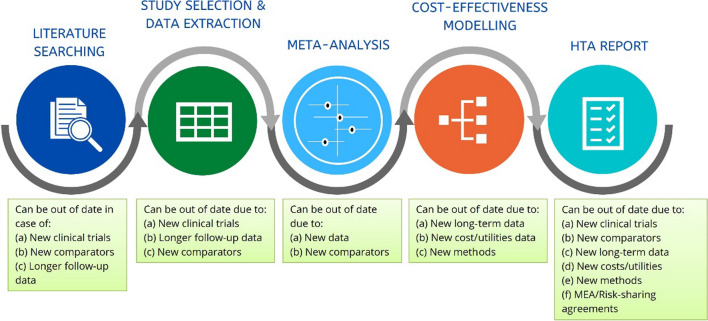
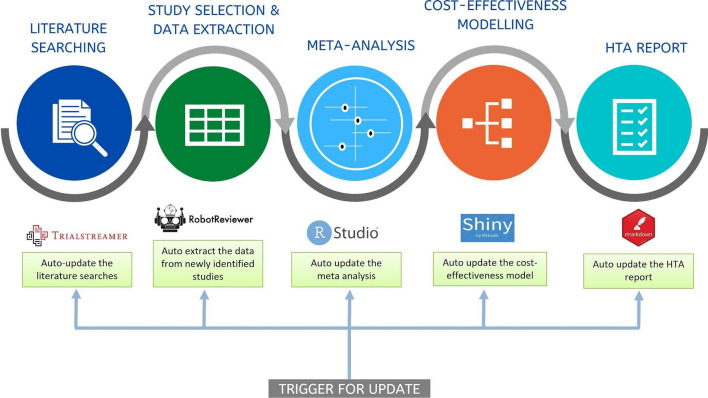
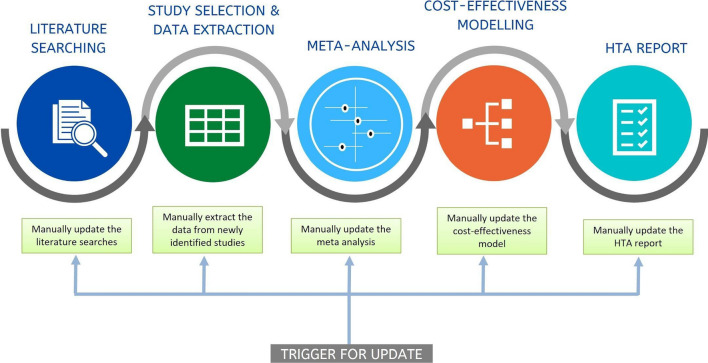
Health technology assessments (HTAs) are typically performed as one-off evaluations and can potentially become out-of-date due to the availability of new data, new comparators, or other factors. Recently, living approaches have been applied to systematic reviews and network meta-analyses to enable evidence syntheses to be updated more easily. In this paper, we provide a definition for 'Living HTA' where such a living approach could be applied to the entire HTA process. Living HTA could involve performing regular or scheduled updates using a traditional manual approach, or indeed in a semi-automated manner leveraging recent technological innovations that automate parts of the HTA process. The practical implementation of living HTA using both approaches (i.e., manual approach and using semi-automation) is described along with the likely issues and challenges with planning and implementing a living HTA process. The time, resources and additional considerations outlined may prohibit living HTA from becoming the norm for every evaluation; however, scenarios where living HTA would be particularly beneficial are discussed.
健康技术评估(HTA)通常作为一次性评估进行,由于新数据、新对照物或其他因素的出现,可能会变得过时。最近,人们采用了动态方法来进行系统评价和网络荟萃分析,以便更轻松地更新证据综合。在本文中,我们提供了“动态 HTA”的定义,其中可以将这种动态方法应用于整个 HTA 过程。动态 HTA 可能涉及使用传统的手动方法定期或定期进行更新,或者实际上以半自动化的方式利用最近的技术创新来自动化 HTA 过程的部分环节。描述了使用这两种方法(即手动方法和使用半自动化)实施动态 HTA 的实际操作,以及规划和实施动态 HTA 过程中可能出现的问题和挑战。概述的时间、资源和其他考虑因素可能会阻止动态 HTA 成为每个评估的标准;然而,讨论了特别有利于动态 HTA 的情况。