Department of Sociology, College of Liberal Arts, University of Minnesota, Minneapolis, Minnesota; Minnesota Population Center, University of Minnesota, Minneapolis, Minnesota.
Division of Epidemiology & Community Health, University of Minnesota School of Public Health, Minneapolis, Minnesota.
Am J Prev Med. 2023 Feb;64(2):259-264. doi: 10.1016/j.amepre.2022.08.005. Epub 2022 Nov 1.
Recent research underscores the exceptionally young age distribution of COVID-19 deaths in the U.S. compared with that of international peers. This paper characterizes how high levels of COVID-19 mortality at midlife ages (45-64 years) are deeply intertwined with continuing racial inequity in COVID-19 mortality.
Mortality data from Minnesota in 2020-2022 were analyzed in June 2022. Death certificate data (COVID-19 deaths N=12,771) and published vaccination rates in Minnesota allow vaccination and mortality rates to be observed with greater age and temporal precision than national data.
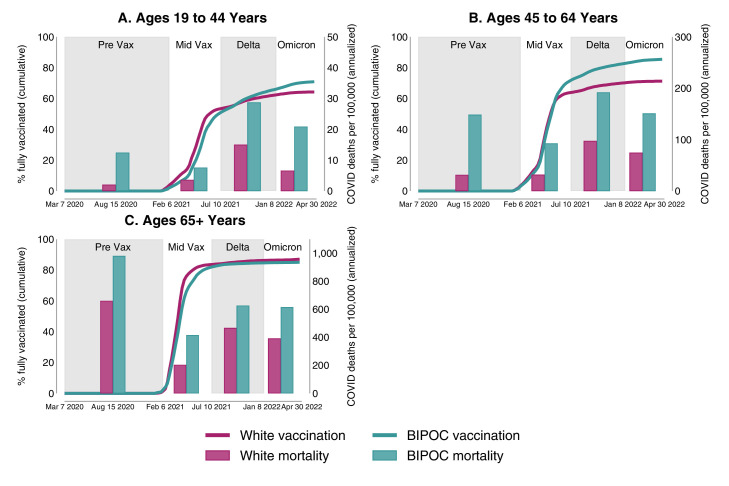
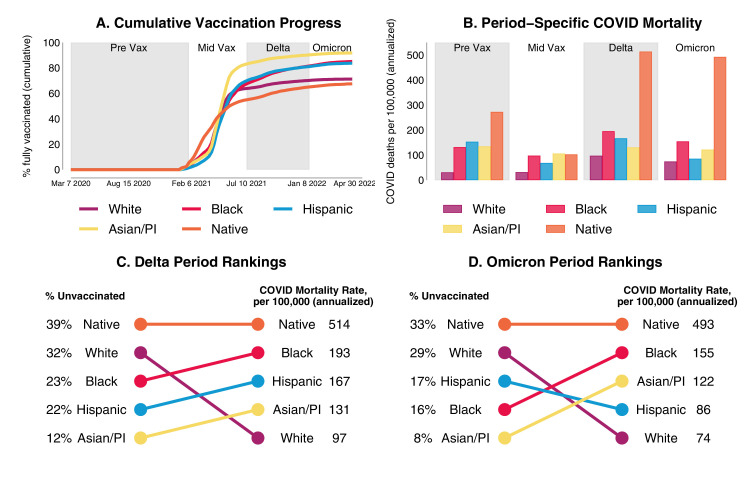
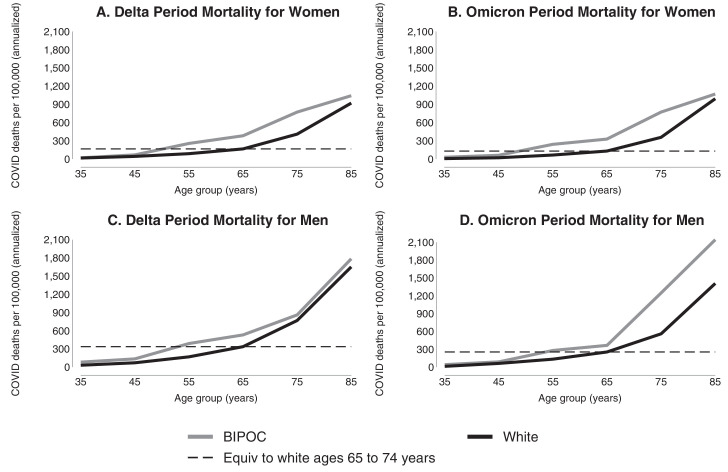
Black, Hispanic, and Asian adults aged <65 years were all more highly vaccinated than White populations of the same ages during most of Minnesota's substantial and sustained Delta surge and all the subsequent Omicron surges. However, White mortality rates were lower than those of all other groups. These disparities were extreme; at midlife ages (ages 45-64 years), during the Omicron period, more highly vaccinated populations had COVID-19 mortality that was 164% (Asian-American), 115% (Hispanic), or 208% (Black) of White COVID-19 mortality at these ages. In Black, Indigenous, and People of Color populations as a whole, COVID-19 mortality at ages 55-64 years was greater than White mortality at 10 years older.
This discrepancy between vaccination and mortality patterning by race/ethnicity suggests that if the current period is a pandemic of the unvaccinated, it also remains a pandemic of the disadvantaged in ways that can decouple from vaccination rates. This result implies an urgent need to center health equity in the development of COVID-19 policy measures.
最近的研究强调,与国际同行相比,美国 COVID-19 死亡病例的年龄分布极为年轻。本文描述了中年(45-64 岁)COVID-19 死亡率水平较高与 COVID-19 死亡率持续存在的种族不平等之间的深度交织。
2022 年 6 月分析了 2020-2022 年明尼苏达州的死亡率数据。明尼苏达州的死亡证明数据(COVID-19 死亡人数 N=12771)和已公布的疫苗接种率使疫苗接种和死亡率能够以比国家数据更高的年龄和时间精度进行观察。
在明尼苏达州 Delta 浪潮大幅持续期间以及随后的所有 Omicron 浪潮中,年龄<65 岁的黑人群体、西班牙裔群体和亚裔成年人的疫苗接种率均高于同年龄段的白人。然而,白人的死亡率却低于其他所有群体。这些差异非常显著;在中年(45-64 岁)年龄组中,在 Omicron 期间,疫苗接种率较高的人群 COVID-19 死亡率是同年龄段白人的 164%(亚裔美国人)、115%(西班牙裔)或 208%(非裔美国人)。在整个黑人群体、原住民和有色人种中,55-64 岁年龄组的 COVID-19 死亡率高于白人 10 岁时的死亡率。
这种按种族/族裔划分的疫苗接种和死亡率模式的差异表明,如果当前时期是未接种疫苗者的大流行,那么它也仍然是弱势群体的大流行,这种情况与疫苗接种率脱钩。这一结果意味着迫切需要在制定 COVID-19 政策措施时将健康公平放在中心位置。