Infectious Disease Department, Hospital del Mar, Barcelona, Spain.
IMIM (Hospital del Mar Medical Research Institute), Barcelona, Spain.
Sci Rep. 2023 Jan 18;13(1):944. doi: 10.1038/s41598-023-28178-y.
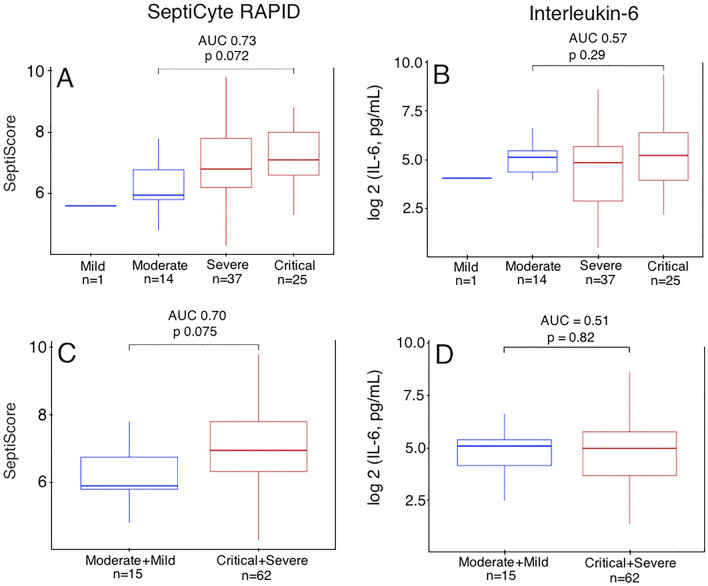
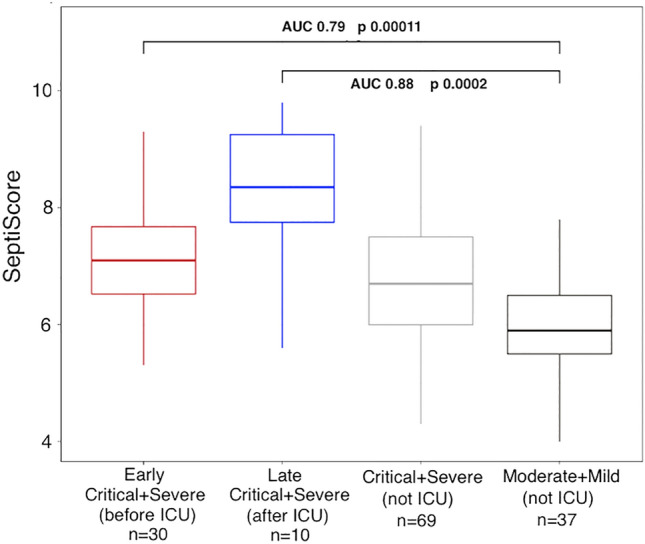
Tools for the evaluation of COVID-19 severity would help clinicians with triage decisions, especially the decision whether to admit to ICU. The aim of this study was to evaluate SeptiCyte RAPID, a host immune response assay (Immunexpress, Seattle USA) as a triaging tool for COVID-19 patients requiring hospitalization and potentially ICU care. SeptiCyte RAPID employs a host gene expression signature consisting of the ratio of expression levels of two immune related mRNAs, PLA2G7 and PLAC8, measured from whole blood samples. Blood samples from 146 adult SARS-CoV-2 (+) patients were collected within 48 h of hospital admission in PAXgene blood RNA tubes at Hospital del Mar, Barcelona, Spain, between July 28th and December 1st, 2020. Data on demographics, vital signs, clinical chemistry parameters, radiology, interventions, and SeptiCyte RAPID were collected and analyzed with bioinformatics methods. The performance of SeptiCyte RAPID for COVID-19 severity assessment and ICU admission was evaluated, relative to the comparator of retrospective clinical assessment by the Hospital del Mar clinical care team. In conclusion, SeptiCyte RAPID was able to stratify COVID-19 cases according to clinical severity: critical vs. mild (AUC = 0.93, p < 0.0001), critical vs. moderate (AUC = 0.77, p = 0.002), severe vs. mild (AUC = 0.85, p = 0.0003), severe vs. moderate (AUC = 0.63, p = 0.05). This discrimination was significantly better (by AUC or p-value) than could be achieved by CRP, lactate, creatine, IL-6, or D-dimer. Some of the critical or severe cases had "early" blood draws (before ICU admission; n = 33). For these cases, when compared to moderate and mild cases not in ICU (n = 37), SeptiCyte RAPID had AUC = 0.78 (p = 0.00012). In conclusion, SeptiCyte RAPID was able to stratify COVID-19 cases according to clinical severity as defined by the WHO COVID-19 Clinical Management Living Guidance of January 25th, 2021. Measurements taken early (before a patient is considered for ICU admission) suggest that high SeptiScores could aid in predicting the need for later ICU admission.
工具可评估 COVID-19 严重程度,帮助临床医生进行分诊决策,尤其是是否收入 ICU 的决策。本研究旨在评估 SeptiCyte RAPID,这是一种宿主免疫反应检测(Immunexpress,美国西雅图),作为需要住院治疗和可能 ICU 护理的 COVID-19 患者的分诊工具。 SeptiCyte RAPID 采用宿主基因表达特征,由来自全血样本的两种免疫相关 mRNA(PLA2G7 和 PLAC8)表达水平的比值组成。2020 年 7 月 28 日至 12 月 1 日,西班牙巴塞罗那玛尔医院(Hospital del Mar)在 PAXgene 血液 RNA 管中采集了 146 例成人 SARS-CoV-2(+)患者的血液样本,这些患者在入院后 48 小时内采集。收集并分析了人口统计学、生命体征、临床化学参数、影像学、干预措施和 SeptiCyte RAPID 的数据,并采用生物信息学方法进行了分析。与玛尔医院临床护理团队的回顾性临床评估比较,评估了 SeptiCyte RAPID 对 COVID-19 严重程度评估和 ICU 入院的性能。结论:SeptiCyte RAPID 能够根据临床严重程度对 COVID-19 病例进行分层:危急与轻症(AUC=0.93,p<0.0001)、危急与中度(AUC=0.77,p=0.002)、严重与轻症(AUC=0.85,p=0.0003)、严重与中度(AUC=0.63,p=0.05)。这种区分(通过 AUC 或 p 值)明显优于 CRP、乳酸、肌酸、IL-6 或 D-二聚体。一些危急或严重的病例有“早期”血液采集(在 ICU 入院前;n=33)。对于这些病例,与不在 ICU 的中度和轻症病例(n=37)相比,SeptiCyte RAPID 的 AUC=0.78(p=0.00012)。总之,正如世界卫生组织 2021 年 1 月 25 日发布的 COVID-19 临床管理指南所定义的,SeptiCyte RAPID 能够根据临床严重程度对 COVID-19 病例进行分层。早期(在考虑患者是否需要 ICU 入院之前)的测量结果表明,高 SeptiScore 可能有助于预测后期 ICU 入院的需求。