Giberson-Chen Carew C, Shaw Brian L, Rudisill Samuel S, Carrier Robert E, Farina Evan M, Pearson Brad, Asnis Peter D, O'Donnell Evan A
Harvard Combined Orthopaedic Residency Program, Massachusetts General Hospital, Harvard Medical School, Boston, Massachusetts, USA. .
Larner College of Medicine, University of Vermont, Burlington, Vermont, USA.
Orthop J Sports Med. 2023 Jan 11;11(1):23259671221140853. doi: 10.1177/23259671221140853. eCollection 2023 Jan.
The current literature lacks an updated review examining return to play (RTP) and return to prior performance (RTPP) after shoulder surgery in professional baseball players.
To summarize the RTP rate, RTPP rate, and baseball-specific performance metrics among professional baseball players who underwent shoulder surgery.
Systematic review; Level of evidence, 4.
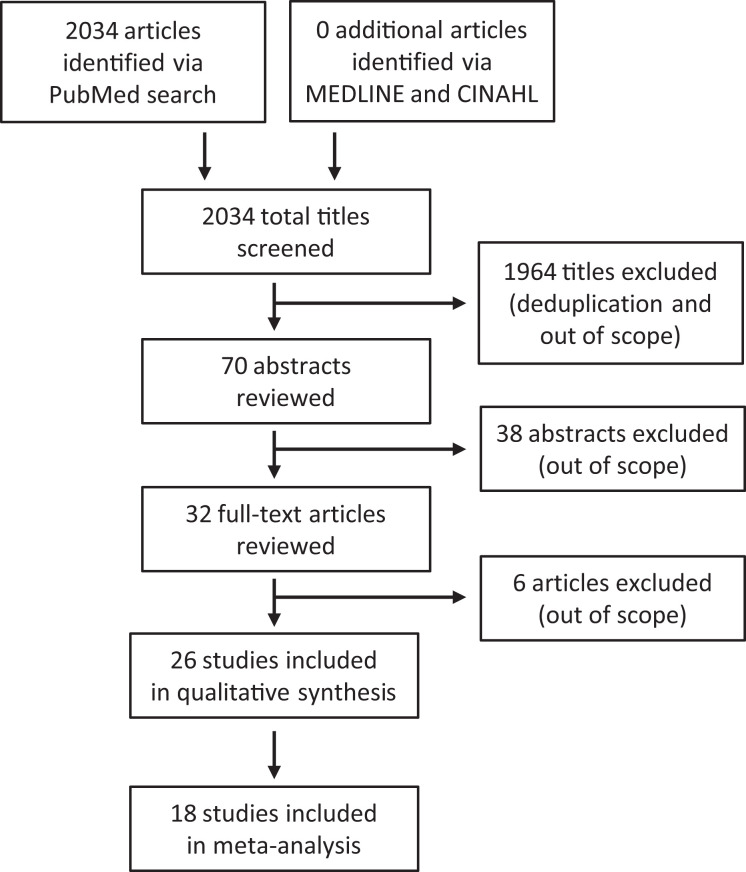
A literature search was performed utilizing the PubMed, MEDLINE, and CINAHL databases and according to PRISMA (Preferred Reporting Items for Systematic Reviews and Meta-Analyses) guidelines. Inclusion criteria were English-language studies reporting on postoperative RTP and/or RTPP in professional baseball players who underwent shoulder surgery between 1976 and 2016. RTP rates, RTPP rates, and baseball-specific performance metrics were extracted from qualifying studies. A total of 2034 articles were identified after the initial search. Meta-analysis was performed where applicable, yielding weighted averages of RTP and RTPP rates and comparisons between pitchers and nonpitchers for each type of surgery. Baseball-specific performance metrics were reported as a narrative summary.
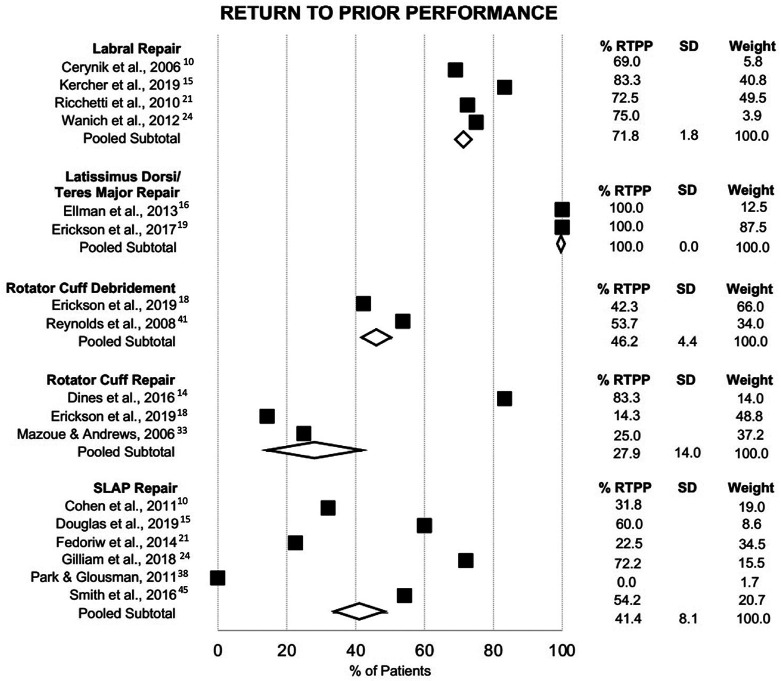
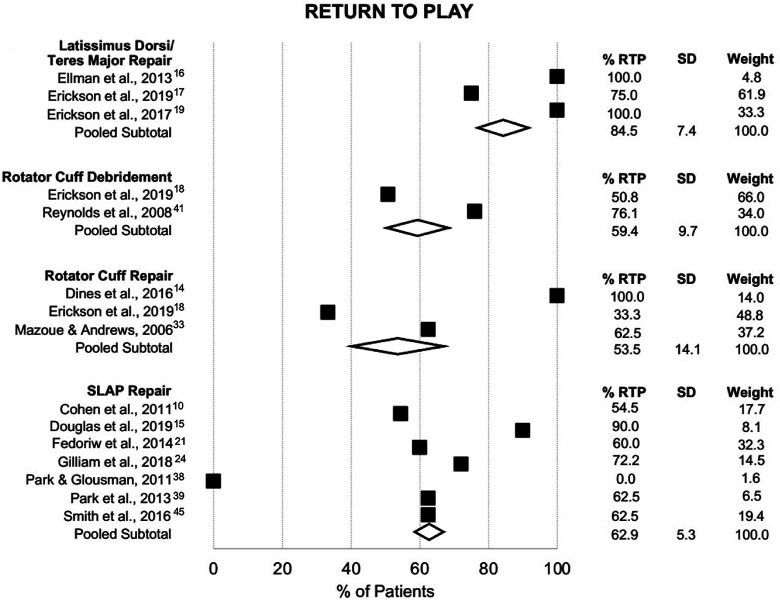
Overall, 26 studies featuring 1228 professional baseball players were included. Patient-level outcome data were available for 529 players. Surgical interventions included rotator cuff debridement (n = 197), rotator cuff repair (RCR; n = 43), superior labrum from anterior to posterior repair (n = 124), labral repair (n = 103), latissimus dorsi/teres major (LD/TM) repair (n = 21), biceps tenodesis (n = 17), coracoclavicular ligament reconstruction (n = 15), anterior capsular repair (n = 5), and scapulothoracic bursectomy (n = 4). Rotator cuff debridement was the most common surgical procedure, while scapulothoracic bursectomy was the least common (37.2% and 0.8% of interventions, respectively). Meta-analysis revealed that the RTP rate was highest for LD/TM repair (84.5%) and lowest for RCR (53.5%), while the RTPP rate was highest for LD/TM repair (100.0%) and lowest for RCR (27.9%). RTP and RTPP rates were generally higher for position players than for pitchers. Nonvolume performance metrics were unaffected by shoulder surgery, while volume statistics decreased or remained similar.
RTP and RTPP rates among professional baseball players were modest after most types of shoulder surgery. Among surgical procedures commonly performed on professional baseball players, RTP and RTPP rates were highest for LD/TM repair and lowest for RCR.
当前文献缺乏对职业棒球运动员肩部手术后恢复比赛(RTP)和恢复术前表现(RTPP)的最新综述。
总结接受肩部手术的职业棒球运动员的RTP率、RTPP率以及特定于棒球的表现指标。
系统综述;证据等级,4级。
根据PRISMA(系统综述和荟萃分析的首选报告项目)指南,利用PubMed、MEDLINE和CINAHL数据库进行文献检索。纳入标准为1976年至2016年间报道接受肩部手术的职业棒球运动员术后RTP和/或RTPP的英文研究。从符合条件的研究中提取RTP率、RTPP率和特定于棒球的表现指标。初步检索后共识别出2034篇文章。在适用的情况下进行荟萃分析,得出RTP和RTPP率的加权平均值以及每种手术类型投手和非投手之间的比较。特定于棒球的表现指标以叙述性总结的形式报告。
总体而言,纳入了26项研究,涉及1228名职业棒球运动员。529名运动员有患者层面的结局数据。手术干预包括肩袖清创术(n = 197)、肩袖修复术(RCR;n = 43)、从前往后上盂唇修复术(n = 124)、盂唇修复术(n = 103)、背阔肌/大圆肌(LD/TM)修复术(n = 21)、肱二头肌固定术(n = 17)、喙锁韧带重建术(n = 15)、前关节囊修复术(n = 5)和肩胛胸壁滑囊切除术(n = 4)。肩袖清创术是最常见的手术,而肩胛胸壁滑囊切除术是最不常见的(分别占干预措施的37.2%和0.8%)。荟萃分析显示,LD/TM修复术的RTP率最高(84.5%),RCR的最低(53.5%),而LD/TM修复术的RTPP率最高(100.0%),RCR的最低(27.9%)。位置球员的RTP和RTPP率通常高于投手。非数量表现指标不受肩部手术影响,而数量统计数据减少或保持相似。
大多数类型的肩部手术后,职业棒球运动员的RTP和RTPP率适中。在职业棒球运动员中常见的手术中,LD/TM修复术的RTP和RTPP率最高,RCR的最低。