Department of Metabolic Medicine, Graduate School of Medicine, Osaka University, Suita, Japan.
Department of Diabetes Care Medicine, Graduate School of Medicine, Osaka University, Suita, Japan.
Diabetes. 2023 Apr 1;72(4):511-519. doi: 10.2337/db22-0557.
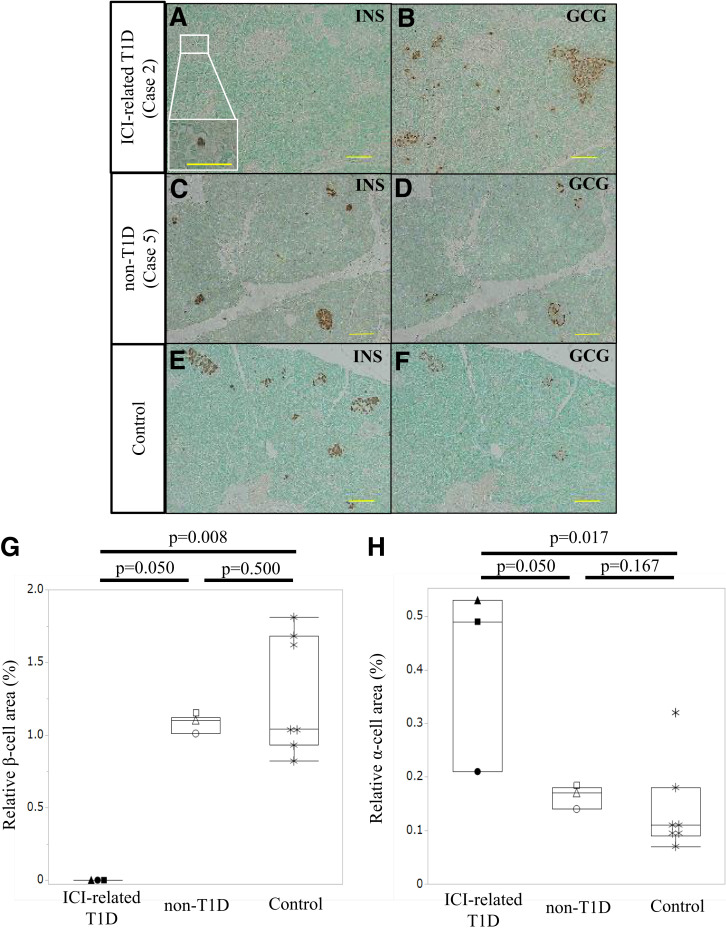
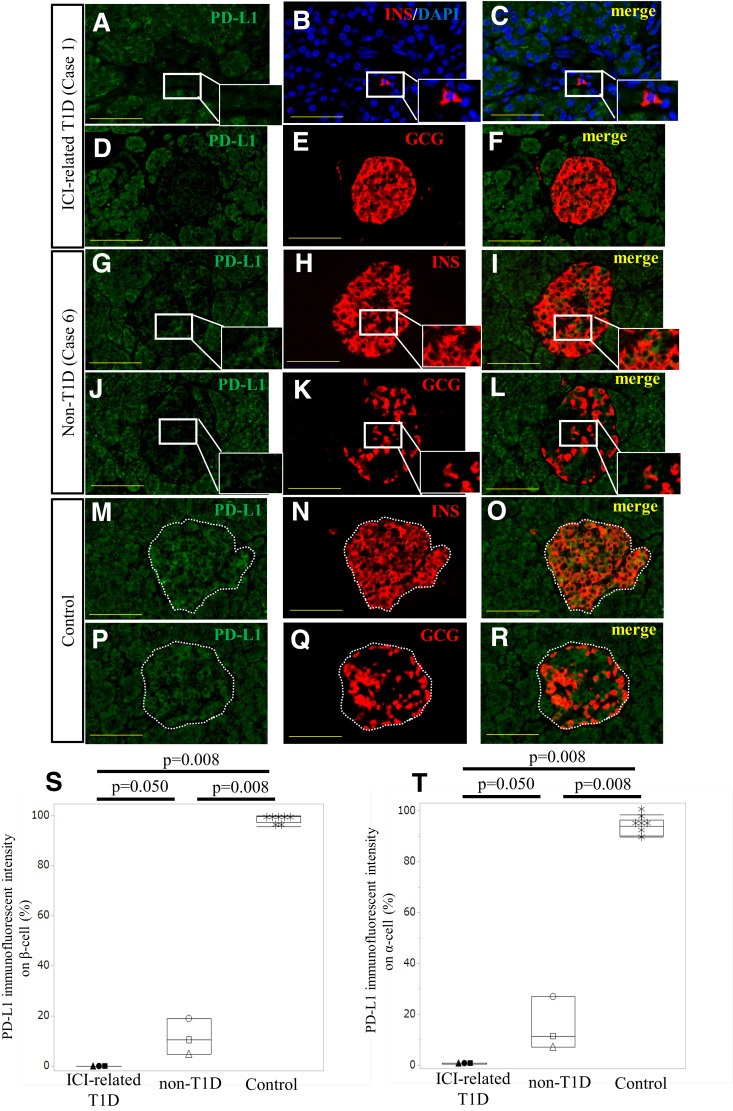
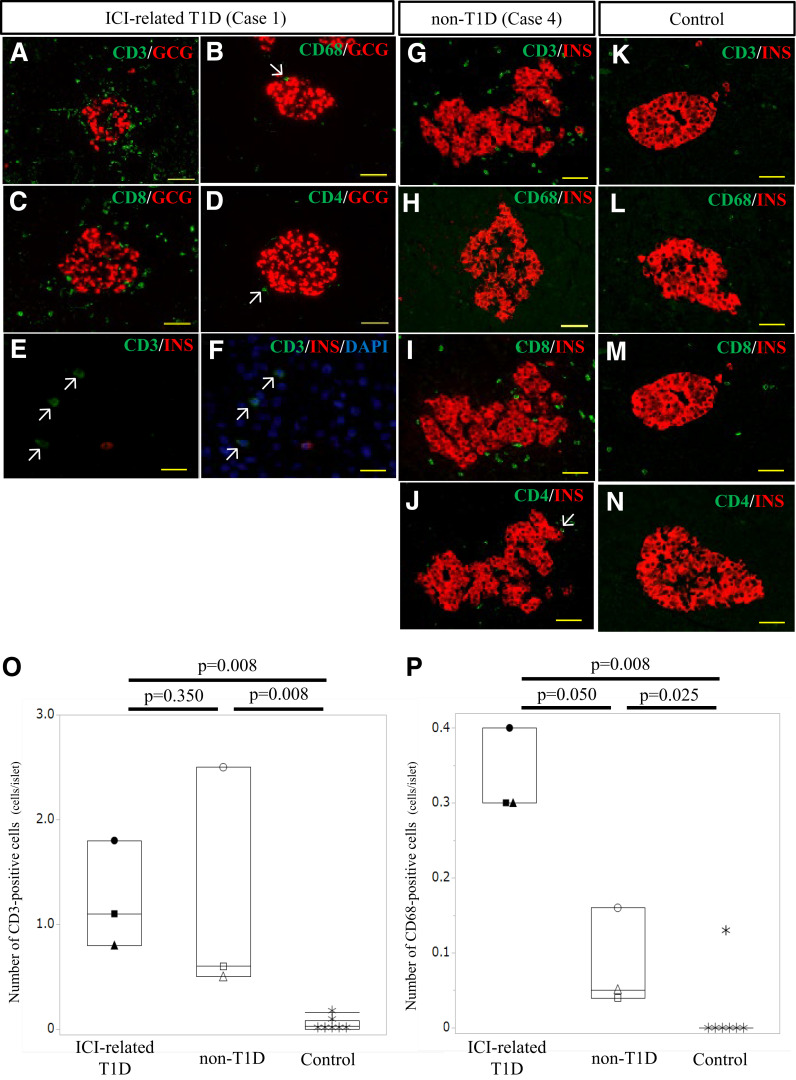
Immune checkpoint inhibitors (ICIs) could cause type 1 diabetes (T1D). However, the underlying mechanism remains unclear. We immunohistochemically analyzed pancreatic specimens from three individuals with ICI-related T1D, and their histopathological data were compared those from three patients who had received ICI therapy but did not develop T1D (non-T1D) and seven normal glucose-tolerant subjects as control subjects. All ICI-related T1D patients had susceptible HLA haplotypes. In ICI-related T1D, the β-cell area decreased and the α-cell area increased compared with non-T1D and control subjects. The number of CD3-positive cells around islets increased in ICI-related T1D and non-T1D compared with control subjects, while the number of CD68-positive cells around islets increased in ICI-related T1D compared with non-T1D and control subjects. The expression ratios of programmed death-ligand 1 (PD-L1) on islets decreased in non-T1D and almost completely disappeared in ICI-related T1D, while PD-L1 expression was observed in most cells of pancreatic islets in control subjects. This study, therefore, indicates that ICI therapy itself could reduce PD-L1 expression on islets in all subjects, which may be related to β-cell vulnerability. In addition, we showed that absence of PD-L1 expression on β-cells, genetic susceptibility, and infiltration of macrophages as well as T lymphocytes around islets might be responsible for T1D onset.
免疫检查点抑制剂(ICI)可导致 1 型糖尿病(T1D)。然而,其潜在机制尚不清楚。我们免疫组化分析了 3 例 ICI 相关 T1D 患者的胰腺标本,并将其组织病理学数据与 3 例接受 ICI 治疗但未发生 T1D(非 T1D)的患者和 7 名正常糖耐量的受试者进行比较。所有 ICI 相关 T1D 患者均具有易感 HLA 单倍型。与非 T1D 和对照组相比,ICI 相关 T1D 患者的β细胞面积减少,α细胞面积增加。与对照组相比,ICI 相关 T1D 和非 T1D 患者胰岛周围 CD3 阳性细胞数量增加,而 ICI 相关 T1D 患者胰岛周围 CD68 阳性细胞数量增加。非 T1D 患者胰岛 PD-L1 的表达比例降低,几乎完全消失在 ICI 相关 T1D 中,而对照组的胰岛中大多数细胞均有 PD-L1 表达。因此,本研究表明,ICI 治疗本身可能会降低所有受试者胰岛 PD-L1 的表达,这可能与β细胞的易感性有关。此外,我们还表明,β细胞上 PD-L1 表达的缺失、遗传易感性以及胰岛周围巨噬细胞和 T 淋巴细胞的浸润可能是 T1D 发病的原因。