Mozafarian Nafiseh, Hashemipour Mahin, Yazdi Maryam, Hani Tabaei Zavareh Mohsen, Hovsepian Silva, Heidarpour Maryam, Taheri Ensiyeh
Child Growth and Development Research Center, Research Institute for Primordial Prevention of Noncommunicable Disease, Isfahan University of Medical Sciences, Isfahan, Iran.
Metabolic Liver Disease Research Center, Isfahan University of Medical Sciences, Isfahan, Iran.
Adv Biomed Res. 2022 Nov 28;11:103. doi: 10.4103/abr.abr_80_21. eCollection 2022.
This systematic review and meta-analysis aimed to overview the observational studies on the association of exposure to air pollution and type 1 diabetes mellitus (T1DM).
Based on PRISMA guidelines, we systematically reviewed the databases of PubMed, Scopus, Embase, and Web of Science databases to determine the association of air pollution exposure and T1DM. Quality assessment of the papers was evaluated using the Strengthening the Reporting of Observational Studies in Epidemiology (STROBE) checklist for observational studies. The odds ratios (OR) and their 95% confidence intervals (CI) were calculated to assess the strength of the associations between air pollutants (gases and particulate matter air pollutants including PM10, PM2.5, NO2, volatile organic compound, SO4, SO2, O3) and T1DM.
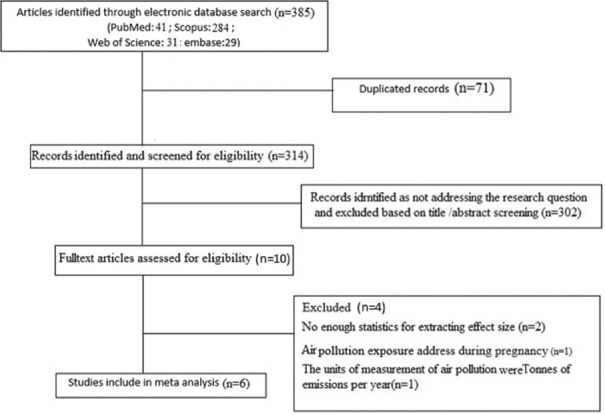
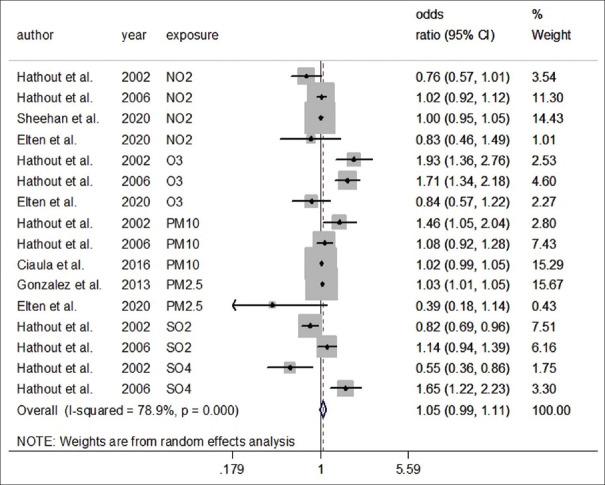
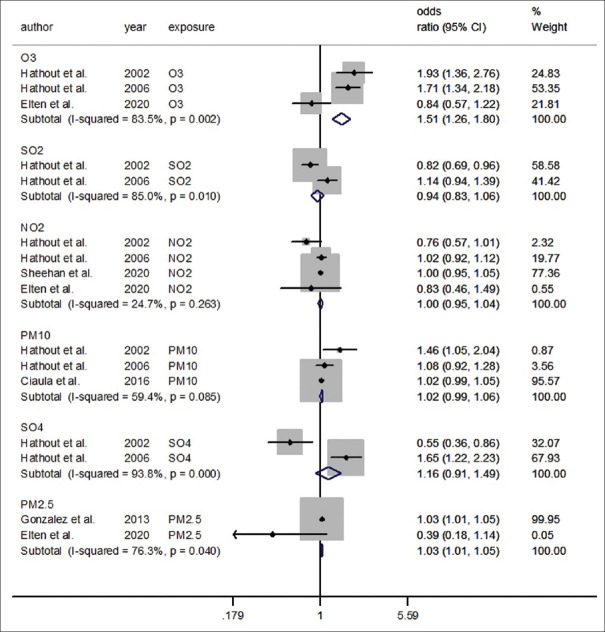
Out of 385 initially identified papers, 6 studies were used for this meta-analysis. Fixed effects meta-analysis showed a significant association between per 10 μg/m increase in O3 and PM2.5 exposures with the increased risk of T1DM (3 studies, OR = 1.51, 95% CI: 1.26, 1.80, = 83.5% for O3 and two studies, OR = 1.03, 95% CI: 1.01, 1.05, = 76.3% for PM2.5). There was no evidence of association between increased risk of T1DM and exposure to PM10 (OR = 1.02, 95% CI: 0.99-1.06, = 59.4%), SO4 (OR = 1.16, 95% CI: 0.91-1.49, = 93.8%), SO2 (OR = 0.94, 95% CI: 0.83-1.06, = 85.0%), and NO2 (OR = 0.995,95% CI: 1.05-1.04, = 24.7%).
Recent publications indicated that exposure to ozone and PM2.5 may be a risk factor for T1DM. However, due to limited available studies, more prospective cohort studies are needed to clarify the role of air pollutants in T1DM occurrence.
本系统评价和荟萃分析旨在概述关于空气污染暴露与1型糖尿病(T1DM)关联的观察性研究。
根据PRISMA指南,我们系统检索了PubMed、Scopus、Embase和Web of Science数据库,以确定空气污染暴露与T1DM之间的关联。使用流行病学观察性研究报告强化(STROBE)清单对论文进行质量评估。计算比值比(OR)及其95%置信区间(CI),以评估空气污染物(气体和颗粒物空气污染物,包括PM10、PM2.5、NO2、挥发性有机化合物、SO4、SO2、O3)与T1DM之间关联的强度。
在最初识别的385篇论文中,6项研究用于本荟萃分析。固定效应荟萃分析显示,O3每增加10μg/m以及PM2.5暴露与T1DM风险增加之间存在显著关联(3项研究,OR = 1.51,95%CI:1.26,1.80,I² = 83.5%为O3;2项研究,OR = 1.03,95%CI:1.01,1.05,I² = 76.3%为PM2.5)。没有证据表明T1DM风险增加与PM10暴露(OR = 1.02,95%CI:0.99 - 1.06,I² = 59.4%)、SO4暴露(OR = 1.16,95%CI:0.91 - 1.49,I² = 93.8%)、SO2暴露(OR = 0.94,95%CI:0.83 - 1.06,I² = 85.0%)和NO2暴露(OR = 0.995,95%CI:1.05 - 1.04,I² = 24.7%)之间存在关联。
近期出版物表明,暴露于臭氧和PM2.5可能是T1DM的一个风险因素。然而,由于现有研究有限,需要更多前瞻性队列研究来阐明空气污染物在T1DM发生中的作用。