Division of Pediatric Infectious Diseases and Rheumatology, Department of Pediatrics and Adolescent Medicine, University Medical Center, Medical Faculty, University of Freiburg, Mathildenstr. 1, 79106, Freiburg, Germany.
Department of Pediatrics, University Hospital, Medical Faculty Carl Gustav Carus, Technische Universität Dresden, Dresden, Germany.
Sci Rep. 2023 Jan 20;13(1):1173. doi: 10.1038/s41598-022-26832-5.
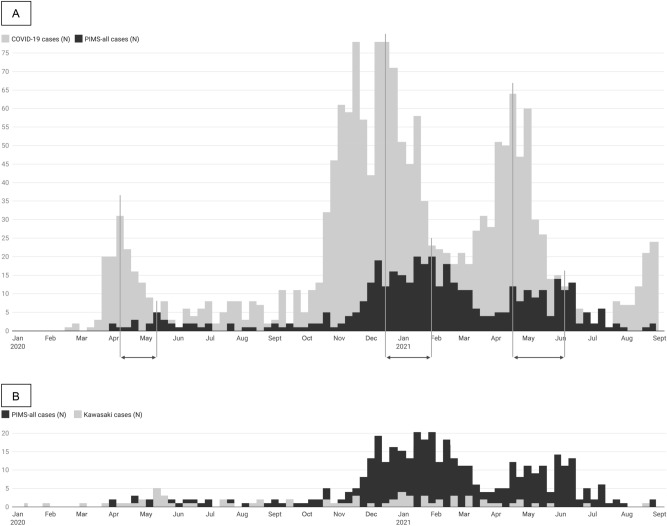
The connection between Pediatric Inflammatory Multisystem Syndrome (PIMS) and Kawasaki Disease (KD) is not yet fully understood. Using the same national registry, clinical features and outcome of children hospitalized in Germany, and Innsbruck (Austria) were compared. Reported to the registry were 395 PIMS and 69 KD hospitalized patients. Patient age in PIMS cases was higher than in KD cases (median 7 [IQR 4-11] vs. 3 [IQR 1-4] years). A majority of both PIMS and KD patients were male and without comorbidities. PIMS patients more frequently presented with organ dysfunction, with the gastrointestinal (80%), cardiovascular (74%), and respiratory (52%) systems being most commonly affected. By contrast, KD patients more often displayed dermatological (99% vs. 68%) and mucosal changes (94% vs. 64%), plus cervical lymph node swelling (51% vs. 34%). Intensive care admission (48% vs. 19%), pulmonary support (32% vs. 10%), and use of inotropes/vasodilators (28% vs. 3%) were higher among PIMS cases. No patients died. Upon patient discharge, potentially irreversible sequelae-mainly cardiovascular-were reported (7% PIMS vs. 12% KD). Despite differences in age distribution and disease severity, PIMS and KD cases shared many common clinical and prognostic characteristics. This supports the hypothesis that the two entities represent a syndrome continuum.
小儿炎症性多系统综合征(PIMS)与川崎病(KD)之间的联系尚未完全阐明。本研究利用同一国家注册中心,比较了德国和因斯布鲁克(奥地利)住院儿童的临床特征和结局。该注册中心报告了 395 例 PIMS 和 69 例 KD 住院患者。PIMS 组患者的年龄高于 KD 组(中位数 7 [IQR 4-11] vs. 3 [IQR 1-4] 岁)。两组患者大多数为男性,且无合并症。PIMS 患者更常出现器官功能障碍,胃肠道(80%)、心血管(74%)和呼吸系统(52%)最常受累。相比之下,KD 患者更常出现皮肤(99% vs. 68%)和黏膜变化(94% vs. 64%),以及颈部淋巴结肿大(51% vs. 34%)。PIMS 组患者更常需要入住重症监护病房(48% vs. 19%)、肺支持(32% vs. 10%)和使用正性肌力药/血管扩张剂(28% vs. 3%)。无患者死亡。患者出院时,报告了潜在不可逆的后遗症(7% PIMS 对 12% KD)。尽管在年龄分布和疾病严重程度上存在差异,但 PIMS 和 KD 病例具有许多共同的临床和预后特征。这支持了这两种实体代表综合征连续体的假说。