Department of Surgery, Faculty of Medicine and Health, Örebro University, Örebro, Sweden.
Division of Surgery, Department of Clinical Sciences, Danderyd Hospital, Karolinska Institutet, Stockholm, Sweden.
Int J Obes (Lond). 2023 Apr;47(4):251-256. doi: 10.1038/s41366-023-01254-z. Epub 2023 Jan 20.
Glucagon-like Peptide-1 receptor agonists (GLP-1 RA) and metabolic and bariatric surgery (MBS) both improve cardiovascular outcomes in patients with severe obesity and type-2 diabetes (T2D). The aim of the present study was to assess the impact of MBS on major cardiovascular adverse events (MACE) in patients with severe obesity and T2D compared to patients with T2D treated with GLP-1 RA.
In this propensity score matched cohort study on nationwide data, patients with T2D and severe obesity who underwent MBS in Sweden from 2007 until 2019 were identified from the Scandinavian Obesity Surgery Registry and matched to a non-surgical group with T2D treated with GLP-1 RA (81.7% liraglutide, 9.0% dulaglutide, 6.0% exenatide, 1.6% lixisenatide and 0.8% semaglutide) from the general population using generalized linear model. Major outcome was MACE (hospitalization for acute coronary syndrome or cerebrovascular event or all-cause death), evaluated with multivariable Cox regression.
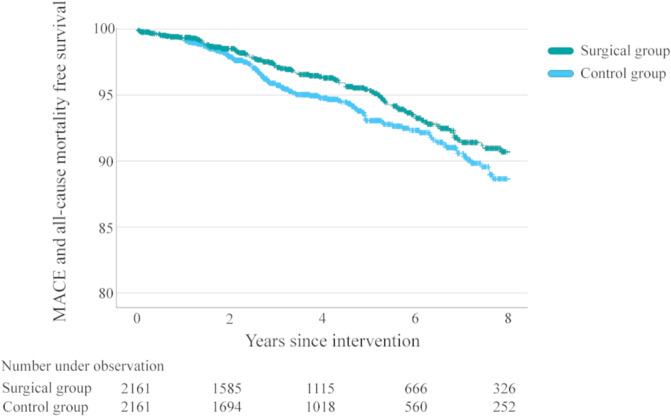
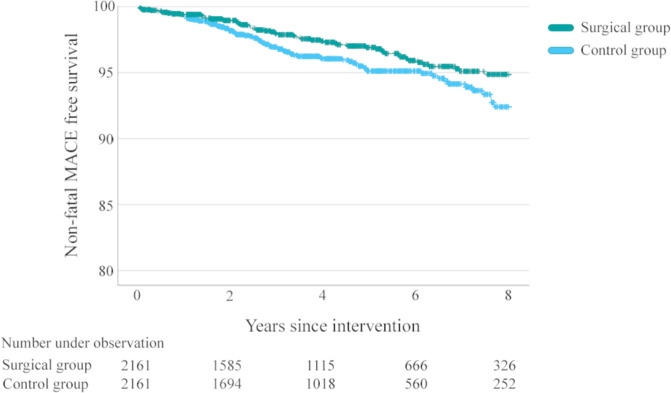
In total 2161 patients (obesity class I (10.2%), class II (40.3%), class III (49.5%)) were matched to 2161 non-surgical patients (mean age 51.1 ± 9.29 vs 51.5 ± 8.92 years, 64.8% vs. 64.4% women, with mean number of diabetes drugs of 2.5 ± 0.89 vs 2.6 ± 0.87, a mean duration of diabetes of 6.0 ± 4.15 vs 6.0 ± 4.51 years with 44.2% vs. 42.8% being treated with insulin at baseline). During the study period, 113 patients (8-year cumulative incidence 9.3%) compared to 130 non-surgical patients (8-year cumulative incidence 11.3%) suffered from MACE or all-cause mortality (HR 0.76, 95%CI 0.59-0.98), and 69 patients (8-year cumulative incidence 5.1%) compared to 92 non-surgical patients (8-year cumulative incidence 7.6%) suffered from a non-fatal MACE (HR 0.68, 95%CI 0.49-0.93).
In this matched cohort study, MBS was associated with lower risk for MACE compared to treatment with early GLP-1 RA in patients with T2D.
胰高血糖素样肽-1 受体激动剂(GLP-1RA)和代谢与减重手术(MBS)均可改善严重肥胖和 2 型糖尿病(T2D)患者的心血管结局。本研究旨在评估与接受 GLP-1RA 治疗的 T2D 患者相比,MBS 对严重肥胖和 T2D 患者的主要心血管不良事件(MACE)的影响。
在这项基于全国数据的倾向评分匹配队列研究中,从瑞典的斯堪的纳维亚肥胖手术登记处确定了 2007 年至 2019 年期间接受 MBS 的 T2D 合并严重肥胖患者,并使用广义线性模型与普通人群中接受 GLP-1RA(81.7%利拉鲁肽、9.0%度拉鲁肽、6.0%艾塞那肽、1.6%利司那肽和 0.8%司美格鲁肽)治疗的非手术组患者进行匹配。主要结局为 MACE(急性冠状动脉综合征或脑血管事件或全因死亡的住院治疗),采用多变量 Cox 回归进行评估。
共纳入 2161 例患者(肥胖症 I 级(10.2%)、II 级(40.3%)、III 级(49.5%))与 2161 例非手术患者匹配(平均年龄 51.1±9.29 岁比 51.5±8.92 岁,64.8%比 64.4%为女性,平均使用 2.5±0.89 种糖尿病药物比 2.6±0.87 种,糖尿病平均病程 6.0±4.15 年比 6.0±4.51 年,44.2%比 42.8%患者基线时接受胰岛素治疗)。在研究期间,113 例患者(8 年累积发生率 9.3%)与 130 例非手术患者(8 年累积发生率 11.3%)发生 MACE 或全因死亡率(HR 0.76,95%CI 0.59-0.98),69 例患者(8 年累积发生率 5.1%)与 92 例非手术患者(8 年累积发生率 7.6%)发生非致死性 MACE(HR 0.68,95%CI 0.49-0.93)。
在这项匹配队列研究中,与接受早期 GLP-1RA 治疗的 T2D 患者相比,MBS 与较低的 MACE 风险相关。