Department of Inorganic Chemistry, Faculty of Pharmacy, Medical University of Gdańsk, 80-416 Gdansk, Poland.
Biomolecules. 2023 Jan 13;13(1):172. doi: 10.3390/biom13010172.
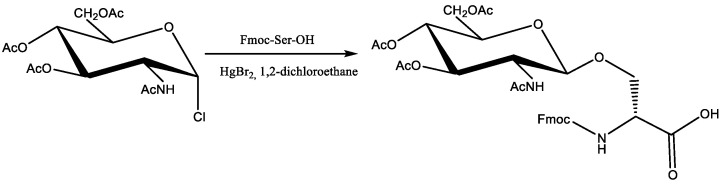
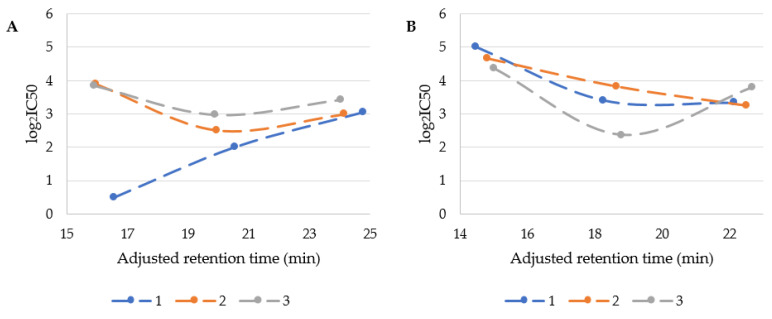
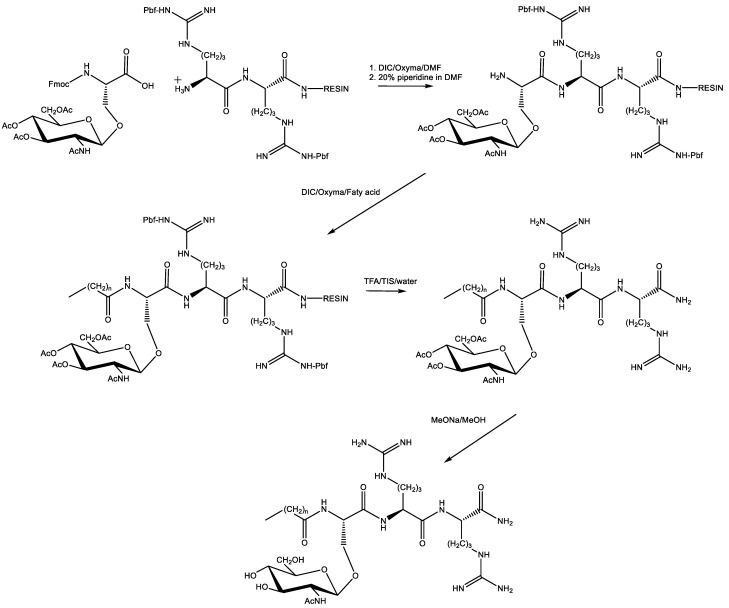
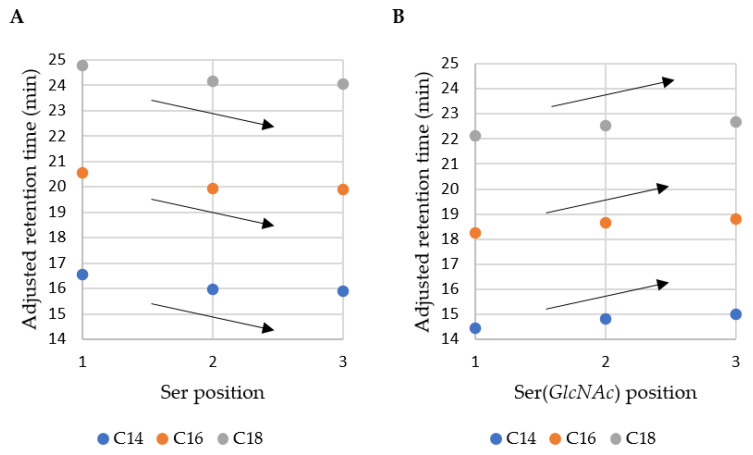
Ultrashort cationic lipopeptides (USCLs) are promising antimicrobial agents that may be used to combat pathogens such as bacteria and fungi. USCLs consist of a few basic amino acid residues and at least one lipid moiety, usually a fatty acid chain. Generally, USCLs are potent antimicrobials but their major shortcoming is a relatively high cytotoxicity and hemolytic activity. Glycopeptide antibiotics (e.g. vancomycin) are essential in combating bacterial infections and are popular in medicinal practice. However, literature concerning the effect of glycosylation of peptides on their antimicrobial activity is rather scarce. For the first time, this study highlights the effect of USCLs glycosylation on in vitro biological activity. The aim of this study was to evaluate the impact of glycosylation of a series of USCLs on antimicrobial activity, cytotoxicity and hemolytic activity. Straight-chain fatty acids (C14, C16, C18) were attached to the -terminal amino group of tripeptides-SRR-NH, RSR-NH and RRS-NH. Two groups of the lipopeptides were synthetized, the first with unmodified L-serine (USCLs) and the other with L-serine -glycosylated by -acetyl-β-d-glucosamine to produce new class of glycosylated ultrashort cationic lipopeptide (gUSCLs). Both USCLs and gUSCLs were tested against planktonic and biofilm cultures of ESKAPE strains (, , , , , spp.) and , and hemolytic activity on human erythrocytes and cytotoxicity against the HaCaT cell line was examined. Generally, USCLs and gUSCLs proved to be active against all the tested strains. The highest activity displayed was by lipopeptides containing the C18 fatty acid. Antimicrobial, hemolytic and cytotoxic activities were mainly correlated with amino acid sequence (position of serine/glycosylated serine) and hydrophobicity of molecule and were found to be highly strain-dependent. In general, glycosylation did not guarantee an increased antimicrobial activity or a decreased hemolytic and cytotoxic activities. However, in some cases, gUSCLs proved to be superior to their USCLs analogs. The most pronounced differences were found for peptides with C18 fatty acid and serine at the first and second position against both planktonic cells and biofilm of , as well as the second and third position against . It is noteworthy that gUSCLs were also more active against biofilm than were USCLs.
超短阳离子脂肽(USCLs)是一种很有前途的抗菌剂,可用于对抗细菌和真菌等病原体。USCLs 由几个碱性氨基酸残基和至少一个脂质部分组成,通常是脂肪酸链。一般来说,USCLs 是有效的抗菌剂,但它们的主要缺点是相对较高的细胞毒性和溶血活性。糖肽抗生素(如万古霉素)在对抗细菌感染方面至关重要,在医学实践中也很受欢迎。然而,关于肽的糖基化对其抗菌活性的影响的文献相当稀少。本研究首次强调了 USCLs 糖基化对体外生物学活性的影响。本研究旨在评估一系列 USCLs 的糖基化对其抗菌活性、细胞毒性和溶血活性的影响。直链脂肪酸(C14、C16、C18)被连接到三肽-SRR-NH、RSR-NH 和 RRS-NH 的-NH2 末端。合成了两组脂肽,一组是未修饰的 L-丝氨酸(USCLs),另一组是用-N-乙酰基-β-D-葡萄糖胺糖基化的 L-丝氨酸,以产生新的糖基化超短阳离子脂肽(gUSCLs)。我们测试了 USCLs 和 gUSCLs 对 ESKAPE 菌株(,,,,, spp.)和 的浮游生物和生物膜培养物的活性,以及对人红细胞的溶血活性和对 HaCaT 细胞系的细胞毒性。一般来说,USCLs 和 gUSCLs 对所有测试菌株都表现出活性。含有 C18 脂肪酸的脂肽表现出最高的活性。抗菌、溶血和细胞毒性活性主要与氨基酸序列(丝氨酸/糖基化丝氨酸的位置)和分子的疏水性相关,并且高度依赖于菌株。一般来说,糖基化并不能保证增加抗菌活性或降低溶血和细胞毒性活性。然而,在某些情况下,gUSCLs 比它们的 USCLs 类似物表现出更好的效果。最显著的差异是在含有 C18 脂肪酸和丝氨酸的肽中发现的,在浮游生物和生物膜中对 和 的第一和第二位,以及第二位和第三位对 的活性。值得注意的是,gUSCLs 对生物膜的活性也高于 USCLs。