Nakata Norio, Siina Tsuyoshi
Division of Artificial Intelligence in Medicine, Center for Integrated Medical Research, The Jikei University, School of Medicine, 3-25-8 Nishi-Shinbashi, Minato-ku, Tokyo 105-8461, Japan.
Shibaura Institute of Technology, Graduate School of Science and Engineering, 3-7-5 Toyosu Koto-ku, Tokyo 135-8548, Japan.
Bioengineering (Basel). 2023 Jan 5;10(1):69. doi: 10.3390/bioengineering10010069.
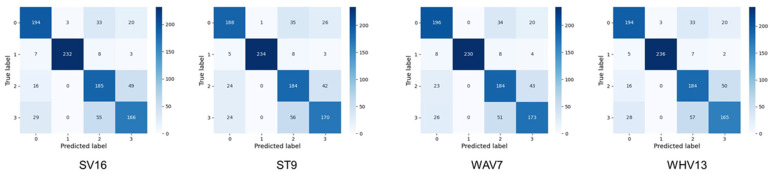
Ultrasound (US) is often used to diagnose liver masses. Ensemble learning has recently been commonly used for image classification, but its detailed methods are not fully optimized. The purpose of this study is to investigate the usefulness and comparison of some ensemble learning and ensemble pruning techniques using multiple convolutional neural network (CNN) trained models for image classification of liver masses in US images. Dataset of the US images were classified into four categories: benign liver tumor (BLT) 6320 images, liver cyst (LCY) 2320 images, metastatic liver cancer (MLC) 9720 images, primary liver cancer (PLC) 7840 images. In this study, 250 test images were randomly selected for each class, for a total of 1000 images, and the remaining images were used as the training. 16 different CNNs were used for training and testing ultrasound images. The ensemble learning used soft voting (SV), weighted average voting (WAV), weighted hard voting (WHV) and stacking (ST). All four types of ensemble learning (SV, ST, WAV, and WHV) showed higher values of accuracy than the single CNN. All four types also showed significantly higher deep learning (DL) performance than ResNeXt101 alone. For image classification of liver masses using US images, ensemble learning improved the performance of DL over a single CNN.
超声(US)常用于诊断肝脏肿块。集成学习最近常用于图像分类,但其详细方法尚未得到充分优化。本研究的目的是研究一些集成学习和集成剪枝技术的实用性,并比较使用多个卷积神经网络(CNN)训练模型对US图像中的肝脏肿块进行图像分类的效果。US图像数据集分为四类:良性肝肿瘤(BLT)6320张图像、肝囊肿(LCY)2320张图像、转移性肝癌(MLC)9720张图像、原发性肝癌(PLC)7840张图像。在本研究中,为每个类别随机选择250张测试图像,共1000张图像,其余图像用作训练集。使用16种不同的CNN对超声图像进行训练和测试。集成学习使用软投票(SV)、加权平均投票(WAV)、加权硬投票(WHV)和堆叠(ST)。所有四种类型的集成学习(SV、ST、WAV和WHV)的准确率值均高于单个CNN。这四种类型的集成学习在深度学习(DL)性能方面也均显著高于单独的ResNeXt101。对于使用US图像对肝脏肿块进行图像分类,集成学习比单个CNN提高了DL的性能。