Jee Changhoon, Batsaikhan Enkhzul, Salim Chinnu
Department of Pharmacology, Addiction Science and Toxicology (PHAST), College of Medicine, University of Tennessee Health Science Center, 71 S Manassas St., Memphis, TN 38103, USA.
Metabolites. 2022 Dec 31;13(1):62. doi: 10.3390/metabo13010062.
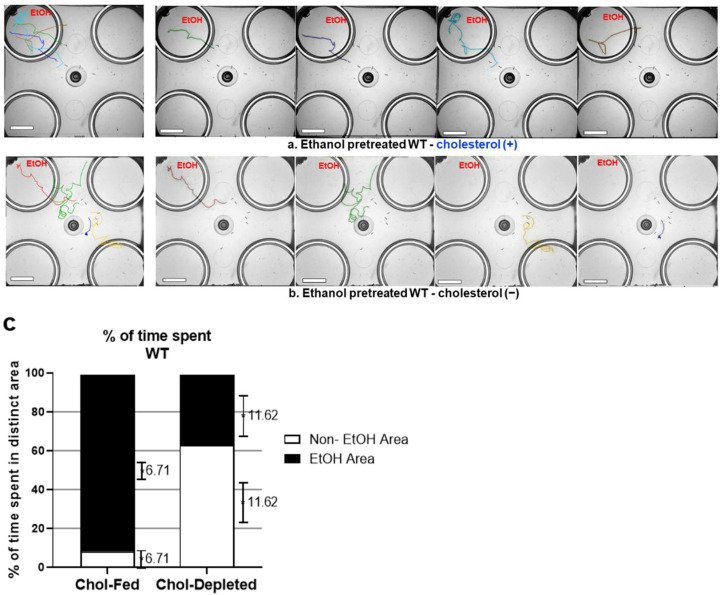
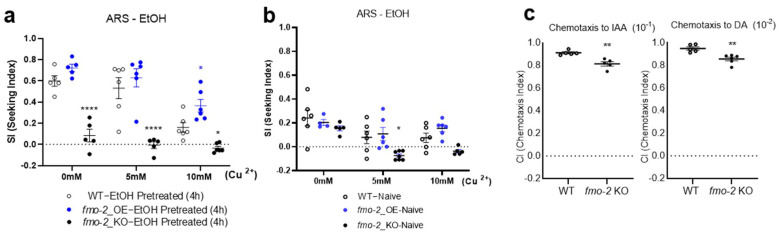
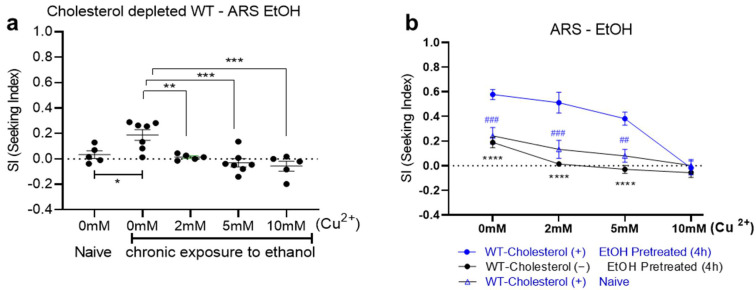
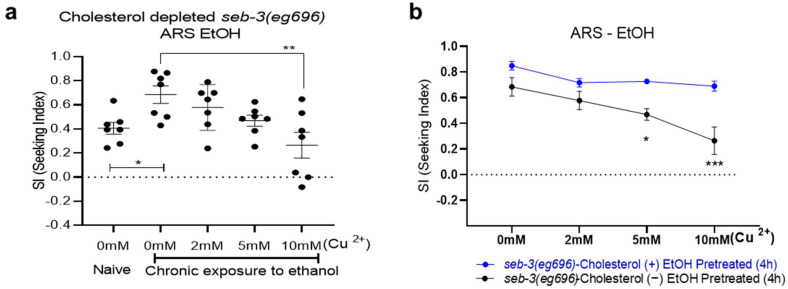
Persistent alcohol seeking despite the risk of aversive consequences is a crucial characteristic of alcohol use disorders (AUDs). Therefore, an improved understanding of the molecular basis of alcohol seeking despite aversive stimuli or punishment in animal models is an important strategy to understand the mechanism that underpins the pathology of AUDs. Aversion-resistant seeking (ARS) is characterized by disruption in control of alcohol use featured by an imbalance between the urge for alcohol and the mediation of aversive stimuli. We exploited , a genetically tractable invertebrate, as a model to elucidate genetic components related to this behavior. We assessed the neuropeptide system and its transcriptional regulation to progress aversion-resistant ethanol seeking at the system level. Our functional genomic approach preferentially selected molecular components thought to be involved in cholesterol metabolism, and an orthogonal test defined functional roles in ARS through behavioral elucidation. Our findings suggest that (flavin-containing monooxygenase-2) plays a role in the progression of aversion-resistant ethanol seeking in .
尽管存在厌恶后果的风险,但持续寻求酒精是酒精使用障碍(AUDs)的一个关键特征。因此,在动物模型中更好地理解尽管存在厌恶刺激或惩罚仍寻求酒精的分子基础,是理解支撑AUDs病理机制的重要策略。抗厌恶寻求(ARS)的特征是酒精使用控制受到破坏,表现为对酒精的渴望与厌恶刺激的调节之间失衡。我们利用一种具有遗传易处理性的无脊椎动物作为模型,以阐明与这种行为相关的遗传成分。我们评估了神经肽系统及其转录调控,以在系统水平上推进抗厌恶乙醇寻求行为。我们的功能基因组学方法优先选择了被认为参与胆固醇代谢的分子成分,并且通过行为阐释的正交试验确定了其在ARS中的功能作用。我们的研究结果表明,(含黄素单加氧酶-2)在抗厌恶乙醇寻求行为的进展中发挥作用。