Graduate School of Sciences and Technology for Innovation, Yamaguchi University, 2-16-1 Tokiwadai, Ube 755-8611, Yamaguchi, Japan.
Molecules. 2023 Jan 10;28(2):694. doi: 10.3390/molecules28020694.
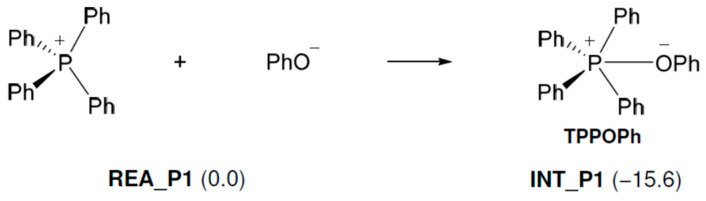
The mechanism of the phenol-epoxide ring-opening reaction using tetraphenylphosphonium-tetraphenylborate (TPP-K) was investigated using the density functional theory (DFT) method. The reaction was initiated by breaking the P-B bond of TPP-K. The generated tetraphenylborate (TetraPB) reacted with phenol to form a phenoxide ion, which combined with tetraphenylphosphonium (TPP) to produce the active species, i.e., tetraphenylphosphonium phenolate (TPP-OPh). The phenoxide ion in TPP-OPh nucleophilically attacked the epoxide. Simultaneously, the H atom in the phenolic OH group moved to the O atom of the ring-opened epoxide. The formed phenoxide ion bound to TPP again, and TPP-OPh was regenerated. The rate-determining steps in the reaction were the cleavage of the P-B bond and the triphenylborane-forming reaction. The free energies of activation were calculated to be 36.3 and 36.1 kcal/mol, respectively. It is also suggested that these values in the rate-determining steps could be manipulated by substituents introduced on the Ph group of TetraPB. Based on these results, it is possible to construct new design guidelines for latent hardening accelerators such as TPP-K.
采用密度泛函理论(DFT)方法研究了四苯膦四苯硼(TPP-K)引发的酚-环氧化物开环反应的机理。反应由 TPP-K 的 P-B 键断裂引发。生成的四苯硼酸盐(TetraPB)与苯酚反应形成酚氧离子,该离子与四苯膦(TPP)结合生成活性物质,即四苯膦酚盐(TPP-OPh)。TPP-OPh 中的酚氧离子亲核进攻环氧化物。同时,酚羟基中 H 原子迁移到开环环氧化物的 O 原子上。形成的酚氧离子再次与 TPP 结合,生成 TPP-OPh。反应的速控步骤是 P-B 键的断裂和三苯基硼烷的形成反应。计算得到的活化自由能分别为 36.3 和 36.1 kcal/mol。还表明,TetraPB 的 Ph 基团上引入取代基可以改变这些速控步骤中的值。基于这些结果,可以为 TPP-K 等潜伏性硬化促进剂构建新的设计指南。