Division of Hepato-Gastroenterology, Department of Internal Medicine, Kaohsiung Chang Gung Memorial Hospital, Taiwan 123 Ta-Pei Road, Niao-Sung District, Kaohsiung 833, Taiwan.
Liver Transplantation Program, Kaohsiung Chang Gung Memorial Hospital, Kaohsiung 833, Taiwan.
Viruses. 2022 Dec 30;15(1):115. doi: 10.3390/v15010115.
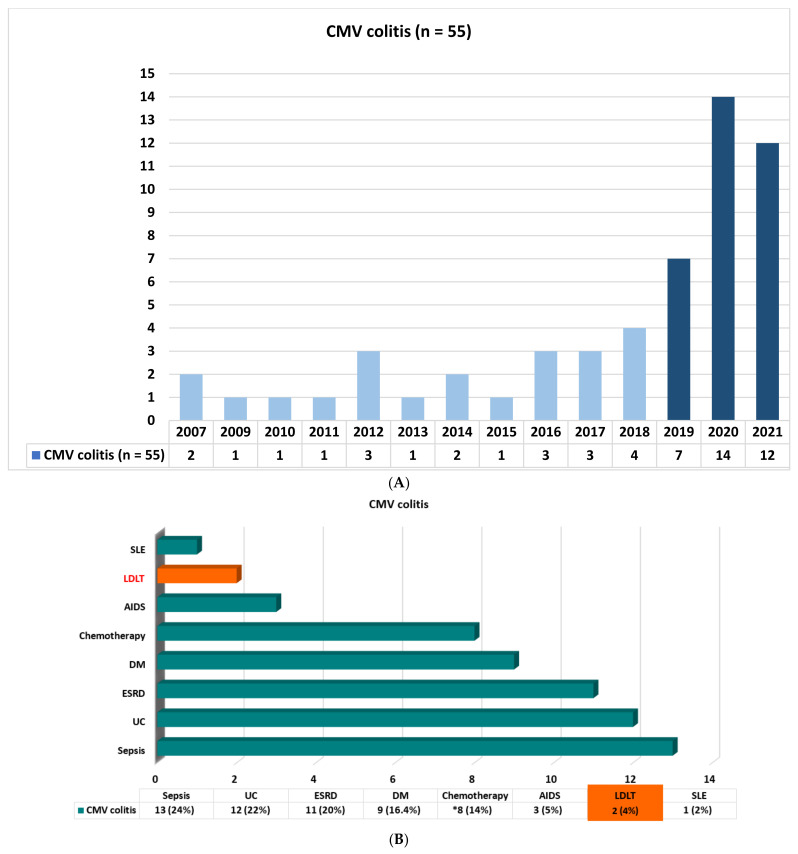
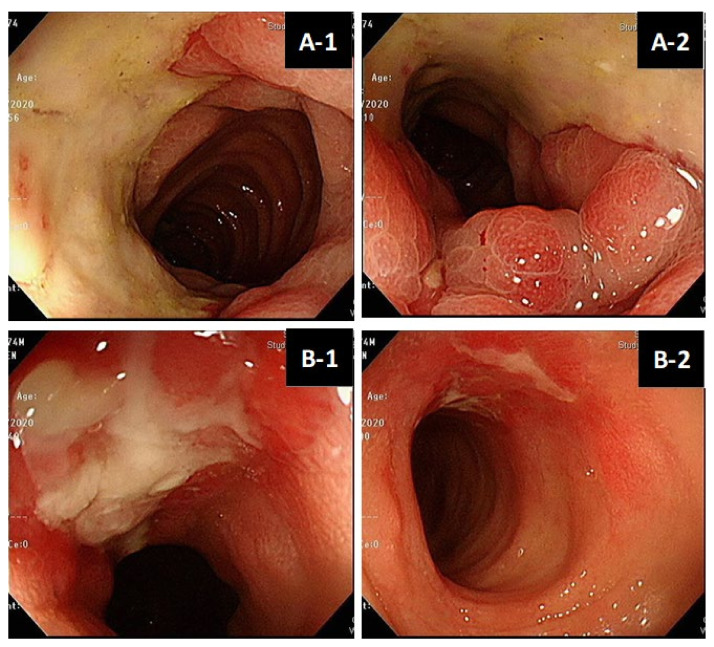
Cytomegalovirus (CMV) infection is a common occurrence in liver transplantation (LT) even in an era of preventive strategies. However, the diagnosis of CMV colitis remains challenging. This study aimed to focus on the clinical significance of endoscopic biopsy-proven CMV colitis in patients following living donor liver transplantation (LDLT). From January 2007 to December 2021, a total of 55 CMV colitis cases were retrospectively enrolled and divided into a non-LDLT group in 53 and an LDLT group in 2 cases. Clinical demographics, diagnostic measurement, histopathology, and anti-viral therapy were investigated. There were 1630 cases undergoing LDLT in the period 2007-2021, with only 2 recipients being confirmed to have CMV colitis in 2021 (2/114, 1-year incidence: 1.75%). Comparisons between the 53 non-LDLT cases and 2 LDLT cases are as follows: Serum anti-CMV immunoglobulin M (IgM) was shown to be positive (n = 3, 5.5% vs. n = 0, = 1.0) and negative (n = 20, 37.7% vs. n = 2, 100%, = 0.16); anti-CMV immunoglobulin G (IgG) was positive (n = 19, 35.8% vs. n = 2, 100%, = 0.14) and none were negative; CMV DNAemia was shown to be detectable (n = 14, 26.4% vs. n = 1, 50%, = 0.47) and undetectable (n = 14, 26.4% vs. n = 1, 50%, = 0.47). Among the two recipients with CMV colitis, one had CMV DNAemia and the other had no CMV DNAemia upon the development of symptoms; negative anti-CMV-IgM and positive anti-CMV-IgG were observed both pre-transplant and post-transplant; finally, CMV colitis was documented based on the presence of inclusion bodies and positive immunohistochemistry (IHC) staining in histology. Patients with immunocompromised status, in particular organ transplantation, may have positive serum anti-CMV IgM/IgG antibodies both before and after transplantation. This study emphasized the fact that endoscopic biopsy with IHC staining may be a more powerful tool for making an accurate diagnosis of CMV colitis in the setting of living donor liver transplantation.
巨细胞病毒 (CMV) 感染在肝移植 (LT) 中很常见,即使在预防策略时代也是如此。然而,CMV 结肠炎的诊断仍然具有挑战性。本研究旨在关注活体供肝移植 (LDLT) 后经内镜活检证实的 CMV 结肠炎患者的临床意义。
2007 年 1 月至 2021 年 12 月,共回顾性纳入 55 例 CMV 结肠炎病例,分为非 LDLT 组 53 例和 LDLT 组 2 例。研究了临床人口统计学、诊断测量、组织病理学和抗病毒治疗。2007-2021 年期间有 1630 例 LDLT 患者,其中仅 2021 年有 2 例患者确诊为 CMV 结肠炎 (2/114,1 年发生率:1.75%)。53 例非 LDLT 病例与 2 例 LDLT 病例的比较如下:血清抗 CMV 免疫球蛋白 M (IgM) 阳性 (n = 3,5.5%比 n = 0, = 1.0) 和阴性 (n = 20,37.7%比 n = 2,100%, = 0.16);抗 CMV 免疫球蛋白 G (IgG) 阳性 (n = 19,35.8%比 n = 2,100%, = 0.14)和阴性 (n = 0,0%比 n = 2,100%, = 0.14);CMV DNAemia 显示可检测 (n = 14,26.4%比 n = 1,50%, = 0.47)和不可检测 (n = 14,26.4%比 n = 1,50%, = 0.47)。在发生症状的 2 例 CMV 结肠炎患者中,1 例有 CMV DNAemia,1 例无 CMV DNAemia;移植前后均观察到抗 CMV-IgM 阴性和抗 CMV-IgG 阳性;最终,组织学中存在包涵体和免疫组织化学 (IHC) 染色阳性诊断为 CMV 结肠炎。
具有免疫抑制状态的患者,特别是接受器官移植的患者,在移植前后可能具有血清抗 CMV IgM/IgG 抗体阳性。本研究强调了这样一个事实,即在活体供肝移植的背景下,内镜活检结合 IHC 染色可能是一种更强大的工具,可以准确诊断 CMV 结肠炎。