Gomis-Rüth F Xavier, Stöcker Walter
Proteolysis Laboratory, Department of Structural Biology, Molecular Biology Institute of Barcelona (IBMB), Higher Scientific Research Council (CSIC), Barcelona, Catalonia, Spain.
Institute of Molecular Physiology (IMP), Johannes Gutenberg-University Mainz (JGU), Mainz, Germany.
Front Mol Biosci. 2023 Jan 4;9:1080836. doi: 10.3389/fmolb.2022.1080836. eCollection 2022.
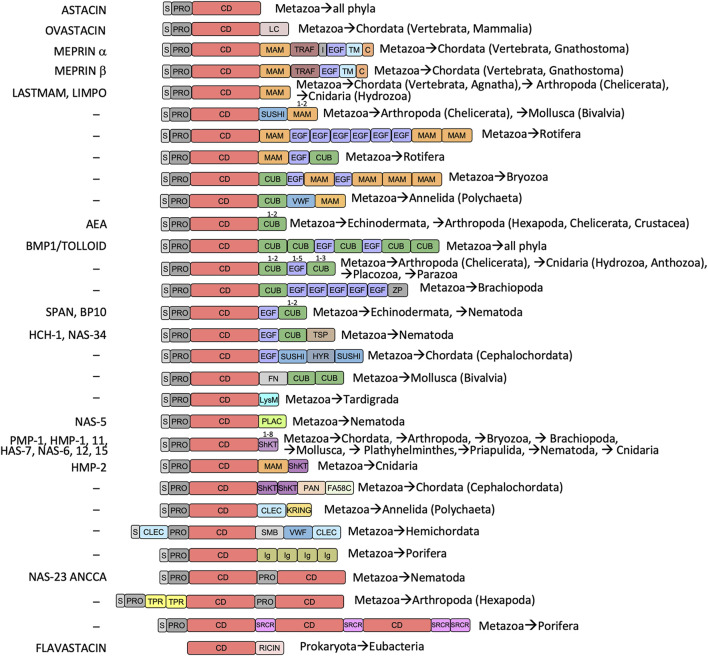
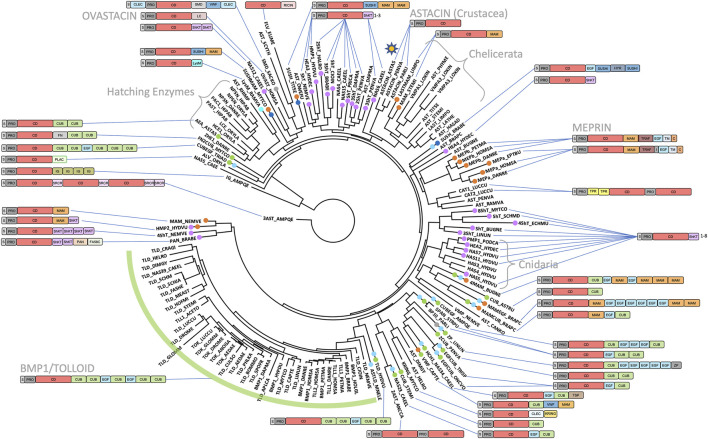
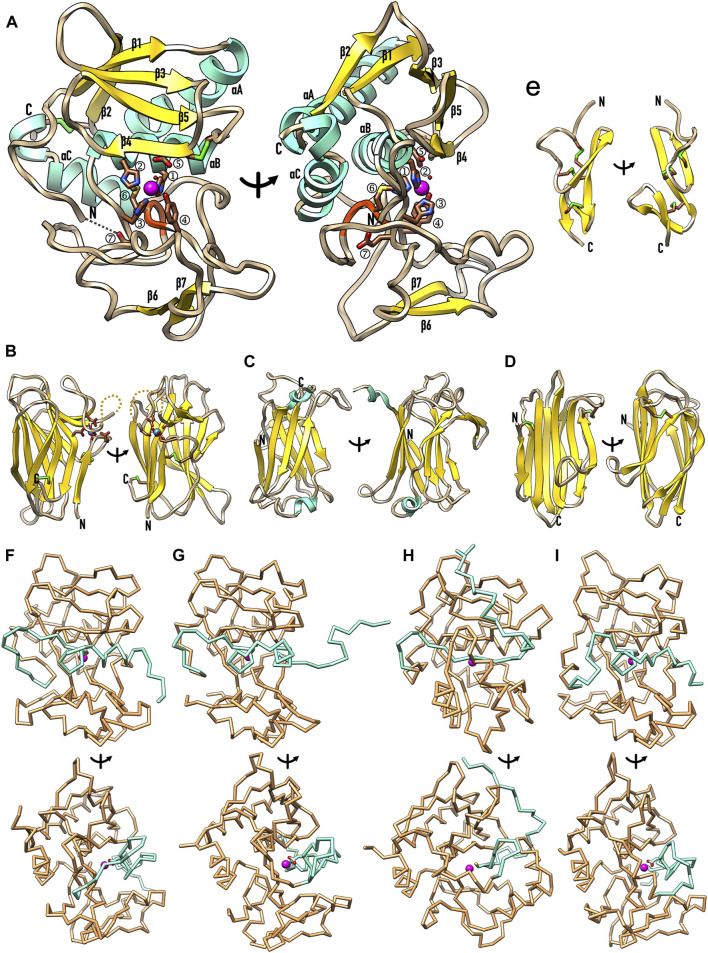
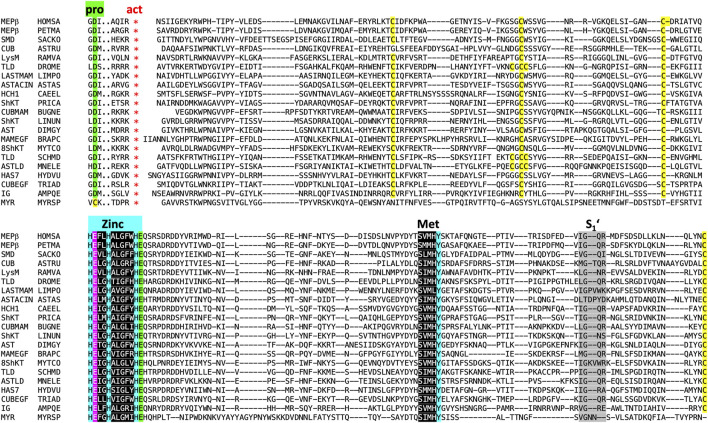
The astacins are a family of metallopeptidases (MPs) that has been extensively described from animals. They are multidomain extracellular proteins, which have a conserved core architecture encompassing a signal peptide for secretion, a prodomain or prosegment and a zinc-dependent catalytic domain (CD). This constellation is found in the archetypal name-giving digestive enzyme astacin from the European crayfish . Astacin catalytic domains span ∼200 residues and consist of two subdomains that flank an extended active-site cleft. They share several structural elements including a long zinc-binding consensus sequence (HEXXHXXGXXH) immediately followed by an EXXRXDRD motif, which features a family-specific glutamate. In addition, a downstream SIMHY-motif encompasses a "Met-turn" methionine and a zinc-binding tyrosine. The overall architecture and some structural features of astacin catalytic domains match those of other more distantly related MPs, which together constitute the metzincin clan of metallopeptidases. We further analysed the structures of PRO-, MAM, TRAF, CUB and EGF-like domains, and described their essential molecular determinants. In addition, we investigated the distribution of astacins across kingdoms and their phylogenetic origin. Through extensive sequence searches we found astacin CDs in > 25,000 sequences down the tree of life from humans beyond Metazoa, including Choanoflagellata, Filasterea and Ichtyosporea. We also found < 400 sequences scattered across non-holozoan eukaryotes including some fungi and one virus, as well as in selected taxa of archaea and bacteria that are pathogens or colonizers of animal hosts, but not in plants. Overall, we propose that astacins originate in the root of Holozoa consistent with Darwinian descent and that the latter genes might be the result of horizontal gene transfer from holozoan donors.
虾红素蛋白酶是一类金属肽酶(MPs),已在动物中得到广泛描述。它们是多结构域细胞外蛋白,具有保守的核心结构,包括用于分泌的信号肽、前结构域或前体片段以及锌依赖性催化结构域(CD)。这种结构组合存在于欧洲小龙虾中典型的、赋予该家族名称的消化酶虾红素蛋白酶中。虾红素蛋白酶催化结构域跨越约200个残基,由两个侧翼为延伸活性位点裂隙的亚结构域组成。它们共享几个结构元件,包括紧接着EXXRXDRD基序的长锌结合共有序列(HEXXHXXGXXH),该基序具有家族特异性谷氨酸。此外,下游的SIMHY基序包含一个“甲硫氨酸转折”甲硫氨酸和一个锌结合酪氨酸。虾红素蛋白酶催化结构域的整体结构和一些结构特征与其他关系更远的MPs相匹配,它们共同构成了金属肽酶的金属锌蛋白酶家族。我们进一步分析了PRO、MAM、TRAF、CUB和EGF样结构域的结构,并描述了它们的基本分子决定因素。此外,我们研究了虾红素蛋白酶在不同生物界的分布及其系统发育起源。通过广泛的序列搜索,我们在从人类到后生动物之外的生命之树中超过25000个序列中发现了虾红素蛋白酶CD,包括领鞭毛虫、丝盘虫和鱼孢菌。我们还在包括一些真菌和一种病毒在内的非全动物真核生物以及作为动物宿主病原体或定植菌的古菌和细菌的选定分类群中发现了不到400个序列,但在植物中未发现。总体而言,我们认为虾红素蛋白酶起源于全动物界的根部,符合达尔文的遗传学说,而后一种基因可能是来自全动物界供体的水平基因转移的结果。