Department of Maternal, Child and Adolescent Health, School of Public Health, Anhui Medical University, Hefei, China.
Key Laboratory of Population Health Across Life Cycle, Ministry of Education of the People's Republic of China, Hefei, China.
Front Immunol. 2023 Jan 4;13:1036739. doi: 10.3389/fimmu.2022.1036739. eCollection 2022.
Inflammation is closely related to poor mental and physical health, including depressive symptoms and its specific symptoms. To reveal the linear and nonlinear relationships between depressive symptoms and chronic inflammation levels, and perform further analysis of the associations between symptom-specificity of depressive symptoms and inflammation among young adults by using a prospective design.
In this longitudinal study, we examined college students recruited from two universities in China, who were examined at baseline and 2-years follow-up. Depressive symptoms were measured by applying the Patient Health Questionnaire 9 (PHQ-9) at baseline. Plasma levels of four inflammatory biomarkers, including interleukin-6 (IL-6), interleukin-1β (IL-1β), tumor necrosis factor-α (TNF-α), and C reactive protein (CRP) were assayed at baseline and 2-year follow-up. In addition to the conventional generalized linear models, as well as restricted cubic splines were innovatively used to analyze the cross-sectional and longitudinal nonlinear relationships between depressive symptoms and inflammatory biomarkers.
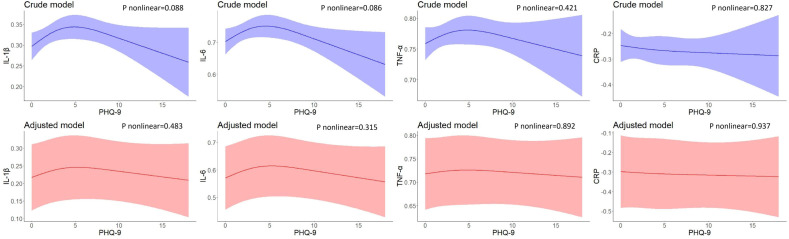
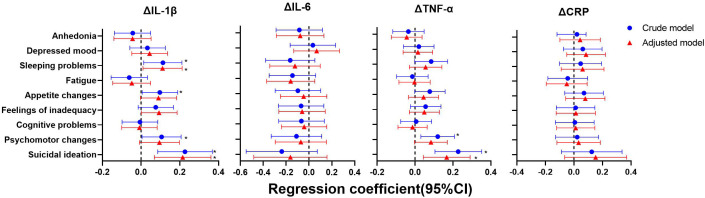
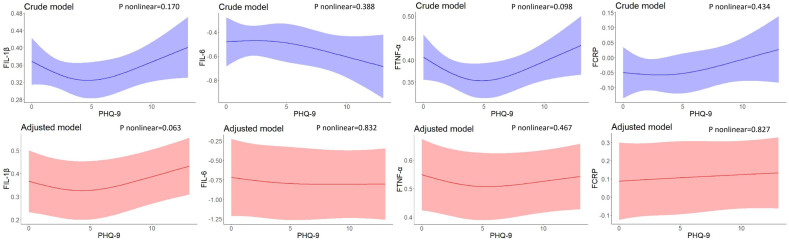
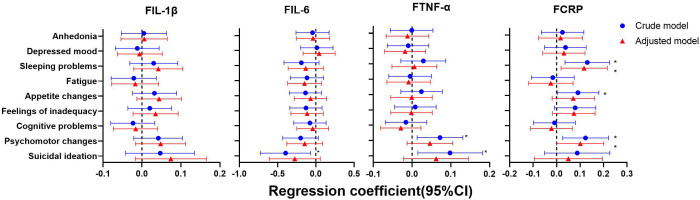
Generalized linear model analysis revealed that there were no statistical associations between depressive symptoms and any inflammatory biomarker levels. The results of the restricted cubic spline demonstrated a U-shaped nonlinear association between depressive symptoms and ΔIL-1β or ΔTNF-α (changes in baseline and 2-year follow-up), but these associations disappeared after adjusting the confounders. Symptom-specificity of depressive symptoms such as sleeping problems and suicidal ideation were associated with lower IL-1β at baseline or changes in IL-1β levels. Sleeping problems and psychomotor changes at baseline were associated with higher CRP at 2-year follow-up. Suicidal ideation at baseline was associated with changes in TNF-α levels.
Our findings suggested that symptom-specificity of depressive symptoms was associated with inflammation during a 2-year follow-up at the transition to adulthood. Simultaneously, more research is warranted to seek the directionality of depressive symptoms and chronic inflammation.
炎症与不良的身心健康密切相关,包括抑郁症状及其特定症状。为了揭示抑郁症状与慢性炎症水平之间的线性和非线性关系,并通过前瞻性设计进一步分析年轻成年人抑郁症状特异性与炎症之间的关联。
在这项纵向研究中,我们检查了来自中国两所大学的大学生,他们在基线和 2 年随访时接受了检查。在基线时使用患者健康问卷 9(PHQ-9)测量抑郁症状。在基线和 2 年随访时测定了四种炎症生物标志物的血浆水平,包括白细胞介素 6(IL-6)、白细胞介素 1β(IL-1β)、肿瘤坏死因子-α(TNF-α)和 C 反应蛋白(CRP)。除了常规的广义线性模型外,还创新性地使用了限制立方样条来分析抑郁症状与炎症生物标志物之间的横断面和纵向非线性关系。
广义线性模型分析显示,抑郁症状与任何炎症生物标志物水平之间均无统计学关联。限制立方样条的结果表明,抑郁症状与ΔIL-1β或ΔTNF-α(基线和 2 年随访时的变化)之间呈 U 形非线性关联,但这些关联在调整混杂因素后消失。抑郁症状的特异性,如睡眠问题和自杀意念,与基线时的 IL-1β较低或 IL-1β水平的变化有关。基线时的睡眠问题和精神运动变化与 2 年随访时的 CRP 较高有关。基线时的自杀意念与 TNF-α水平的变化有关。
我们的研究结果表明,在成年过渡期间,抑郁症状的特异性与炎症有关。同时,需要进行更多的研究以寻找抑郁症状和慢性炎症的方向。