Gruhonjic Imran, West Derek
Department of Orthopedic Surgery, SSM Health St. Anthony's Hospital, 1111 N Dewey Ave, Oklahoma City, OK 73103, United States.
J Orthop Case Rep. 2022 Aug;12(8):5-8. doi: 10.13107/jocr.2022.v12.i08.2942.
Femoral neck fractures in patients with a history of above knee amputation present as a strain for orthopedic surgeons due to the difficulty of positioning and handling of the limb for proper reduction. Surgical treatment options typically involve open reduction internal fixation versus arthroplasty depending on patient factors such as age, surgeon skill, and available equipment.
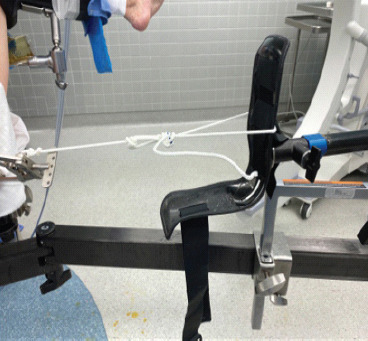
We present a case of a femoral neck fracture (OTA 31-B2) in a relatively active 89-year-old Caucasian male after a ground level fall that has been ambulating with a prosthesis since his teenage years. In this report, we describe the patient positioning, technique used to treat a femoral neck fracture (OTA 31-B2) using the femoral neck system, and the successful outcome of our patient 1 year from the injury.
We conclude that using the femoral neck system (FNS) is a viable option for patients with a high above knee amputation where, due to the length of the limb and potentially the lack of appropriately sized implants, dislocating and reducing the hip for total hip arthroplasties and hemiarthroplasties provide a challenge.
有膝上截肢病史的患者发生股骨颈骨折,对于骨科医生而言是一项挑战,因为要将肢体摆放到合适位置以进行正确复位存在困难。手术治疗方案通常根据患者年龄、医生技术和可用设备等因素,在切开复位内固定术和关节成形术之间进行选择。
我们报告一例相对活跃的89岁白种男性患者,平地摔倒后发生股骨颈骨折(OTA 31-B2),该患者自青少年时期起就一直使用假肢行走。在本报告中,我们描述了患者的体位摆放、使用股骨颈系统治疗股骨颈骨折(OTA 31-B2)的技术,以及受伤1年后患者的良好预后。
我们得出结论,对于高位膝上截肢患者,使用股骨颈系统(FNS)是一种可行的选择,由于肢体长度以及可能缺乏尺寸合适的植入物,在全髋关节置换术和半髋关节置换术中进行髋关节脱位和复位具有挑战性。